
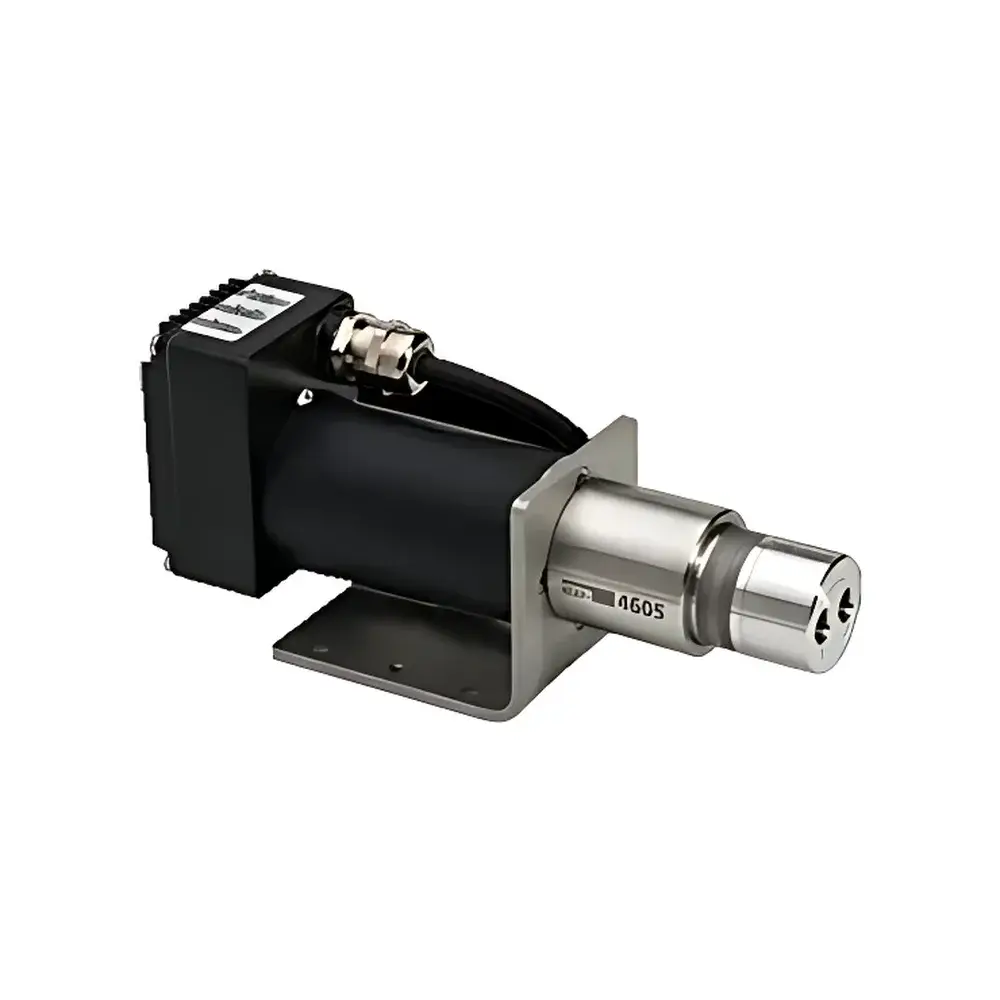
HNPM MZR-4605 Micro-Dosing Peristaltic Pump
| Brand | HNPM |
|---|---|
| Origin | Germany |
| Model | MZR-4605 |
| Flow Rate Range | 0.012–72 mL/min |
| Viscosity Range | 0.3–50,000 mPa·s |
| Precision (CV) | <1% |
| Speed Range | 1–6000 rpm |
| Displacement per Revolution | 12 µL |
| Minimum Dose Volume | 2 µL |
| Pressure Differential | 0–10 bar (water, 1 mPa·s), up to 50 bar (oil, 16 mPa·s) |
| Max. Inlet Pressure | 5 bar (10–40 bar with optional configuration) |
| Fluid Path Materials | SS 316L (1.4404 / 1.4435), tungsten carbide, Ni-based alloys |
| Seals | Graphite-reinforced PTFE, FPM (standard), EPDM/FFPM (optional) |
| Motor | 24 V DC servo motor, 44 W |
| Controller | Integrated 16-bit microcontroller |
| Interfaces | 0–10 V analog, RS-232, 1 digital I/O |
| Dimensions (L×W×H) | 143 × 45 × 65 mm |
| Weight | ~800 g |
| Operating Temperature | −5 to +60 °C (−20 to +150 °C with optional configuration) |
| Connection | Frontal 1/4″–28 UNF |
Overview
The HNPM MZR-4605 Micro-Dosing Peristaltic Pump is a precision-engineered fluid handling solution designed for repeatable, low-pulse volumetric delivery in demanding laboratory and industrial environments. Unlike conventional peristaltic pumps relying on elastomeric tubing compression, the MZR-4605 employs a patented rotary micro annular gear mechanism—eliminating tubing fatigue, pulsation-induced shear, and flow inconsistency associated with traditional designs. This architecture enables true micro-dosing capability down to 2 µL per discrete event, with continuous flow control across a dynamic range of 0.012–72 mL/min. Its operational principle centers on positive displacement via precisely machined tungsten carbide gears rotating within a stainless steel 316L (1.4404/1.4435) housing, ensuring metrological stability under variable backpressure (up to 50 bar with high-viscosity media). The pump is engineered for long-term reliability in chemically aggressive or high-purity applications where contamination risk, material compatibility, and dose reproducibility are critical—particularly in GLP-compliant analytical workflows, small-batch pharmaceutical formulation, and microreactor feed control.
Key Features
- Sub-microliter dosing resolution: 2 µL minimum discrete volume with CV <1% across full viscosity range (0.3–50,000 mPa·s)
- Low-shear, low-pulse delivery enabled by annular gear geometry—no elastomer degradation or tubing replacement required
- Integrated 16-bit microcontroller with real-time speed and torque monitoring for closed-loop flow regulation
- Robust wetted path: SS 316L housing, tungsten carbide gears, graphite-reinforced PTFE seals (FPM standard; EPDM/FFPM optional)
- Compact footprint (143 × 45 × 65 mm) and lightweight design (~800 g) suitable for OEM integration into analytical platforms or benchtop automation
- Multi-interface connectivity: 0–10 V analog input/output, RS-232 serial communication, and configurable digital I/O for PLC synchronization
- Wide operating temperature tolerance: −5 to +60 °C standard; extended range (−20 to +150 °C) available with custom thermal management
Sample Compatibility & Compliance
The MZR-4605 accommodates a broad spectrum of process fluids without chemical incompatibility concerns—including aqueous solutions, polar solvents (e.g., methanol, acetone), hydrocarbons, lubricants, adhesives, UV-curable resins, inkjet inks, and non-Newtonian gels. Its all-metal fluid path eliminates extractables and leachables, supporting compliance with ISO 10993 biocompatibility guidelines for contact with pharmaceutical intermediates. The pump meets CE marking requirements under the Machinery Directive 2006/42/EC and Electromagnetic Compatibility Directive 2014/30/EU. When integrated into validated systems, it supports audit-ready operation under FDA 21 CFR Part 11 (with appropriate software controls), EU Annex 11, and GMP/GLP documentation frameworks. Optional calibration certificates traceable to PTB (Physikalisch-Technische Bundesanstalt) are available upon request.
Software & Data Management
The embedded controller provides deterministic command execution with sub-millisecond response latency. Firmware supports programmable ramp profiles, multi-step dispensing sequences, and real-time flow rate logging at 10 Hz resolution. RS-232 interface enables bidirectional communication with host systems running LabVIEW, Python (PySerial), or custom SCADA architectures. Analog 0–10 V inputs allow seamless integration into PID-controlled reactor loops or feedback-regulated synthesis platforms. All operational parameters—including rotational speed, cumulative volume dispensed, motor current draw, and thermal status—are accessible via ASCII command protocol. Audit trails can be exported as CSV for regulatory review; firmware updates are performed via secure bootloader over serial interface.
Applications
- Microfluidic reagent delivery in analytical chemistry and life science instrumentation
- Precise metering of catalysts, initiators, or crosslinkers in polymer synthesis and R&D-scale batch reactors
- Controlled dispensing of conductive inks, dielectric pastes, and photoresists in printed electronics manufacturing
- Automated sample introduction in ICP-MS, HPLC, and capillary electrophoresis systems requiring pulse-free flow
- Dose-critical feeding in sterile pharmaceutical filling lines (non-contact configurations)
- Vacuum-compatible fluid transfer in thin-film coating and vacuum deposition tools
- Calibration standard delivery for gravimetric flowmeter validation (ISO 4064-2)
FAQ
What is the smallest discrete volume the MZR-4605 can deliver?
The pump achieves a minimum discrete dose of 2 µL, verified gravimetrically per ISO 8503-2 under controlled environmental conditions.
Can the MZR-4605 handle abrasive slurries or particulate-laden fluids?
It is not recommended for suspended solids >5 µm due to tight gear clearances; filtration to ≤1 µm is advised for particulate-containing media.
Is the pump suitable for use in inert atmosphere gloveboxes?
Yes—its sealed housing and absence of outgassing elastomers make it compatible with N₂- or Ar-purged environments; optional O-rings in FFPM enhance vacuum integrity.
How is calibration traceability maintained?
Factory calibration uses NIST-traceable gravimetric standards; users may perform field verification using certified reference weights and timed collection protocols per ASTM D3427.
Does the controller support external triggering for synchronized dispensing?
Yes—the digital input accepts TTL or dry-contact pulses for start/stop/step commands, enabling precise coordination with camera triggers, stage motion, or sensor events.



