
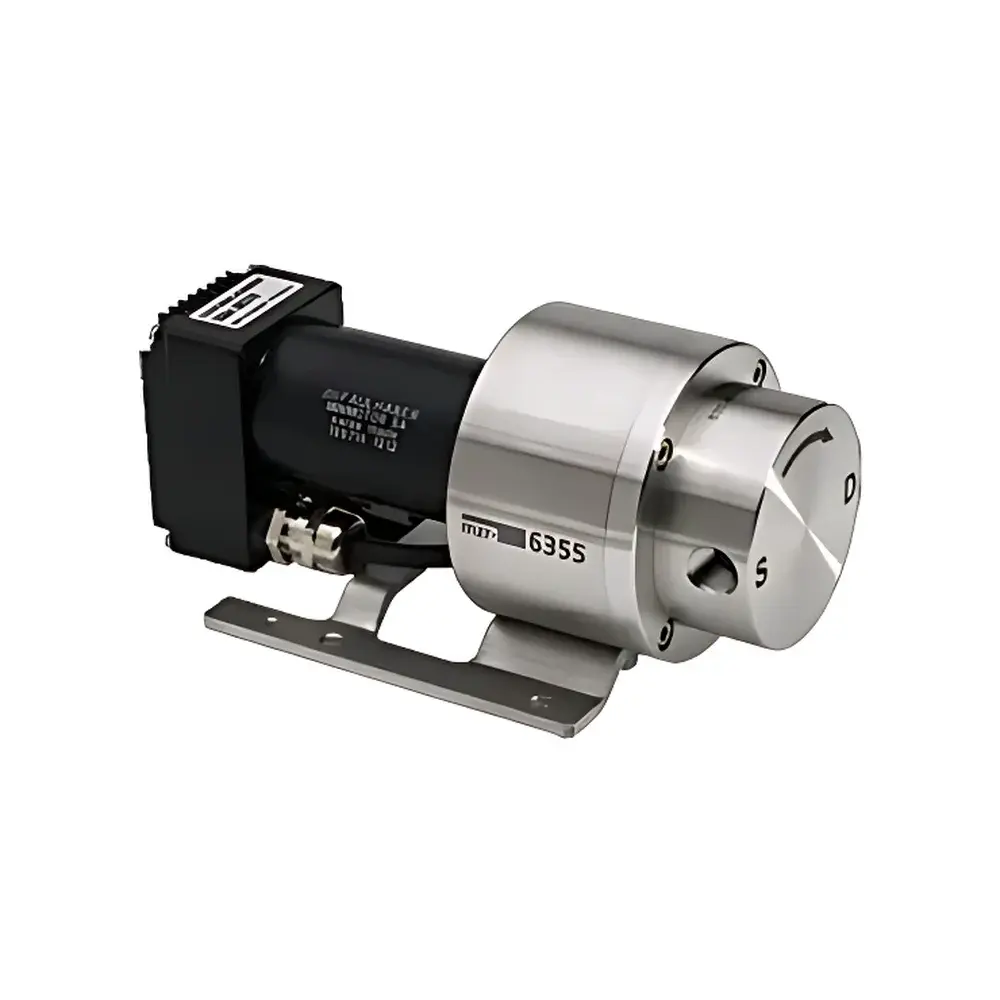
HNPM MZR-6355 Chemically Inert Peristaltic Pump
| Brand | HNPM |
|---|---|
| Origin | UK |
| Model | MZR-6355 |
| Flow Rate | 0.024–144 mL/min |
| Speed Range | 1–6000 rpm |
| Precision | CV < 1% |
| Max Pressure | 80 bar |
| Displacement | 24 µL |
| Min Dose | 15 µL |
| Dimensions | 146 × 70 × 72 mm |
| Weight | ~1650 g |
| Operating Temp | −5 to +60 °C (−20 to +150 °C with optional thermal module) |
| Wetted Materials | Alloy C22 (DIN 2.4602), SSiC, Al₂O₃, ZrO₂, FFKM (Kalrez® 6375) |
| Motor | 24 V DC, 44 W, Brushless DC Servo with Encoder & Microcontroller |
| Interfaces | 0–10 V, 0(4)–20 mA, RS-232, 1x Digital I/O, Optional CAN Bus |
| Drive | 8-pole NdFeB Magnetic Coupling |
| Viscosity Range | 0.3–1000 mPa·s |
| Fluid Connection | 1/8" NPT Female |
Overview
The HNPM MZR-6355 Chemically Inert Peristaltic Pump is a precision-engineered, sealless positive displacement pump designed for continuous or discrete dosing of aggressive, corrosive, and ultra-pure fluids in demanding laboratory and pilot-scale process environments. Unlike conventional peristaltic pumps relying on elastomeric tubing compression, the MZR-6355 employs a patented rotary micro-ring gear mechanism—eliminating valves, seals, and pulsation while ensuring true pulse-free flow. Its core operating principle is based on volumetric displacement via precisely machined ceramic rotors rotating within chemically inert chambers, delivering repeatable metering through mechanical synchronization rather than fluid elasticity. This architecture enables stable operation across wide viscosity ranges (0.3–1000 mPa·s) and supports high-pressure applications up to 80 bar (1160 psi), making it suitable for integration into microreactor systems, continuous flow synthesis platforms, and corrosion-resistant analytical sample introduction lines.
Key Features
- Full-body chemical inertness achieved through wetted components fabricated from Alloy C22 (DIN 2.4602), sintered silicon carbide (SSiC), alumina (Al₂O₃), and stabilized zirconia (ZrO₂)
- FFKM (Kalrez® 6375) elastomer seals as standard—resistant to strong oxidizers, halogenated solvents, concentrated acids (e.g., HNO₃, H₂SO₄), and caustics (e.g., NaOH, KOH)
- Brushless DC servo motor with integrated encoder and embedded microcontroller for closed-loop speed and position control
- Pulse-free flow profile enabled by micro-ring gear geometry—no check valves, no backflow, no priming required
- High metrological fidelity: coefficient of variation (CV) < 1% across full flow range; minimum dispense volume of 15 µL
- Modular interface architecture supporting analog (0–10 V / 0(4)–20 mA), digital (RS-232), and industrial fieldbus (optional CAN bus) communication protocols
- Compact footprint (146 × 70 × 72 mm) and low mass (~1.65 kg) optimized for benchtop integration and mobile process units
Sample Compatibility & Compliance
The MZR-6355 is validated for use with highly reactive media including hydrofluoric acid, aqua regia, chlorine dioxide solutions, hydrogen peroxide (>30%), and organometallic precursors. Its material compatibility matrix conforms to ASTM D543 and ISO 15142 standards for chemical resistance classification. All wetted surfaces meet USP Class VI biocompatibility requirements and are non-leaching under GLP/GMP-relevant extraction conditions. The pump’s construction avoids threaded brass, aluminum, or standard stainless steel—eliminating galvanic corrosion risks in mixed-acid or redox environments. Optional thermal modules extend operational temperature limits to −20 °C to +150 °C, enabling cryogenic solvent delivery or elevated-temperature catalytic feed streams. No lubricants contact the fluid path; maintenance intervals exceed 10,000 operating hours under nominal load.
Software & Data Management
Control and monitoring are implemented via HNPM’s open-protocol firmware stack, accessible through vendor-neutral SCPI commands over RS-232 or configurable analog I/O. The embedded controller logs real-time parameters—including actual RPM, cumulative volume, torque load, and thermal status—with timestamped audit trails compliant with FDA 21 CFR Part 11 when deployed with external electronic lab notebook (ELN) or LIMS integration. Firmware updates are delivered via signed binary packages to ensure integrity verification. For automated workflows, the pump supports deterministic triggering via TTL-level digital input (start/stop/pause) and synchronized output signals for coordination with spectrometers, pressure sensors, or reactor control units. No proprietary drivers or runtime dependencies are required—interfacing is native to LabVIEW, Python (pySerial), MATLAB, and TwinCAT environments.
Applications
- Continuous-flow chemistry: precise stoichiometric reagent addition in microreactors and chip-based synthesis systems
- Corrosion-resistant sampling: automated feeding of digestates into ICP-MS or IC systems without tubing degradation
- Electrolyte formulation: metering of LiPF₆, HF scavengers, and fluorinated carbonates in battery R&D labs
- Pharmaceutical process analytical technology (PAT): inline dilution and standard addition for UV/Vis or Raman calibration loops
- Environmental testing: controlled delivery of acidic or alkaline leachates in TCLP and SPLP protocols
- Materials science: dispersion of nanoscale catalysts in aggressive solvents (e.g., oleum, fuming nitric acid)
FAQ
Is the MZR-6355 compatible with hydrofluoric acid (HF)?
Yes—wetted materials including Alloy C22, SSiC, and ZrO₂ exhibit negligible corrosion rates (<0.1 mm/year) in aqueous HF up to 48% concentration at 25 °C, per ASTM G31 immersion testing.
Can it be used in explosion-hazardous areas?
Not intrinsically safe by default; however, ATEX/IECEx-certified versions with encapsulated motor windings and non-sparking enclosures are available upon request.
Does it support bidirectional flow?
No—the rotary ring gear design is unidirectional; reverse flow requires external valve routing or system-level reconfiguration.
What is the maximum allowable inlet pressure?
The pump is rated for differential pressure only; inlet pressure must remain ≤1 bar absolute to prevent cavitation in low-viscosity fluids below 10 mPa·s.
How is calibration traceability maintained?
Each unit ships with a factory-issued calibration certificate referencing NIST-traceable gravimetric flow standards; recalibration intervals are defined per ISO/IEC 17025 accredited procedures.



