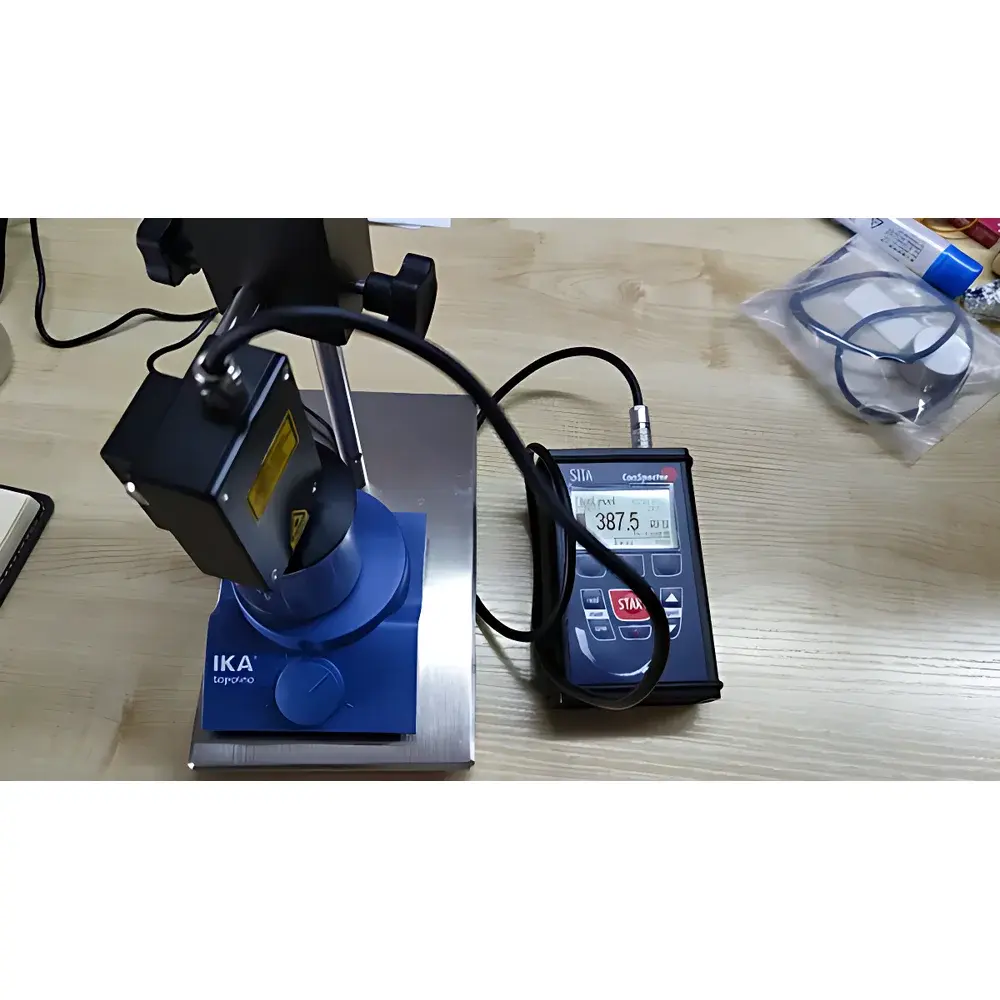
SITA CleanoSpector, ProLinet15 & ConSpector Integrated Cleaning Process Monitoring System for Metal Hardware Components
| Brand | SITA |
|---|---|
| Origin | Germany |
| Model(s) | CleanoSpector, ProLinet15, ConSpector |
| Measurement Principle | Bubble Pressure Method (Dynamic/Static Surface Tension), UV-Induced Fluorescence (Contamination Quantification), Confocal UV Fluorescence (Surface Residue Detection) |
| Compliance | Designed for ISO 9001, IATF 16949, and GLP-aligned process validation |
| Software | SITA LabSoft v5.2 with Audit Trail, Data Export (CSV/PDF), Multi-User Access Control |
| Certifications | CE, RoHS, Factory Calibration Certificate per Unit |
| Operating Environment | 10–40 °C, 30–80% RH non-condensing |
Overview
The SITA CleanoSpector, ProLinet15, and ConSpector system constitutes an integrated, physics-based monitoring platform engineered for real-time, quantitative control of aqueous cleaning processes in precision metal hardware manufacturing—specifically for furniture hardware components requiring high-fidelity surface integrity prior to phosphating, passivation, or powder coating. Unlike conventional endpoint testing or manual titration, this tri-instrument solution applies three orthogonal measurement principles—dynamic surface tension (via bubble pressure method), bulk-phase contamination quantification (via UV-excited fluorescence), and post-cleaning surface residue detection (via confocal UV fluorescence)—to close the feedback loop across the entire cleaning train: pre-degreasing, main degreasing, rinse stages, and final surface verification. Each instrument is calibrated traceably to NIST-traceable reference standards and operates under stable thermal conditions (±0.2 °C), ensuring reproducibility within ±0.3 mN/m for surface tension and ±2 RFU for fluorescence intensity under routine lab conditions.
Key Features
- Clamp-mounted CleanoSpector with dual-mode (static/dynamic) surface tension measurement; configurable bubble age range from 10 ms to 10,000 ms for surfactant activity profiling
- ProLinet15 inline-compatible contamination monitor using 254 nm UV excitation and narrowband 340–420 nm emission detection for hydrocarbon, ester, and glycol-based soil quantification
- ConSpector handheld surface cleanliness verifier featuring motorized Z-axis focus, automatic background subtraction, and calibrated RFU (Relative Fluorescence Units) output referenced to ISO 8502-3 certified test panels
- All units support Ethernet/IP and Modbus TCP protocols for integration into MES/SCADA systems (e.g., Siemens SIMATIC, Rockwell FactoryTalk)
- SITA LabSoft v5.2 software includes 21 CFR Part 11-compliant user authentication, electronic signatures, and immutable audit trail logging of all calibration, measurement, and parameter changes
- Factory-installed temperature-compensation algorithms eliminate manual correction for bath temperatures between 20–80 °C
Sample Compatibility & Compliance
The system is validated for use with alkaline, neutral, and mildly acidic aqueous cleaning media commonly deployed in multi-stage conveyorized parts washers (e.g., Henkel Bonderite, Chemetall Oxsilan-compatible formulations). It accommodates turbidities up to 500 NTU and suspended solids ≤100 mg/L without filtration. All instruments comply with EN 61326-1 (EMC for industrial environments) and EN 61010-1 (safety for laboratory equipment). Data integrity meets ALCOA+ criteria (Attributable, Legible, Contemporaneous, Original, Accurate, Complete, Consistent, Enduring, Available) as required for GMP-relevant cleaning validation per Annex 15 of the EU GMP Guidelines. Instrument-specific documentation includes IQ/OQ protocols and a Certificate of Conformance with traceable calibration records.
Software & Data Management
SITA LabSoft v5.2 provides centralized configuration, real-time dashboard visualization, and automated report generation. Users define process limits (e.g., dynamic surface tension <47.0 mN/m at 60 ms bubble age; bulk contamination <1,200 RFU; post-clean surface residue <150 RFU) with configurable alarms (email/SMS via SMTP/HTTP API). Raw data—including time-stamped spectra, pressure transients, and fluorescence decay curves—are stored in encrypted SQLite databases with SHA-256 hashing. Export functions support CSV (for statistical process control in Minitab/JMP), PDF (formatted for internal QA review), and XML (for LIMS ingestion). Role-based access controls enforce separation of duties: operators view only live readings; supervisors approve calibration events; quality managers archive final reports with digital signatures.
Applications
This system is deployed in Tier-1 and Tier-2 automotive and furniture hardware suppliers where batch-to-batch consistency in zinc-plated hinges, stainless steel drawer slides, and aluminum extrusion fittings is mandated by OEM specifications (e.g., IKEA IWAY, Hettich QM-System). Typical use cases include: optimizing surfactant dosing intervals in recirculating degreasing baths to reduce chemical consumption by 18–25%; correlating bulk contamination rise rates with conveyor line speed and part load density to adjust dwell time; validating rinse water purity before electrophoretic deposition; and establishing statistically robust cleanliness baselines for PPAP submissions. Case studies demonstrate reduction in rework due to powder coating adhesion failure from 3.7% to <0.4% over six months, with ROI typically achieved within 11 months.
FAQ
Can the CleanoSpector distinguish between different surfactant chemistries in mixed formulations?
Yes—by analyzing the shape and inflection points of dynamic surface tension vs. bubble age curves, experienced users can differentiate anionic, nonionic, and amphoteric surfactants when baseline reference curves are established.
Is the ConSpector suitable for detecting silicone-based release agents on stamped steel parts?
Yes—silicones exhibit strong UV-induced fluorescence under 254 nm excitation; the instrument’s spectral response has been verified against ASTM D7471-18 reference standards for silicone residue detection.
Does ProLinet15 require periodic lamp replacement?
The UV-LED light source is rated for 15,000 hours of continuous operation; no lamp replacement is scheduled within the first five years under typical 2-shift usage.
How frequently must the CleanoSpector be recalibrated?
Factory calibration remains valid for 12 months under normal use; annual recalibration using certified ethanol/water standards is recommended and documented in the instrument’s calibration log.
Can raw fluorescence spectra be exported for multivariate analysis?
Yes—LabSoft supports full-spectrum export (intensity vs. wavelength) in ASCII format for PCA or PLS regression modeling in external chemometric software.