
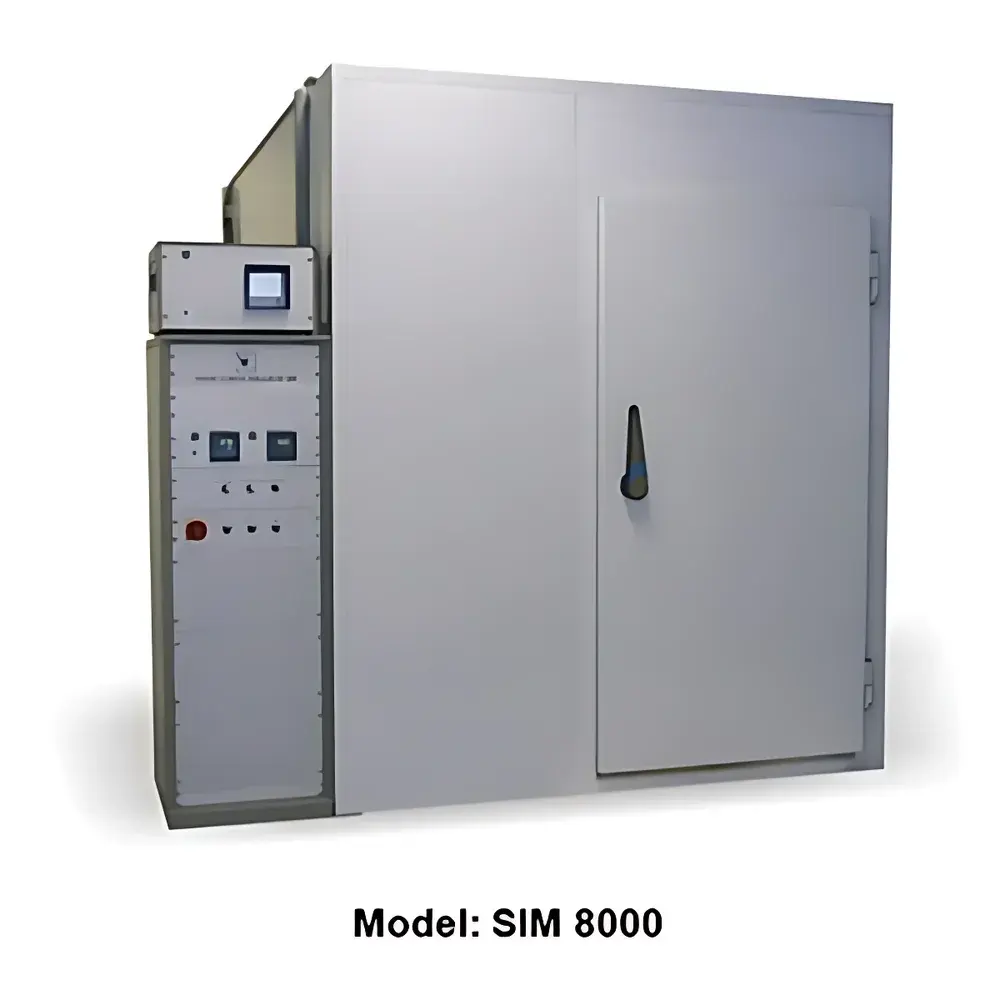
ANSEROS SIM 8000 Ozone Aging Test Chamber
| Brand | ANSEROS |
|---|---|
| Origin | Germany |
| Model | SIM 8000 |
| Chamber Volume | 8000 L |
| Temperature Range | 15–70 °C (RT = 23 °C) |
| Humidity Range | 30–80 % RH |
| Ozone Concentration Control | 20–200 pphm |
| Ozone Measurement Principle | Non-dispersive UV Absorption |
| Ozone Detection Limit | 1 pphm |
| Response Time | 5 s |
| Accuracy | ±1 pphm (ozone), ±5 K (temperature), −1 to +4 % RH (humidity) |
| Airflow Velocity in Test Zone | 600 mm/s |
| Air Exchange Rate | 400 L/h |
| Power Supply | 230 V / 50 Hz |
Overview
The ANSEROS SIM 8000 Ozone Aging Test Chamber is a high-capacity, precision-engineered environmental test system designed for accelerated ozone aging evaluation of elastomeric materials—particularly rubber compounds used in critical sealing components, automotive hoses, power cables, and aerospace gaskets. Operating on the fundamental kinetic principle τ·Cn = const., where τ denotes time-to-crack initiation and C represents ozone concentration (pphm), the SIM 8000 enables quantifiable correlation between controlled oxidative stress and material degradation kinetics. This relationship is empirically validated through logarithmic plotting (log τ vs. log C), yielding linear regression parameters essential for service-life prediction under real-world atmospheric exposure. The chamber integrates a closed-loop ozone generation, monitoring, and feedback control architecture based on non-dispersive ultraviolet (UV) absorption spectroscopy—a method standardized in ASTM D1149 and ISO 1431-1 for ozone resistance testing of vulcanized rubber. Its 8000 L internal volume accommodates full-scale assemblies and multi-sample static/dynamic fixtures, supporting both ISO 1431-3-compliant dynamic strain testing and ASTM D1149 static exposure protocols.
Key Features
- 8000-liter test volume with modular internal dimensions (680 × 650 × 400 mm usable space), enabling evaluation of large-format cable bundles, extruded profiles, and assembled seals
- Integrated PLC-based control system with PID-regulated ozone dosing, temperature, and humidity management—ensuring long-term stability and repeatability across extended test cycles (up to 1000+ hours)
- UV photometric ozone analyzer featuring dual-wavelength reference compensation, auto-zero calibration every 2 seconds, and pressure/temperature compensation (600–1500 mbar, 0–60 °C)
- Precision ozone delivery: 20–200 pphm range with ±1 pphm accuracy, <10 min 95% settling time to setpoint, and zero drift correction independent of optical path degradation
- Conditioned airflow system maintaining uniform 600 mm/s laminar flow across test zone and 400 L/h air exchange rate—minimizing boundary layer effects and ensuring consistent ozone mass transfer
- Thermal control: 15–70 °C operating range (±5 K accuracy), ramp rate up to 0.4 K/min; humidity control: 30–80 % RH (−1 to +4 % RH accuracy), 95% stabilization within 20 minutes
Sample Compatibility & Compliance
The SIM 8000 supports both static and dynamically strained sample configurations via optional mechanical fixtures—including tensile elongation frames compliant with ISO 1431-3 Annex A. It meets functional requirements of major international standards: ASTM D1149 (Standard Test Method for Rubber Deterioration—Ozone Cracking), ISO 1431-1 (Elastomers—Resistance to ozone cracking—Part 1: Static strain), and ISO 1431-3 (Dynamic strain testing). All measurement subsystems—including ozone sensing, temperature, and humidity—are traceable to national metrological standards (PTB Germany). The system architecture adheres to GLP principles, with audit-ready event logging, user access control, and electronic signature support for regulated environments requiring FDA 21 CFR Part 11 compliance (when paired with validated software modules).
Software & Data Management
The embedded controller records timestamped ozone concentration, temperature, humidity, and system status at configurable intervals (1–60 s). Raw data export is supported via USB or Ethernet in CSV format, compatible with LIMS integration and statistical analysis platforms (e.g., JMP, Minitab). Optional PC-based software provides real-time trend visualization, alarm configuration (e.g., ozone deviation >±5 pphm), and automated report generation per ISO/IEC 17025 documentation templates. All calibration events, operator actions, and system faults are logged with immutable timestamps and user IDs—supporting full traceability for quality audits.
Applications
- Accelerated lifetime prediction of EPDM, NBR, CR, and FKM compounds in automotive weatherstripping and coolant hoses
- Qualification testing of high-voltage cable insulation under simulated tropospheric ozone exposure
- Comparative screening of antioxidant packages and protective wax formulations
- Validation of surface-modified rubber grades for aerospace seal applications per SAE AS5678
- Root-cause analysis of field failures linked to ozone-induced microcracking in elastomeric joints
FAQ
What ozone concentration ranges does the SIM 8000 support, and how is accuracy maintained over time?
The system operates from 20 to 200 pphm with ±1 pphm absolute accuracy. Continuous auto-zero correction (every 2 seconds) and pressure/temperature compensation eliminate drift—no span adjustment is required due to single-beam optical design.
Can the chamber accommodate dynamic mechanical testing during ozone exposure?
Yes—optional fixtures enable controlled static strain (per ISO 1431-1) or cyclic deformation (per ISO 1431-3), with synchronized data logging of mechanical input and environmental parameters.
Is the ozone sensor calibrated traceably to national standards?
The UV absorption sensor is factory-calibrated against PTB-certified ozone reference generators; calibration certificates include uncertainty budgets and are supplied with each unit.
How does the system ensure uniform ozone distribution across the 8000 L volume?
A dedicated axial fan array generates 600 mm/s laminar airflow with defined turbulence intensity (<5%), verified by anemometry mapping and validated per ISO 1431-1 Annex B.
What maintenance intervals are recommended for long-term operational reliability?
UV lamp replacement every 12 months; ozone generator electrode cleaning every 6 months; full system verification (temperature/humidity/ozone) annually—documented in the included maintenance logbook.



