
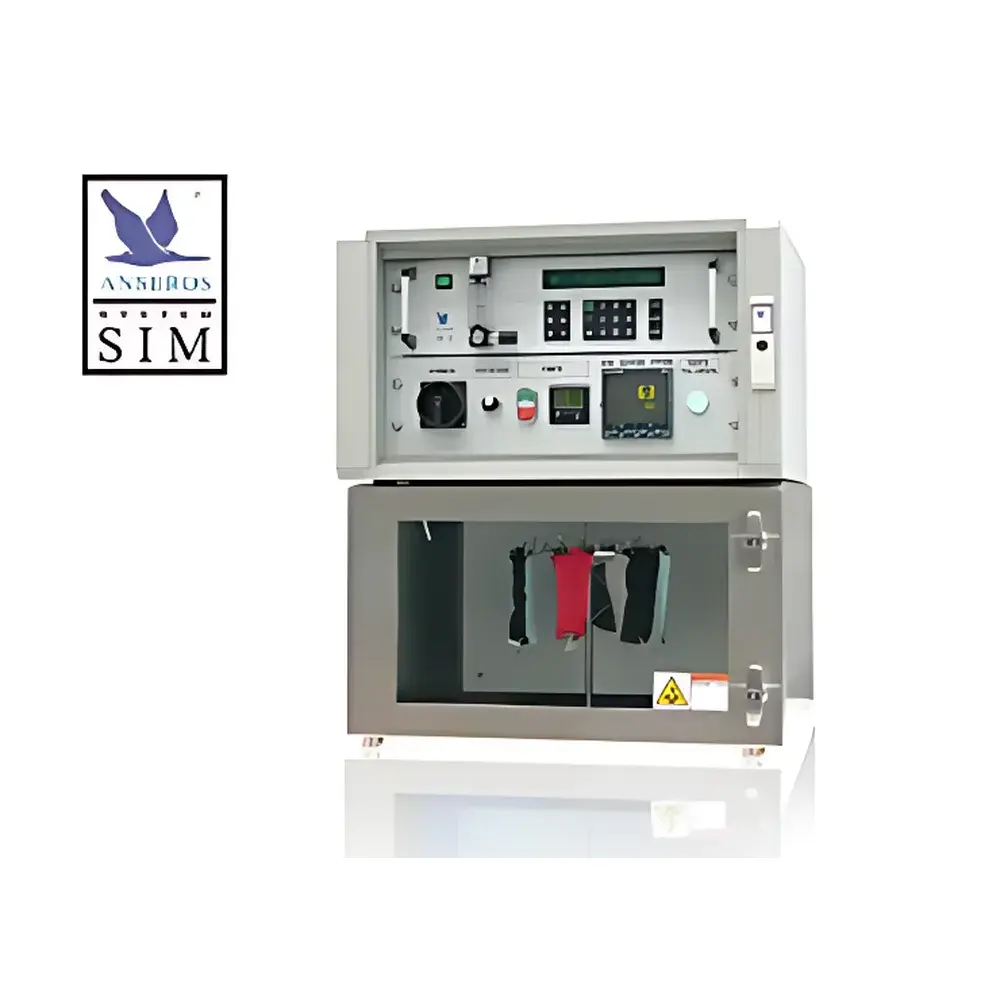
Anseros SIM 6010T Ozone Aging Test Chamber
| Brand | Anseros |
|---|---|
| Origin | Germany |
| Model | SIM 6010T |
| Temperature Range | 26–60 °C (standard), 15–70 °C (extended) |
| Humidity Range | 30–80 % RH |
| Ozone Concentration Control Range | 20–200 pphm |
| Ozone Measurement Principle | Non-dispersive UV absorption |
| Ozone Measurement Range | 0–100 / 1,000 / 10,000 pphm |
| Detection Limit | 1 pphm |
| Response Time | 5 s |
| Accuracy | ±0.2 % of reading (ozone sensor) |
| Airflow Velocity in Chamber | 600 mm/s |
| Air Exchange Rate | 400 L/h |
| Recovery Time to 95 % Set Ozone Level | ≤10 min |
| Recovery Rate | 0.4 K/min |
| Temperature Compensation | Automatic, 0–60 °C ±1 °C |
| Pressure Compensation | Automatic, 600–1500 mbar ±2 mbar |
| Zero Drift | Auto-zeroing cycle every 2 s |
| Span Drift | None (single-beam optical design) |
| Power Supply | 230 V / 50 Hz |
| External Dimensions | 950 × 870 × 610 mm |
| Usable Internal Volume | 680 × 650 × 400 mm |
| Generator/Controller/Detector Cabinet | 1600 × 550 × 600 mm |
Overview
The Anseros SIM 6010T Ozone Aging Test Chamber is an engineered environmental test system designed for accelerated evaluation of ozone-induced degradation in elastomeric materials—particularly rubber compounds used in cables, seals, hoses, tires, and automotive components. It operates on the well-established kinetic relationship between ozone concentration (C, in pphm) and time-to-crack initiation (τ, in hours): τ·Cn = constant, where n is a material-specific exponent derived from ASTM D1149 and ISO 1431-1. By precisely controlling ozone concentration, temperature, and relative humidity within a dynamically ventilated test chamber, the SIM 6010T enables reproducible acceleration of oxidative surface cracking under standardized stress conditions. The system integrates a high-stability UV photometric ozone analyzer (non-dispersive ultraviolet absorption principle), a PID-controlled ozone generator, and a PLC-based environmental management platform—ensuring traceable, auditable, and GLP-compliant test execution.
Key Features
- Triple-parameter environmental control: independent regulation of ozone concentration (20–200 pphm), temperature (15–70 °C), and relative humidity (30–80 % RH) with real-time feedback loops
- UV-based ozone sensor with 1 pphm detection limit, <5 s response time, and auto-zeroing every 2 s—eliminating span drift inherent in dual-beam systems
- Uniform airflow distribution at 600 mm/s and 400 L/h air exchange rate, ensuring homogeneous ozone exposure across all specimen positions
- PLC-driven automation supporting static tensile, dynamic flexing, and unstrained aging protocols per ASTM D1149 Type A/B/C and ISO 1431-1 Annex A
- Temperature stability of ±5 K and humidity accuracy of –1/+4 % RH; thermal recovery rate controlled at 0.4 K/min for precise ramp profiling
- Integrated pressure and temperature compensation algorithms compliant with ISO 6145-7 for volumetric ozone quantification (units: ppm, pphm, gO3/m³, gO3/Nm³)
- Modular cabinet architecture: separate ozone generation, sensing, and control units (1600 × 550 × 600 mm) decoupled from the test chamber to minimize thermal and electromagnetic interference
Sample Compatibility & Compliance
The SIM 6010T accommodates standard dumbbell specimens (ISO 37, ASTM D412), ring-shaped seals (ISO 3601-3), extruded cable jackets, and dynamically loaded hose sections via optional fixtures. Its chamber volume (680 × 650 × 400 mm usable) supports multi-position testing while maintaining laminar flow integrity. The system meets essential requirements of ISO/IEC 17025 for test equipment validation, and its data acquisition architecture supports 21 CFR Part 11-compliant electronic records when paired with validated software extensions. Calibration traceability follows NIST-traceable ozone standards (SRM 2685b), and humidity sensors are certified to ISO 17025-accredited laboratories. All operational parameters—including ozone setpoint deviation, temperature ramp fidelity, and humidity stabilization time (<20 min to 95 % RH)—are documented in the factory acceptance test (FAT) report.
Software & Data Management
The embedded PLC interface provides real-time monitoring of ozone concentration, chamber temperature, RH, airflow velocity, and generator status via a 7-inch industrial touchscreen. Logged data (1-second resolution) is exportable as CSV or Excel-compatible files with ISO 8601 timestamps. Optional Ethernet/IP or Modbus TCP integration enables centralized fleet monitoring in multi-chamber laboratories. Audit trails record operator logins, parameter changes, calibration events, and alarm acknowledgments—supporting GLP and GMP audit readiness. Raw sensor outputs (analog 4–20 mA) are accessible for third-party SCADA integration. Firmware updates are delivered via secure USB handshake with cryptographic signature verification.
Applications
- Accelerated life prediction of EPDM, CR, SBR, and NR compounds in automotive sealing systems
- Validation of ozone-resistant formulations for high-voltage cable insulation (IEC 60502-2, UL 1277)
- Quality conformance testing of aerospace elastomers per AMS 3320B and SAE AS5623
- Regulatory submission support for medical device tubing (ISO 10993-12) and pharmaceutical stoppers
- Material screening during R&D of halogen-free flame-retardant elastomers
- Failure analysis of field-failed rubber components through reverse-engineering of exposure profiles
FAQ
What ozone measurement principle does the SIM 6010T employ?
It uses non-dispersive ultraviolet (NDUV) absorption at 254 nm, complying with ISO 6145-7 and EPA Method O-3.
Is the system suitable for dynamic fatigue testing?
Yes—optional motorized specimen holders enable cyclic extension/compression per ASTM D1149 Type C and ISO 1431-1 Clause 8.3.
How is ozone concentration calibrated?
Using NIST-traceable ozone transfer standards; factory calibration includes zero-gas (synthetic air) and span-gas (certified 100 pphm O3) verification.
Can the chamber operate at sub-ambient temperatures?
No—the minimum operating temperature is 15 °C; it is not equipped with refrigeration or cryogenic cooling.
Does the system meet FDA requirements for regulated environments?
The hardware architecture supports 21 CFR Part 11 compliance when deployed with validated software and procedural controls (e.g., user access tiers, electronic signatures, audit trail retention).



