
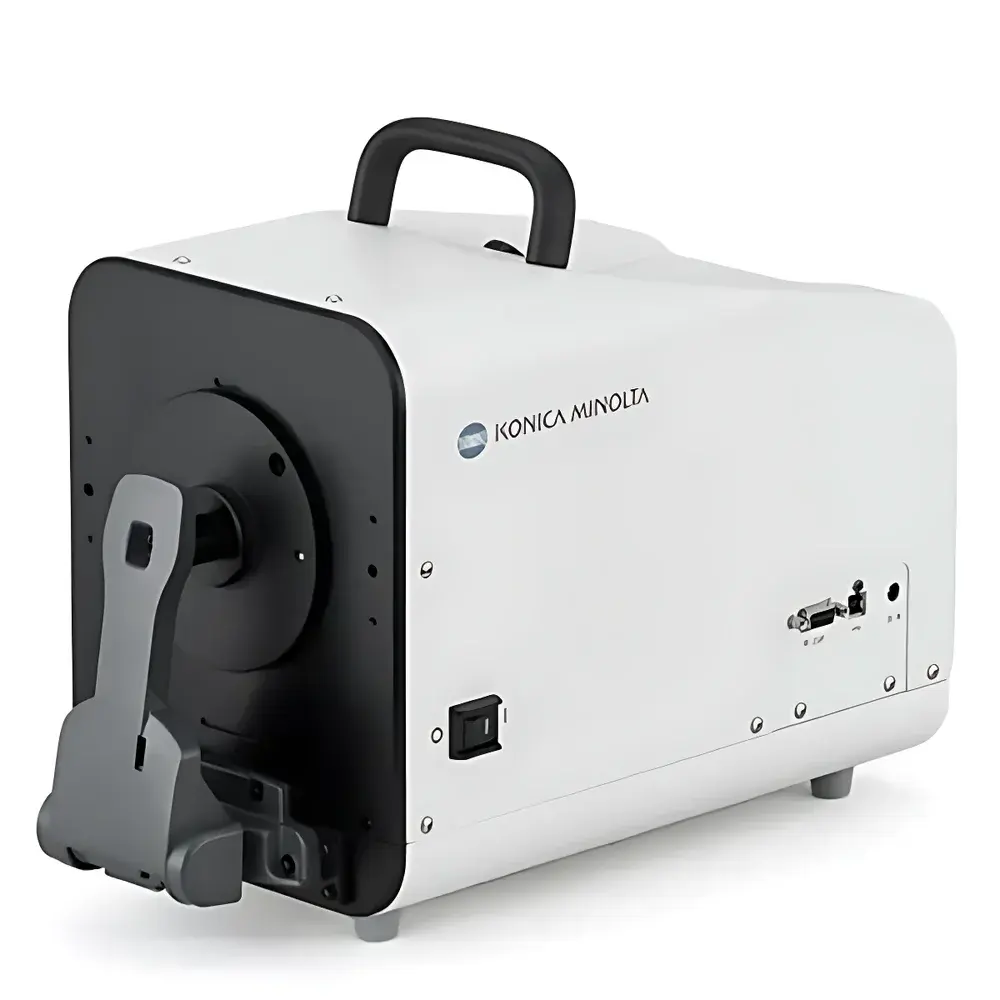
Konika-Minolta CF-300 Non-Contact In-Line Spectrophotometric Color Measurement System
| Brand | Konika-Minolta |
|---|---|
| Origin | Japan |
| Model | CF-300 |
| Product Type | Spectrophotometric Colorimeter |
| Instrument Type | In-Line |
| Optical Geometry | d/8° Integrating Sphere |
| Light Source | High-CRI White LED |
| Spectral Range | 400–700 nm |
| Repeatability | Chromaticity ΔE*ab ≤ 0.02 (standard deviation) |
Overview
The Konika-Minolta CF-300 is a non-contact, in-line spectrophotometric color measurement system engineered for high-precision chromatic evaluation of small-scale industrial components during active production. Based on the d/8° integrating sphere optical geometry—compliant with ISO 7724-1, CIE No. 15, and ASTM E308—the CF-300 employs diffused illumination and hemispherical collection to deliver geometry-insensitive, spectrally resolved reflectance data across the visible spectrum (400–700 nm). Unlike contact-based colorimeters, the CF-300 operates at a fixed 1 mm working distance, eliminating mechanical interference with delicate or viscous surfaces (e.g., cosmetic coatings, liquid paints, soft plastics) while maintaining metrological equivalence to benchtop reference instruments. Its core function is real-time spectral acquisition and CIELAB (ΔE*ab, ΔE00) computation, enabling quantitative pass/fail decisions directly within automated manufacturing environments.
Key Features
- Sub-millimeter measurement aperture: 0.75 × 1 mm target area—optimized for micro-components including watch screws, smartphone buttons, eyeglass hinges, precision fasteners, and pen casings.
- Non-contact operation at 1 mm standoff distance: Prevents surface contamination, deformation, or cross-contamination in sensitive applications such as cosmetics (lipstick, foundation), wet paint films, and medical device coatings.
- High-speed acquisition: Single measurement completed in ≈0.1 s; continuous measurement interval adjustable down to 0.2 s (up to 5 Hz), supporting synchronization with conveyor belt speeds up to 2 m/s under optimized integration.
- Integrated visual targeting system: Dual-axis crosshair projection ensures precise spatial registration of the measurement zone—critical for repeatable positioning on irregular or reflective substrates.
- Stable solid-state illumination: High-color-rendering-index (CRI >95) white LED source provides consistent spectral output over >50,000 hours, eliminating lamp replacement cycles and intensity drift common in tungsten-halogen systems.
- Ruggedized industrial enclosure: IP54-rated housing with thermal stabilization circuitry enables reliable deployment in ambient temperatures from 10°C to 40°C and relative humidity up to 85% non-condensing.
Sample Compatibility & Compliance
The CF-300 accommodates matte, glossy, textured, translucent, and anisotropic surfaces without requiring physical contact or sample preparation. It meets ISO 13655:2017 (spectral measurement of printed materials), ISO 2813 (gloss-independent color), and supports traceability to NIST-traceable standards via factory calibration certificates. For regulated industries, the system architecture permits integration into GLP/GMP-compliant workflows when paired with validated software modules supporting audit trails, electronic signatures, and 21 CFR Part 11–compliant data integrity controls (requires optional Konica Minolta Color Management Software Suite v4.2+).
Software & Data Management
The CF-300 interfaces via Ethernet (TCP/IP) or RS-422 to host SCADA, MES, or PLC systems. Standard firmware includes real-time streaming of L*a*b*, XYZ, and spectral reflectance (31-point, 10 nm intervals) with timestamped metadata. Optional Konica Minolta CM-S100w software enables statistical process control (SPC) charting, tolerance band mapping (ellipsoidal or rectangular ΔE limits), batch reporting, and export to CSV, XML, or OPC UA. All measurement logs are stored with immutable timestamps, operator ID, and environmental sensor readings (optional ambient light/temperature monitoring).
Applications
- Electronics manufacturing: In-line verification of anodized aluminum housings, PVD-coated camera rings, and injection-molded polymer buttons on smartphones and gaming controllers.
- Watchmaking & luxury goods: Consistency control of dial lacquers, ceramic bezels, and stainless-steel bracelet links where surface finish prohibits probe contact.
- Automotive interiors: Real-time monitoring of trim piece color matching across multi-cavity injection molds and robotic spray booths.
- Cosmetics & personal care: Non-destructive assessment of lipstick pigment dispersion, foundation shade uniformity, and nail polish film development without smearing or substrate adhesion.
- Medical devices: Verification of color-coded tubing, syringe barrels, and surgical instrument handles per ISO 15223-1 labeling requirements.
FAQ
What is the minimum measurable object size for the CF-300?
The smallest defined measurement area is 0.75 × 1 mm; successful measurement requires the target to fully cover this aperture with ≥90% fill ratio and minimal edge diffraction.
Can the CF-300 be integrated into a PLC-controlled production line?
Yes—native Modbus TCP and discrete I/O signals (pass/fail, trigger, error) enable direct integration with Allen-Bradley, Siemens, and Mitsubishi PLCs without middleware.
Does the system require periodic recalibration?
Factory calibration remains valid for 12 months under normal operating conditions; annual verification using Konica Minolta CR-10 calibration tiles is recommended for ISO/IEC 17025 compliance.
Is spectral data export supported for third-party analysis?
Yes—raw 31-channel reflectance spectra (400–700 nm, 10 nm steps) are streamable in real time and storable in industry-standard .spc or .csv formats.
How is measurement stability maintained across temperature fluctuations?
Internal thermistor feedback regulates LED drive current and detector bias voltage, limiting spectral shift to <0.3 nm/°C and ΔE*ab drift to <0.01 per °C within the specified operating range.





