
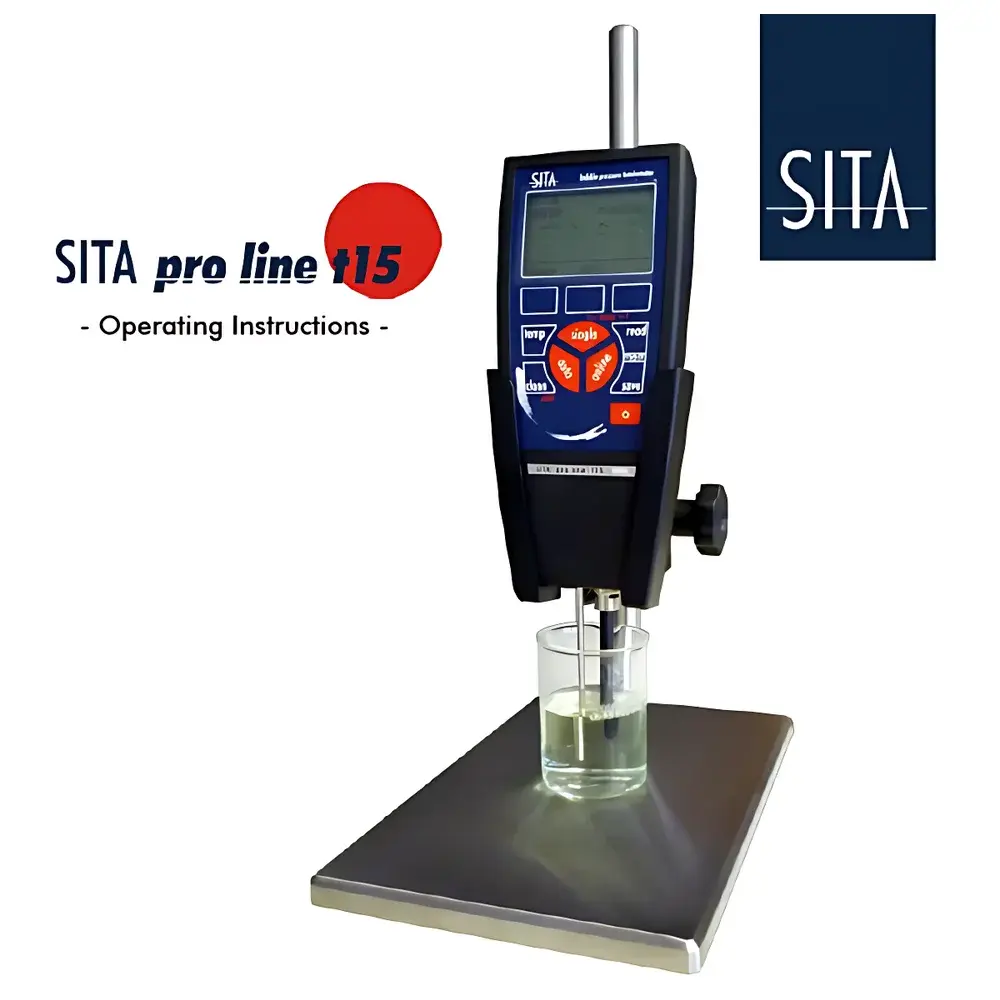
SITA Pro Line t15 / Science Line t100 Automatic Dynamic & Static Surface Tensiometer
| Brand | SITA |
|---|---|
| Origin | Germany |
| Model | Pro Line t15 / Science Line t100 |
| Measurement Range | 10–100 mN/m |
| Measurement Accuracy | ±0.1 mN/m |
| Repeatability | ±0.5 mN/m |
| Bubble Lifetime Control | 15 ms – 20 s (1 ms resolution) |
| Temperature Range | 0–100 °C |
| Temperature Accuracy | ±0.1 °C (max deviation: 0.3 K) |
| Measurement Principle | Maximum Bubble Pressure Method (MBP) |
| Capillary Material | PEEK |
| Capillary Length | 68 mm |
| Sample Viscosity Limit | ≤2000 cP |
| Data Storage | 25 internal measurements |
| Interface | USB |
| Software | Included for real-time plotting, comparative analysis, and export (CSV/PDF) |
| Calibration | Automated with distilled water |
| Housing | Splash-proof, chemically resistant enclosure |
| Dimensions | 75 × 168 × 35 mm |
| Weight | 270 g |
Overview
The SITA Pro Line t15 and Science Line t100 are fully automated benchtop surface tensiometers engineered for high-reproducibility measurement of both static and dynamic surface tension using the Maximum Bubble Pressure (MBP) method—a well-established, ISO/ASTM-aligned technique for interfacial characterization. Unlike pendant drop or Wilhelmy plate methods, MBP directly quantifies surface tension by monitoring pressure differentials required to form and rupture air bubbles at a precisely defined capillary tip immersed in liquid. This principle enables intrinsic time-resolved sensitivity to surfactant adsorption kinetics, making the instrument uniquely suited for evaluating formulation stability, wetting dynamics, and interfacial relaxation behavior in real time. Designed for integration into GLP-compliant QC labs and R&D environments, the system delivers traceable, operator-independent results without manual bubble observation or subjective endpoint judgment.
Key Features
- Three operational modes—Independent (single-point QC), Automatic (multi-parameter programmable sequences), and Online (continuous process monitoring)—each configurable via intuitive front-panel interface or PC software.
- Integrated miniature air compressor and millisecond-precision solenoid valve enable precise, repeatable bubble generation with lifetime control from 15 ms to 20 s (1 ms resolution), supporting both equilibrium and non-equilibrium surface tension profiling.
- PEEK capillary (68 mm length) ensures chemical resistance to acids, bases, and organic solvents; insertion depth independence eliminates positioning error—critical for routine testing across variable sample volumes.
- Embedded Pt100 temperature sensor (68 mm probe) provides simultaneous liquid-phase temperature measurement with ±0.1 °C accuracy and thermal drift compensation per ASTM D1331 and ISO 6295 standards.
- Automated calibration routine using certified distilled water (γ = 72.75 mN/m at 20 °C) ensures long-term metrological traceability without external reference standards.
- Splash-proof, corrosion-resistant housing (IP54 equivalent) and compact footprint (75 × 168 × 35 mm) support deployment in production areas, fume hoods, or mobile lab carts.
Sample Compatibility & Compliance
The instrument accommodates aqueous and non-aqueous formulations with viscosities up to 2000 cP—including ceramic inks, coating resins, pharmaceutical emulsions, agrochemical adjuvants, and cleaning concentrates. Its MBP methodology complies with key international test standards including ISO 6295 (determination of surface tension of detergents), ASTM D1331 (surface and interfacial tension of coatings and related materials), and DIN 53914 (bubble pressure tensiometry). All measurement data include embedded timestamps, temperature metadata, and operator ID fields—supporting audit readiness under FDA 21 CFR Part 11 when used with validated software configurations. The system meets IEC 61000-4 electromagnetic compatibility requirements and operates safely within standard laboratory ambient conditions (15–30 °C, 30–80% RH).
Software & Data Management
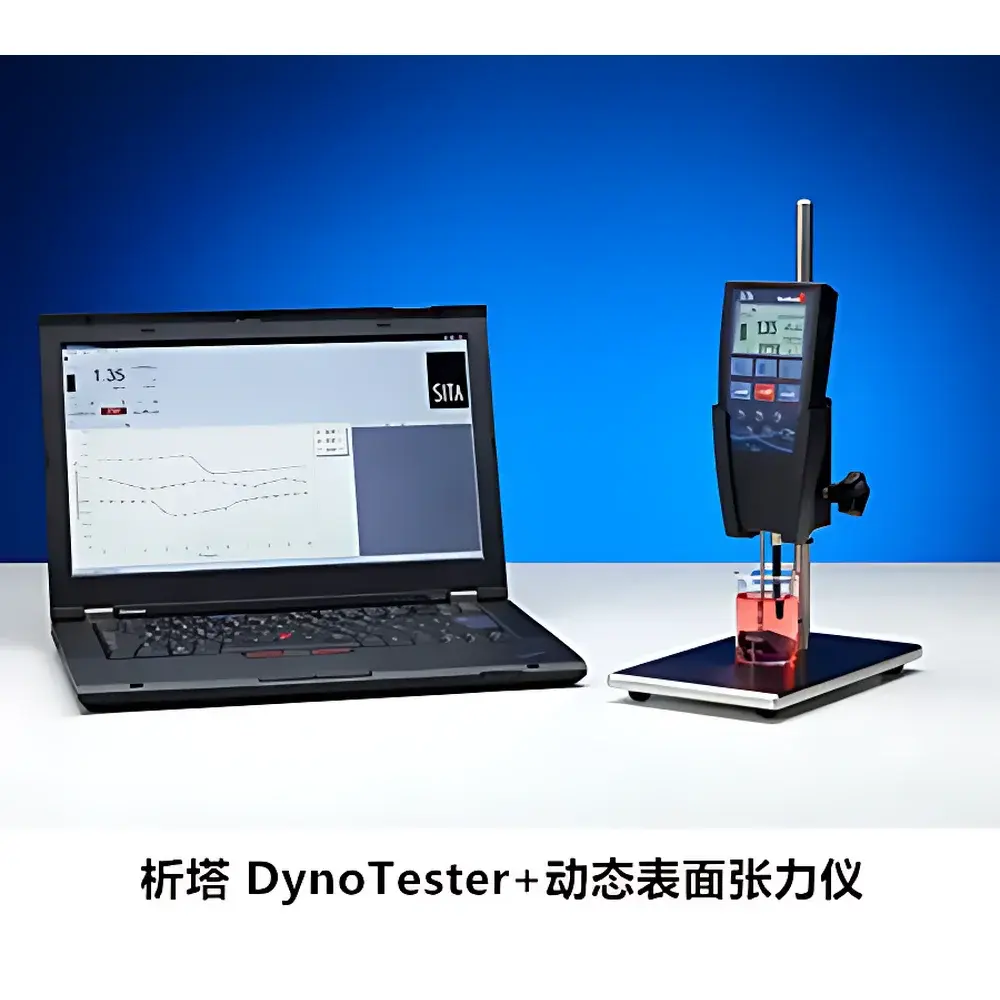
The included Windows-based SITA Tensiometry Suite provides full instrument control, real-time curve visualization (pressure vs. time), automatic γ-calculation via Young-Laplace derivation, and batch reporting. Data are stored internally (25 entries) and synchronously exported via USB to CSV or PDF with customizable templates. Graphical overlays allow side-by-side comparison of kinetic profiles across batches or formulations. Audit trails record all parameter changes, calibration events, and measurement initiations—enabling full traceability per GLP/GMP documentation requirements. Optional API integration supports connection to LIMS or MES platforms for automated data ingestion into enterprise quality systems.
Applications
- Ceramic ink development: Diagnosing jetting instability (e.g., satellite droplets, tailing) linked to insufficient surfactant migration kinetics at nozzle interfaces.
- Paint & coating R&D: Quantifying dynamic surface tension reduction rates to predict substrate wetting, leveling, and cratering defect mitigation.
- Pharmaceutical formulation: Assessing micellization onset and interfacial aging in parenteral emulsions and liposomal suspensions.
- Agrochemical adjuvant screening: Correlating bubble lifetime decay profiles with spreading efficiency on hydrophobic leaf surfaces.
- Quality control in surfactant manufacturing: Verifying batch-to-batch consistency of critical micelle concentration (CMC) and adsorption half-times.
FAQ
What is the fundamental difference between static and dynamic surface tension measured by this instrument?
Static surface tension refers to the equilibrium value attained after sufficient time for surfactant adsorption (typically >10 s bubble lifetime); dynamic surface tension reflects the interfacial state at shorter timescales (ms–s), governed by molecular diffusion and orientation kinetics.
Can the instrument measure interfacial tension between two immiscible liquids?
No—the MBP method requires a gas–liquid interface; for liquid–liquid interfacial tension, a spinning drop or pendant drop tensiometer is recommended.
Is temperature control external or built-in?
The unit includes an integrated Pt100 sensor for accurate liquid-phase temperature monitoring but does not provide active heating/cooling; external thermostatted baths are required for controlled-temperature experiments.
How is compliance with regulatory data integrity requirements addressed?
The software supports electronic signatures, immutable audit logs, and exportable raw data files—all configurable to align with ALCOA+ principles and 21 CFR Part 11 Annex 11 expectations when deployed in validated environments.
What maintenance is required for long-term reliability?
Routine cleaning of the PEEK capillary with appropriate solvents and quarterly verification against distilled water standard are sufficient; no consumables or recalibration services are mandated within the first 24 months of operation.



