
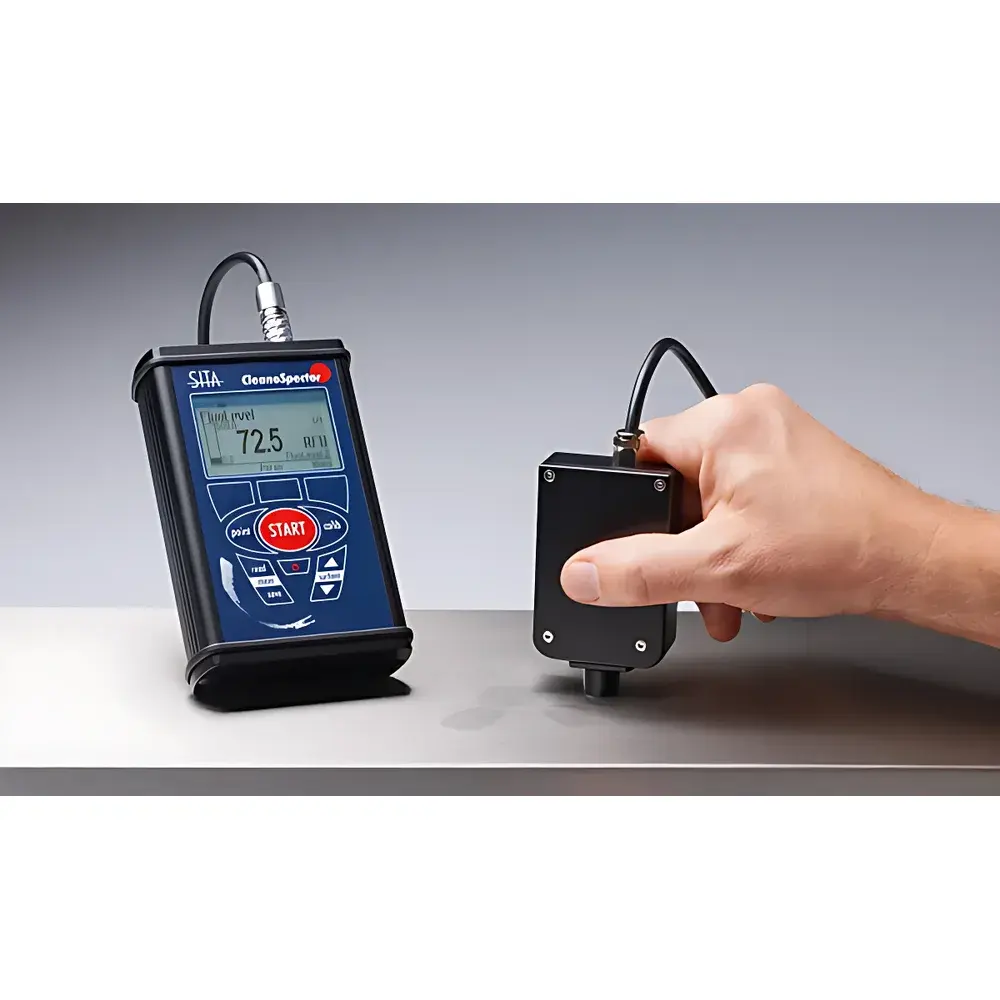
SITA CleanoSpector Surface Cleanliness Analyzer for Rotational Sputtering Target Pre-Bonding Quality Control
| Brand | SITA |
|---|---|
| Origin | Germany |
| Model | CleanoSpector |
| Measurement Principle | UV-Induced Fluorescence (Confocal Optical Detection) |
| Unit | Relative Fluorescence Units (RFU) |
| Compliance | Designed for ISO 14644-1 cleanroom-adjacent process control, supports GLP/GMP-aligned documentation workflows |
| Software | CleanoSpector PC Software v3.2 with audit trail, user access levels, and CSV/PDF export |
| Sample Interface | Non-contact, real-time, spot measurement (Ø 2 mm) |
Overview
The SITA CleanoSpector is a non-destructive, quantitative surface cleanliness analyzer engineered specifically for high-reliability manufacturing processes where organic contamination directly impacts bonding integrity and functional performance. In rotational sputtering target production, the pre-bonding surface condition of the target tube—particularly its inner cylindrical surface—is a critical process gate. Residual organic contaminants—including drawing oils, cutting fluids, polishing agents, release waxes, and fingerprint residues—interfere with metallization adhesion and compromise the uniformity and thermal stability of the indium-based solder layer during vacuum brazing. The CleanoSpector employs confocal UV fluorescence detection: an integrated 365 nm LED excites native fluorophores in hydrocarbon-based contaminants; emitted fluorescence intensity is captured by a precision photodiode array and converted into Relative Fluorescence Units (RFU). This method delivers trace-level sensitivity (detection limit < 0.1 ng/cm² of typical machining oil), repeatability ±2% RFU (n=10, same spot), and measurement independence from surface roughness or reflectivity—enabling robust quantification across diverse ceramic (e.g., ITO, AZO, SiO₂) and metal (e.g., Ti, Cu, Mo) target substrates.
Key Features
- Confocal optical architecture ensures precise depth discrimination—rejecting background fluorescence from substrate bulk or underlying layers, critical for curved inner surfaces of tubular targets.
- Calibration-traceable RFU scale, validated against gravimetric reference standards per DIN 50967 Annex B, enabling cross-shift and cross-facility data comparability.
- Real-time single-spot measurement (< 1 s), with optional 10-point auto-scan mode for circumferential profiling of target tubes (diameter range: 50–300 mm).
- Ruggedized industrial housing (IP54 rated) with integrated ergonomic handle and trigger button for handheld operation inside glove boxes or near cleaning stations.
- On-device pass/fail threshold setting with visual LED feedback (green/red) for inline operator guidance without PC dependency.
- Integrated temperature and humidity sensor to log ambient conditions affecting solvent volatility and contaminant migration—essential for root-cause analysis in yield loss investigations.
Sample Compatibility & Compliance
The CleanoSpector is validated for use on machined, sintered, and polished surfaces common in sputtering target fabrication—including Al₂O₃, SiC, Ti, stainless steel, and molybdenum back tubes. It requires no consumables, solvents, or surface contact, eliminating risk of recontamination or micro-scratching. While not a regulatory instrument per se, its measurement methodology aligns with principles referenced in ASTM F2450 (“Standard Practice for Measuring Organic Contamination on Rigid Surfaces”) and supports compliance with ISO 13485 (medical device manufacturing) and IATF 16949 (automotive supply chain) requirements for process validation and contamination control. Data output meets FDA 21 CFR Part 11 readiness when used with CleanoSpector PC Software v3.2, featuring electronic signatures, audit trail logging, and secure user role management (Admin/Operator/Reviewer).
Software & Data Management
CleanoSpector PC Software provides full traceability for quality assurance systems. Each measurement record includes timestamp, operator ID, location tag, environmental metadata (T/RH), raw RFU values per point, statistical summary (mean, SD, min/max), and annotated image capture (optional USB microscope integration). Reports are exportable as PDF (with company header/footer) or CSV for LIMS integration. Batch reporting enables trending analysis—e.g., tracking average RFU shift across weekly lots to correlate with cleaning bath life or ultrasonic degreaser power drift. The software supports custom SOP-driven workflows: e.g., “Pre-Metallization Gate” protocol requiring ≤5.0 RFU mean across 10 points before wafer transfer to PVD line.
Applications
- Quantitative verification of aqueous/organic solvent cleaning efficacy prior to DC/RF sputtering target metallization.
- Root-cause analysis of low bonding yield in rotary target assembly—correlating localized high-RFU zones with subsequent indium void formation observed via X-ray tomography.
- Validation of storage environment integrity: monitoring RFU increase during warehouse aging to define maximum shelf-life before re-cleaning.
- Process capability assessment (Cpk) for cleaning lines—establishing control limits based on historical RFU distribution from qualified lots.
- Supplier qualification: objective comparison of incoming target tube cleanliness vs. internal specifications, replacing subjective wipe-test pass/fail judgments.
FAQ
How does RFU correlate to actual mass of contamination?
RFU is a relative, instrument-specific unit calibrated against certified reference materials. For common machining oils (e.g., Shell Morlina S4 B), empirical correlations exist: ~1 RFU ≈ 0.15–0.25 ng/cm². Absolute mass conversion requires lab-specific calibration using gravimetrically prepared standards.
Can the CleanoSpector detect inorganic residues like salts or metal oxides?
No. The instrument detects only native fluorescence from organic compounds. Inorganic residues require complementary techniques such as XRF, FTIR, or ion chromatography.
Is surface roughness a factor in measurement accuracy?
The confocal design minimizes topographic interference. Validation testing per ISO 25178-2 shows <3% RFU deviation across Ra 0.1–3.2 µm surfaces—well within typical target tube finish tolerances.
What maintenance is required?
Annual factory recalibration is recommended. Daily verification uses the included quartz reference slide (certified RFU 10.0 ± 0.5). No optical alignment or lamp replacement is needed—the solid-state UV LED has >10,000 h lifetime.
Does the UV light damage sensitive target materials?
Exposure is brief (<100 ms) and low-energy (365 nm, <1 mW/cm²). No photodegradation or surface modification has been observed on ceramics, metals, or coated substrates after repeated measurements.



