
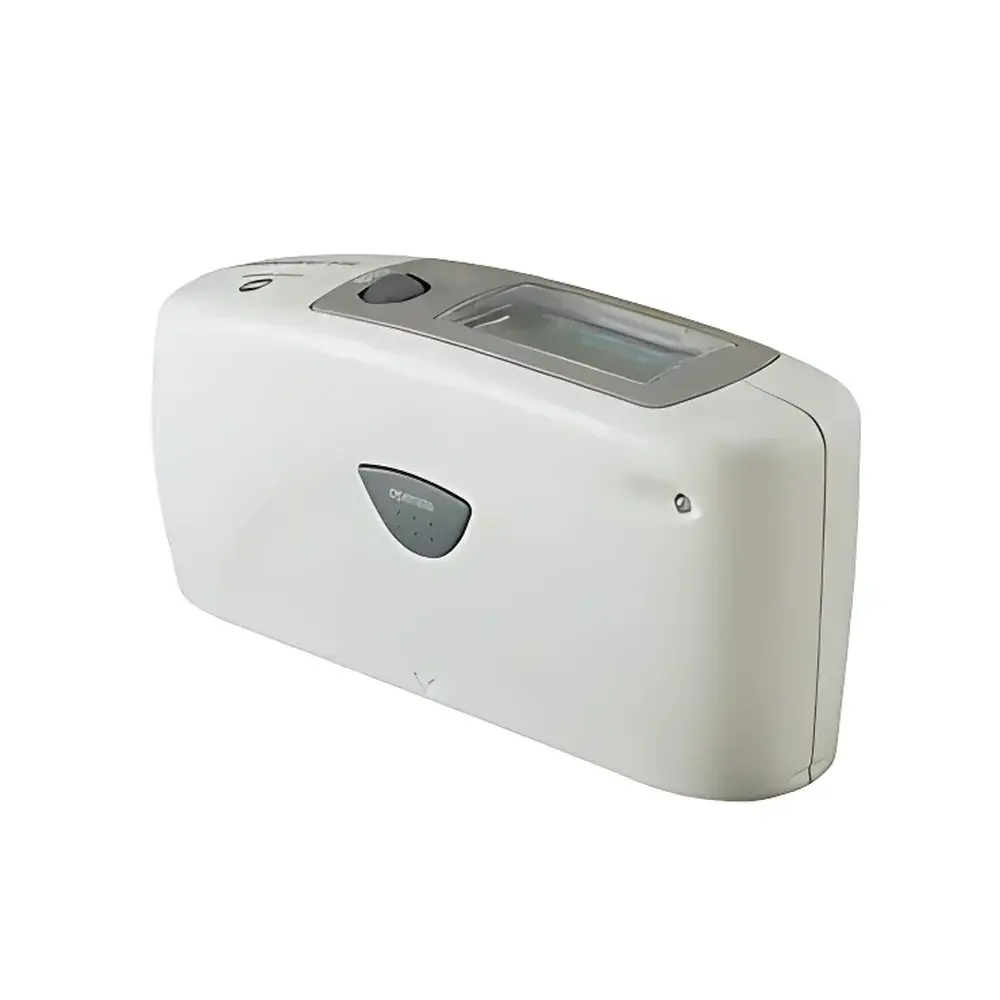
Konica Minolta MG-268 Multi-Angle Gloss Meter
| Brand | Konica Minolta |
|---|---|
| Origin | Japan |
| Model | MG-268 |
| Measurement Angles | 20°, 60°, 85° |
| Gloss Range | 0.0–2,000 GU (20°), 0.0–1,000 GU (60°), 0.0–160 GU (85°) |
| Repeatability | ±0.2 GU (0–99.9 GU), ±0.2% of reading (100–2,000 GU) |
| Inter-instrument Agreement | ±0.5 GU (0–99.9 GU), ±0.5% of reading (100–2,000 GU) |
| Measurement Area | 10×10 mm (20°), 9×15 mm (60°), 5×38 mm (85°) |
| Compliance | ISO 2813, ISO 7668, ASTM D523, ASTM D2457, DIN 67530, JIS Z 8741, BS 3900, BS 6161-12 |
| Data Storage | 999 measurements with timestamp |
| Battery Life | ~10,000 readings (1.5 V AA alkaline) |
| Interface | USB 2.0, Bluetooth 2.0 |
| Operating Temperature | 15–40 °C, ≤85% RH (non-condensing) |
| Dimensions | 155 × 73 × 48 mm |
| Weight | 400 g |
Overview
The Konica Minolta MG-268 Multi-Angle Gloss Meter is a precision optical instrument engineered for quantitative evaluation of specular reflectance from solid material surfaces under standardized geometric conditions. It operates on the principle of mirror-reflection gloss measurement—defined as the ratio of reflected luminous flux to incident flux at a specified angle and geometry—per ISO 2813 and ASTM D523. Unlike single-angle instruments, the MG-268 simultaneously supports three industry-standard incidence angles: 20° (optimized for high-gloss surfaces such as automotive clear coats or polished metals), 60° (the universal reference angle for medium-gloss materials including plastics, painted panels, and coated papers), and 85° (designed for low-gloss and matte finishes like textured polymers or matte-finished wood composites). Its optical architecture employs a stabilized tungsten-halogen light source, precision collimating optics, and a silicon photodiode detector calibrated traceably to NIST-traceable standards. The device delivers metrologically robust results across diverse industrial QC environments—from automotive OEM paint shops and packaging converters to R&D laboratories evaluating coating formulations.
Key Features
- Triple-angle capability (20°, 60°, 85°) with independent measurement areas optimized per angle per ISO 7668: each configured for optimal signal-to-noise ratio and minimal edge effects (10×10 mm at 20°, 9×15 mm at 60°, 5×38 mm at 85°)
- High repeatability: ±0.2 GU (0–99.9 GU) and ±0.2% of reading (100–2,000 GU), verified per ASTM D2457 Annex A2 protocols
- Inter-instrument agreement certified to ±0.5 GU (0–99.9 GU) and ±0.5% of reading (100–2,000 GU), enabling reliable data exchange across multi-site production networks
- Integrated self-diagnostic calibration verification system that monitors optical path stability and triggers user alerts when recalibration is required—reducing drift-related measurement uncertainty over extended operational cycles
- Large backlit LCD display with intuitive rotary dial navigation, supporting eight language options (English, German, French, Spanish, Italian, Portuguese, Russian, Japanese) for global lab deployment
- Extended battery life: approximately 10,000 measurements per set of two 1.5 V AA alkaline cells; also operable via USB bus power during data transfer or firmware updates
- Auto-power-off configurable between 10–99 seconds to conserve energy without compromising workflow continuity
Sample Compatibility & Compliance
The MG-268 accommodates flat, curved, and textured substrates—including thermoplastics, metal sheets, laminated films, ceramic tiles, and coated paperboard—provided surface curvature radius exceeds 200 mm and local roughness (Ra) remains below 1.6 µm. Its angular configuration complies fully with ISO 2813:2014 (Paints and varnishes — Determination of specular gloss), ASTM D523-14 (Standard Test Method for Specular Gloss), and related national standards including JIS Z 8741, DIN 67530, and BS 3900-D5. For regulated industries, the instrument’s deterministic measurement logic, timestamped data logging, and non-volatile memory (999 entries with date/time stamps) support GLP/GMP-aligned documentation practices. While not FDA 21 CFR Part 11–certified out-of-the-box, its raw data export via USB/Bluetooth enables integration into validated LIMS or ELN platforms where electronic signature and audit trail requirements are managed at the system level.
Software & Data Management
Measurement data is stored internally with full metadata: sample ID, standard ID, measurement angle, date/time stamp, and operator-defined notes. Export is supported via USB 2.0 mass storage mode or Bluetooth 2.0 serial profile to Windows/macOS/Linux hosts. Konica Minolta’s optional GlossMeter Utility Software (v3.x) provides statistical analysis (mean, SD, min/max, CPK), PASS/FAIL thresholding with configurable tolerance bands, trend charting across batches, and CSV/PDF report generation compliant with internal QA templates. All firmware updates are delivered through signed binary packages distributed via Konica Minolta’s secure support portal—ensuring version control and integrity verification in controlled manufacturing environments.
Applications
- Automotive: In-line gloss verification of basecoat/clearcoat systems, interior trim components, and wheel finishes against OEM specifications (e.g., GMW14872, Ford WSS-M2P175-B)
- Packaging: Quantitative assessment of gloss uniformity across printed flexible films, folding cartons, and metallized labels to ensure visual consistency and brand fidelity
- Plastics & Composites: Monitoring surface finish stability during extrusion, injection molding, and thermoforming processes—correlating gloss values with melt temperature, mold release agent concentration, and cooling rate
- Coatings R&D: Comparative evaluation of pigment dispersion efficiency, binder selection impact, and additive performance (e.g., matting agents, flow modifiers) using differential gloss metrics (ΔGU)
- Quality Auditing: Third-party certification bodies use the MG-268 to validate conformance with contractual gloss tolerances in supplier scorecards and PPAP submissions
FAQ
What standards does the MG-268 comply with?
The instrument meets ISO 2813, ISO 7668, ASTM D523, ASTM D2457, DIN 67530, JIS Z 8741, BS 3900, and BS 6161-12 for gloss measurement methodology, geometry, and calibration traceability.
Can the MG-268 measure curved surfaces?
Yes—within limits. It is validated for convex/concave surfaces with radii ≥200 mm and surface roughness (Ra) ≤1.6 µm. Smaller radii introduce systematic angular deviation and require empirical correction or use of specialized fixtures.
How is inter-instrument agreement ensured across multiple MG-268 units?
Each unit undergoes factory calibration against master reference standards traceable to NMIJ (National Metrology Institute of Japan). The published inter-instrument agreement specification (±0.5 GU / ±0.5%) reflects worst-case variance observed across 50+ units tested per ISO 5725-2 reproducibility protocols.
Does the MG-268 support automated PASS/FAIL reporting?
Yes. Users define upper/lower gloss limits per angle in the instrument menu. Results display PASS/FAIL status in real time, and all flagged measurements are tagged in stored data for downstream SPC analysis.
Is firmware update capability available in the field?
Yes. Firmware updates are distributed as cryptographically signed binaries via Konica Minolta’s support portal and installed via USB connection—enabling compliance with evolving metrological requirements without hardware modification.




