
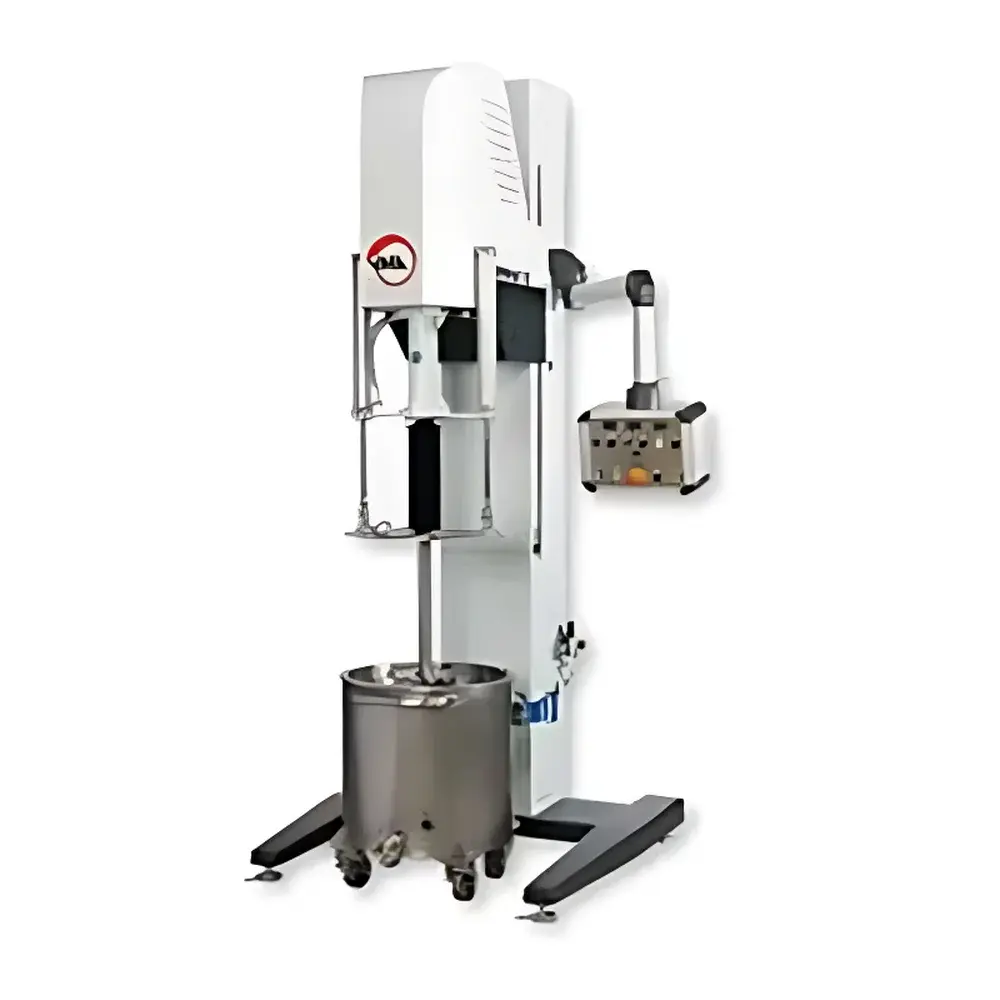
VMA DISPERMAT SC537 High-Speed Vacuum Homogenizer
| Brand | VMA |
|---|---|
| Origin | Germany |
| Model | SC537 |
| Power Rating | 37 kW |
| Max. Batch Volume | 200–1,250 L |
| Control System | PLC-based |
| Safety Certification | ATEX Zones 0/1/2 (optional) |
| Drive Type | Torque-free cantilever shaft |
| Mounting | Central clamping system for vessel stabilization |
| Operating Modes | Atmospheric & vacuum-assisted dispersion |
Overview
The VMA DISPERMAT SC537 is a high-performance, industrial-grade high-speed homogenizer engineered for reproducible dispersion, deagglomeration, and emulsification of complex liquid–solid and liquid–liquid systems. Based on rotor–stator hydrodynamic shear principles, the SC537 generates intense localized turbulence and cavitation within the processing zone, enabling micron-scale particle size reduction and uniform phase distribution. Unlike conventional stirrers or low-shear mixers, this system delivers controlled energy input across scalable batch volumes—from laboratory development (200 L) to pilot- and production-scale manufacturing (up to 1,250 L). Its modular architecture supports integration into GMP-compliant environments, with optional vacuum operation for oxygen-sensitive formulations and ATEX-certified configurations for handling flammable solvents or dust-laden atmospheres.
Key Features
- Torque-free cantilever drive shaft design eliminates mechanical backlash and ensures consistent radial alignment during high-speed operation—critical for long-term repeatability and reduced maintenance.
- Adjustable suspension height enables precise immersion depth control relative to vessel geometry, optimizing flow patterns and minimizing vortex formation or dead zones.
- Integrated central clamping system secures containers of varying diameters and weights (including stainless steel reactors and glass-lined vessels), preventing lateral displacement under high torque loads.
- PLC-based control unit with intuitive HMI interface allows real-time parameter setting and monitoring of rotational speed (0–3,000 rpm), process duration, jacket temperature (if coupled with thermal control), motor current draw, and vacuum level (when equipped).
- Modular safety expansion: Factory-configurable options include ATEX certification for explosive atmospheres (Zones 0, 1, and 2 per EN 60079-0/10/11), full-vacuum dispersion capability (down to ≤10 mbar abs), and Ethernet/IP or Profibus communication protocols for MES/SCADA integration.
Sample Compatibility & Compliance
The SC537 accommodates a broad spectrum of rheological profiles—from low-viscosity Newtonian fluids (e.g., aqueous polymer solutions) to highly viscous non-Newtonian suspensions (e.g., battery electrode slurries, pigment pastes, pharmaceutical suspensions). Its robust construction (316L stainless steel wetted parts, IP54-rated enclosure) complies with ISO 14644-1 Class 8 cleanroom compatibility when installed with appropriate filtration. For regulated industries, the PLC controller supports audit-trail logging, user-level access control, and electronic signature functionality aligned with FDA 21 CFR Part 11 requirements. Process validation documentation—including IQ/OQ templates and FAT/SAT protocols—is available upon request to support GLP and GMP commissioning.
Software & Data Management
The embedded control software provides synchronized acquisition of time-stamped operational parameters (speed, current, vacuum pressure, temperature) at configurable sampling intervals (100 ms–5 s). Raw data exports in CSV format are compatible with statistical process control (SPC) platforms such as Minitab or JMP. Optional cloud-enabled firmware permits remote diagnostics, predictive maintenance alerts (e.g., bearing temperature drift, current harmonics analysis), and version-controlled recipe management across multi-site installations. All firmware updates undergo IEC 62443-3-3 security validation prior to release.
Applications
- Electrode slurry preparation for lithium-ion battery manufacturing (NMC, LFP, silicon-anode formulations)
- Pigment dispersion in automotive coatings, architectural paints, and inkjet inks
- Pharmaceutical nanosuspension development (e.g., poorly water-soluble APIs)
- Food-grade emulsion stabilization (e.g., mayonnaise analogs, plant-based dairy alternatives)
- Ceramic and metal powder slurry homogenization for tape casting and additive manufacturing feedstocks
FAQ
What is the maximum allowable viscosity for continuous operation?
The SC537 is rated for continuous duty up to 50,000 mPa·s at 25°C using standard rotor–stator geometries; higher viscosities require intermittent duty cycles or custom high-torque stator configurations.
Can the system be validated for pharmaceutical use?
Yes—VMA provides qualification documentation packages compliant with ASTM E2500 and ISPE GAMP5, including sensor calibration certificates traceable to NIST standards and material-of-construction compliance reports (EP 3.1.1, USP ).
Is retrofitting vacuum capability possible on existing SC-series units?
Vacuum integration must be performed at the factory level due to structural reinforcement requirements of the base frame and sealing interface redesign; field retrofits are not supported.
What rotor–stator configurations are available?
Standard offerings include fine-dispersion (0.2 mm gap), medium-shear (0.5 mm), and coarse-premix (1.2 mm) geometries; custom designs for abrasive or fibrous media are available under NDA.
Does the PLC system support recipe transfer between different SC537 units?
Yes—recipes are stored in encrypted XML format and can be imported/exported via USB or network share; checksum verification ensures integrity during transfer.



