
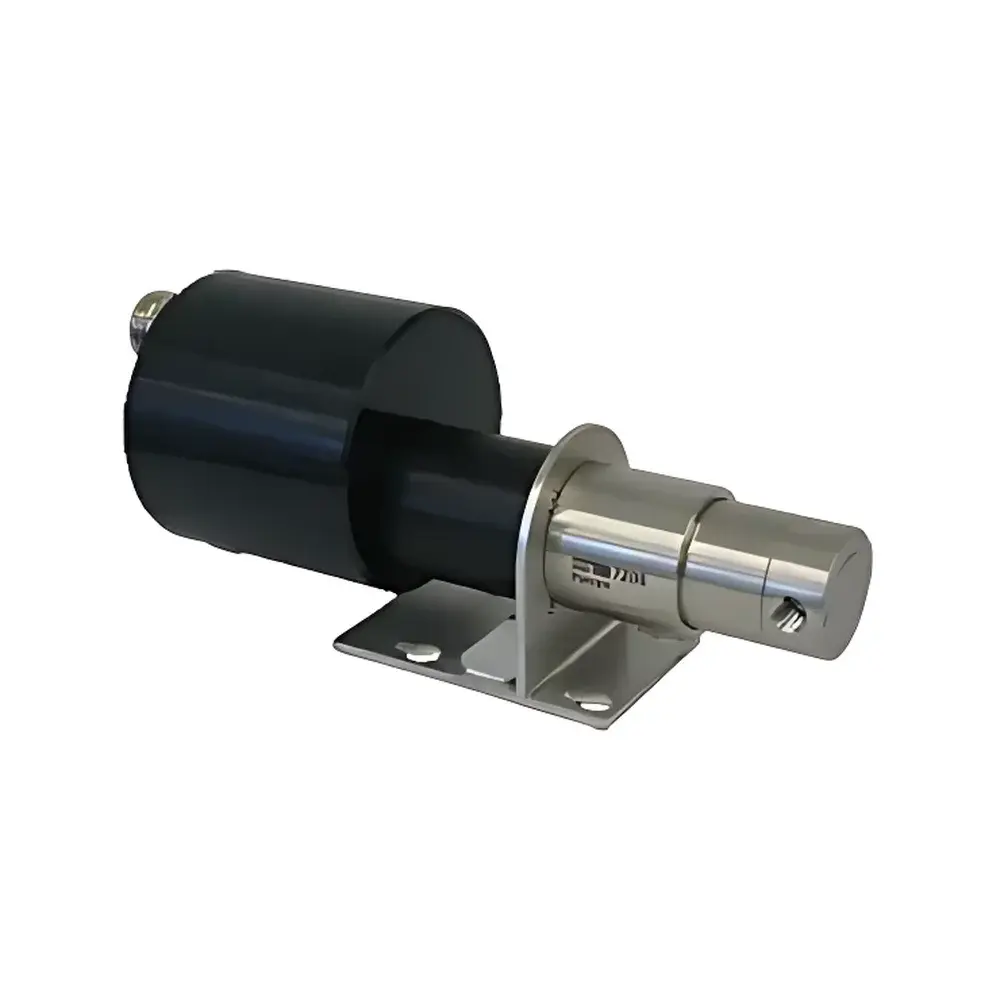
HNPM MZR-7208 Ultra-Compact Micro-Gear Precision Metering Pump
| Brand | HNPM |
|---|---|
| Origin | Germany |
| Model | MZR-7208 |
| Flow Rate | 0.048–288 mL/min |
| Precision (CV) | <1% |
| Viscosity Range | 0.3–50,000 mPa·s (up to 1,000,000 mPa·s with customization) |
| Speed Range | 1–6000 rpm |
| Max Differential Pressure | 30 bar (at 1 mPa·s), 150 bar (≥16 mPa·s) |
| Max Inlet Pressure | 5 bar (10–40 bar optional) |
| Displacement Volume | 48 µL |
| Minimum Dose | 30 µL |
| Wetted Materials | SS 316L, tungsten carbide, Ni-based alloys, graphite-reinforced PTFE, FPM/EPDM/FFPM seals |
| Motor | Brushless DC servo, 36 V DC, 201 W, IP54, 192 mNm continuous torque |
| Encoder | 500 pulses/rev (HEDL 5640) |
| Dimensions (L×W×H) | 211×84×93 mm |
| Weight | ~1500 g |
| Operating Temperature | −5 to +60 °C (−20 to +150 °C with optional configuration) |
Overview
The HNPM MZR-7208 Ultra-Compact Micro-Gear Precision Metering Pump is an engineered solution for high-accuracy, low-pulsation fluid delivery in space-constrained and demanding process environments. Based on rotary micro-ring gear displacement technology, it operates on positive displacement principles—achieving volumetric metering through precisely machined tungsten carbide gears rotating within a stainless steel 316L housing. This architecture ensures minimal shear stress on sensitive fluids while maintaining exceptional repeatability across wide viscosity ranges—from low-viscosity solvents (0.3 mPa·s) to highly viscous gels and pastes (up to 1,000,000 mPa·s under customized configurations). Designed and manufactured in Germany, the pump integrates a high-torque brushless DC servo motor with integrated optical encoder feedback (500 pulses per revolution), enabling closed-loop speed and position control essential for GLP-compliant dosing protocols and automated process integration.
Key Features
- Ultra-compact footprint (211 × 84 × 93 mm) without compromising volumetric accuracy or pressure capability
- Volumetric precision with coefficient of variation (CV) < 1% across full flow range (0.048–288 mL/min)
- High differential pressure tolerance: up to 150 bar at viscosities ≥16 mPa·s; 30 bar at 1 mPa·s
- Robust wetted path construction: SS 316L (1.4404 / 1.4435), tungsten carbide gears, nickel-based alloys, and chemically resistant seals (FPM standard; EPDM/FFPM optional)
- Low-pulsation delivery enabled by optimized gear geometry and rigid mechanical damping—critical for analytical injection, coating uniformity, and adhesive bead consistency
- Integrated 36 V DC brushless servo motor delivering 201 W nominal power and 192 mNm continuous torque, rated IP54 for industrial ambient conditions
- Encoder-synchronized motion control supports traceable dose logging, synchronization with PLCs or LabVIEW-based systems, and compliance with FDA 21 CFR Part 11 audit trail requirements when paired with validated software
Sample Compatibility & Compliance
The MZR-7208 is compatible with a broad spectrum of process and laboratory fluids—including aqueous solutions, methanol, organic solvents, lubricants, adhesives, inks, paints, greases, and hydrogels. Its chemically inert wetted materials meet ASTM F2028 and ISO 10993-5 biocompatibility screening criteria for non-implantable device contact. The pump’s design conforms to CE Machinery Directive 2006/42/EC and electromagnetic compatibility standards EN 61326-1. For regulated pharmaceutical or medical device manufacturing, its repeatable dosing performance supports adherence to USP Analytical Instrument Qualification and ICH Q7 Good Manufacturing Practice guidelines—particularly in API synthesis, formulation development, and small-batch dispensing where volumetric fidelity directly impacts batch release parameters.
Software & Data Management
While the MZR-7208 operates as a standalone analog/digital-controlled pump (0–10 V input, PWM, or RS-485 Modbus RTU interface), it is fully compatible with HNPM’s proprietary PumpControl Suite v3.x for Windows-based configuration, real-time monitoring, and dose history export (CSV/TXT). When integrated into validated workflows, the system supports electronic signature capture, user access levels, and time-stamped audit logs—enabling alignment with 21 CFR Part 11 requirements for electronic records and signatures. Third-party compatibility includes LabVIEW drivers, Python SDKs via serial/Modbus, and native integration into Beckhoff TwinCAT, Siemens TIA Portal, and Rockwell Logix platforms for synchronized multi-axis fluid handling in modular production cells.
Applications
- Chemical process development: precise reagent addition in flow chemistry reactors and microreactor arrays
- Pharmaceutical R&D: metered delivery of active ingredients during lyophilization buffer preparation or nanoparticle formulation
- Industrial coating & dispensing: consistent bead deposition of UV-curable adhesives, conformal coatings, and conductive inks
- Automated analytical sample introduction: low-pulse solvent delivery for HPLC, IC, and ICP-MS autosamplers
- Vacuum-compatible fluid transfer in thin-film deposition systems (e.g., spin coaters, dip coaters)
- Small-scale food & cosmetic prototyping: controlled dosing of emulsifiers, thickeners, and flavor concentrates
FAQ
What is the minimum controllable dose volume?
The pump delivers discrete doses as low as 30 µL, enabled by its 48 µL per revolution displacement volume and encoder-resolved step control.
Can the MZR-7208 handle abrasive slurries?
Yes—tungsten carbide gearing and hardened SS 316L surfaces provide extended service life with particle-laden media up to ISO 4406 class 18/16/13, provided filtration ≤10 µm is implemented upstream.
Is explosion-proof certification available?
ATEX Zone 2 and IECEx certification are available as factory-installed options (model suffix “-EX”), including intrinsically safe barrier integration and temperature-class T4 approval.
How is calibration traceability maintained?
HNPM provides NIST-traceable calibration certificates (ISO/IEC 17025 accredited lab) upon request, covering flow rate, linearity, and repeatability across three viscosity points (1, 100, and 10,000 mPa·s) at 23 ± 1 °C.
What maintenance intervals are recommended?
Under continuous operation at ≤80% of max torque and with filtered, non-abrasive fluids, scheduled inspection is recommended every 5,000 operating hours; seal replacement interval is typically 12–18 months depending on chemical exposure and duty cycle.



