
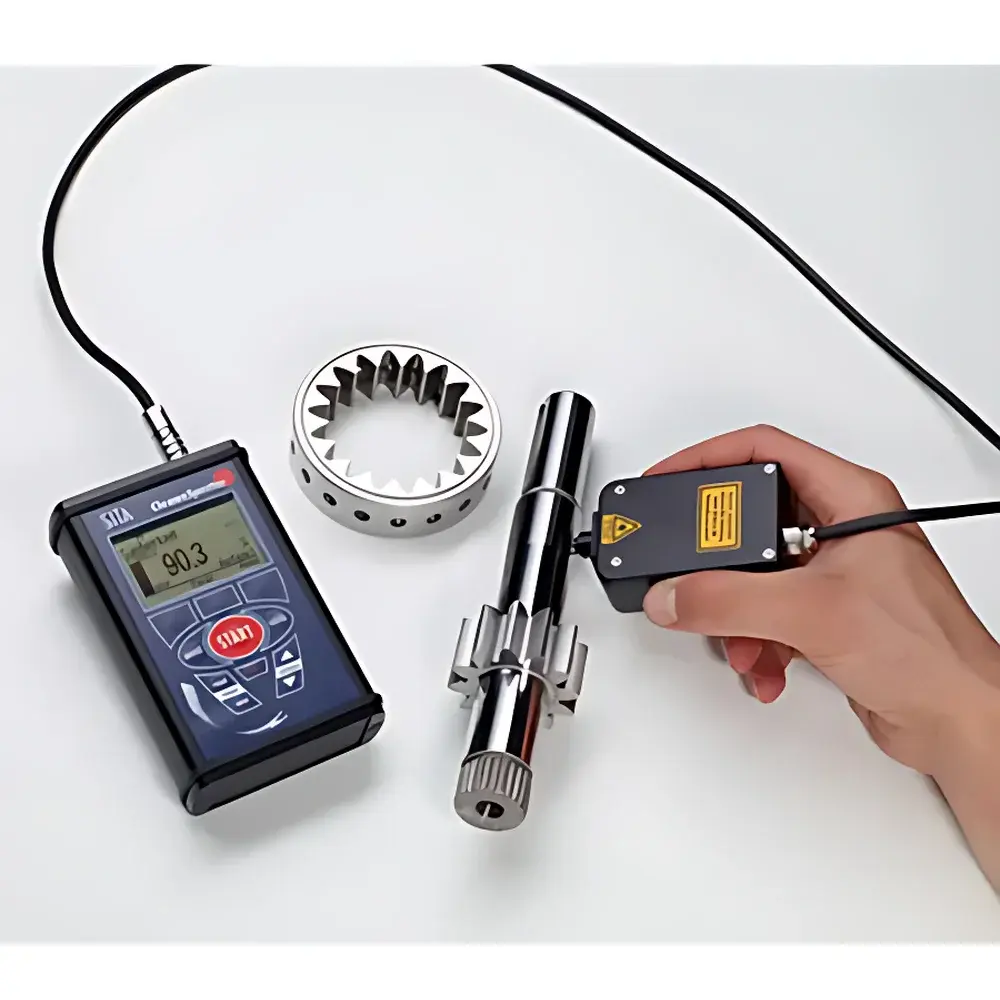
SITA CleanoSpector & Clean Line CI Surface Cleanliness Quantification System for Diamond Wire Manufacturing
| Brand | SITA |
|---|---|
| Origin | Germany |
| Model | CleanoSpector, Clean Line CI |
| Measurement Principle | UV-Induced Fluorescence (Confocal Detection) |
| Compliance | Designed for ISO 14644-1 cleanroom-adjacent process control, GLP-aligned data traceability, compatible with FDA 21 CFR Part 11–enabled software environments |
| Application Focus | Real-time quantification of organic residues (e.g., drawing lubricants, oils, surfactants) on steel wire substrates prior to electroplating |
Overview
The SITA CleanoSpector and Clean Line CI system is an industrial-grade, non-contact surface cleanliness verification platform engineered specifically for high-precision pre-treatment process control in diamond wire manufacturing. It employs confocal UV fluorescence detection — a physics-based, calibration-traceable method — to quantify residual organic contaminants (e.g., drawing lubricants, rolling oils, cleaning agent residues) on metallic substrates such as stainless steel or high-carbon steel mother wires. Unlike subjective wipe tests or solvent extraction methods, this system delivers objective, numerical cleanliness values (% scale) derived from the intensity of UV-excited fluorescence emitted by carbon-based contaminants. The measurement principle relies on the fact that hydrocarbon-based residues absorb UV light at 254–280 nm and re-emit characteristic fluorescence; the magnitude of this signal correlates directly with surface contamination mass per unit area. This enables deterministic pass/fail decisions prior to critical electroplating steps — notably pre-nickel plating — where even sub-monolayer organic residue can compromise nickel adhesion, induce interfacial voids, and ultimately lead to in-service wire fracture during silicon wafer slicing.
Key Features
- Confocal optical architecture ensures precise depth discrimination — isolating fluorescence signals exclusively from the top ~1–2 µm of the wire surface, eliminating interference from bulk substrate or underlying oxide layers.
- Calibration-stable UV LED source (254 nm or 275 nm, model-dependent) with <±2% spectral drift over 12 months, enabling long-term measurement repeatability across shifts and production lines.
- Real-time % cleanliness output (0–100%) referenced against SITA’s proprietary cleanliness standard curve — traceable to NIST-traceable reference samples.
- Integrated spot measurement mode (1 mm diameter) optimized for thin-diameter wires (Ø 30–80 µm), with automatic focus compensation for minor wire vibration or runout.
- Ruggedized IP54-rated housing suitable for wet-process environments near ultrasonic cleaning tanks, acid rinse stations, and drying ovens.
- On-device data logging (up to 10,000 measurements) with timestamp, operator ID, and location tag — exportable via USB or Ethernet to LIMS or MES systems.
Sample Compatibility & Compliance
The CleanoSpector and Clean Line CI are validated for use on bare steel mother wires (e.g., SWRH82B, SUS304) following alkaline degreasing, ultrasonic rinsing, and acidic pickling — typical steps in diamond wire pre-treatment. The system detects hydrocarbon-based contaminants at surface densities ranging from 0.01 to 10 µg/cm², covering industry-relevant ranges for wire drawing lubricants (e.g., mineral oil emulsions, fatty acid esters). While not a certified metrology instrument per ISO/IEC 17025, its measurement protocol aligns with ASTM D7252 (Standard Practice for Determining Surface Cleanliness by Fluorescence) and supports internal quality system requirements under IATF 16949 and ISO 9001. Data integrity features — including user authentication, audit trail generation, and electronic signature capability — facilitate compliance with GLP and GMP documentation standards.
Software & Data Management
SITA’s CleanControl software (v4.2+) provides full data lifecycle management: real-time dashboard visualization, statistical process control (SPC) charting (X̄-R, Cpk), automated alarm thresholds (e.g., warning at 92%, reject at 95%), and PDF report generation with embedded measurement images and metadata. All raw fluorescence intensity values, calibration logs, and user actions are stored with immutable timestamps — satisfying FDA 21 CFR Part 11 requirements when deployed with validated IT infrastructure. Integration with Siemens SIMATIC IT, Rockwell FactoryTalk, or custom OPC UA endpoints enables closed-loop feedback to cleaning process controllers (e.g., adjusting ultrasonic power or dwell time based on real-time cleanliness trends).
Applications
- Verification of post-ultrasonic degreasing efficacy on steel mother wires prior to acid activation.
- Validation of rinse water quality impact on residual surfactant carryover after alkaline cleaning.
- Diagnostics of cleaning bath exhaustion by trending cleanliness drift across consecutive wire batches.
- Root-cause analysis of nickel layer delamination failures via retrospective correlation of pre-plating cleanliness data with post-plating adhesion test results (e.g., tape test, bend test).
- Qualification of new cleaning chemistries or equipment upgrades through before/after controlled trials.
FAQ
What does the % value represent, and how is it calibrated?
The % value is a dimensionless index derived from ratioing the measured fluorescence intensity to that of a reference standard representing “100% clean” (i.e., solvent-rinsed, plasma-cleaned wire verified by XPS). It is not a direct mass concentration but a robust, repeatable relative metric traceable to SITA’s master calibration set.
Can the system detect inorganic residues like salts or metal oxides?
No. The UV fluorescence method is selective for organic compounds containing aromatic or conjugated structures. Inorganic residues require complementary techniques such as ion chromatography or XRF.
Is operator training required to achieve measurement reproducibility?
Minimal training is needed — the system automates focus, exposure, and signal integration. Inter-operator R&R studies show <5% variation under standard operating procedures, significantly lower than visual inspection or solvent wipe methods.
How frequently must the instrument be recalibrated?
Annual factory recalibration is recommended. Field verification using SITA-certified reference wafers is advised before each shift or batch, taking <30 seconds per check.
Does the system support integration into Industry 4.0 architectures?
Yes. Native Modbus TCP and OPC UA support enable direct connection to SCADA, MES, and digital twin platforms for predictive maintenance modeling of cleaning line performance.



