
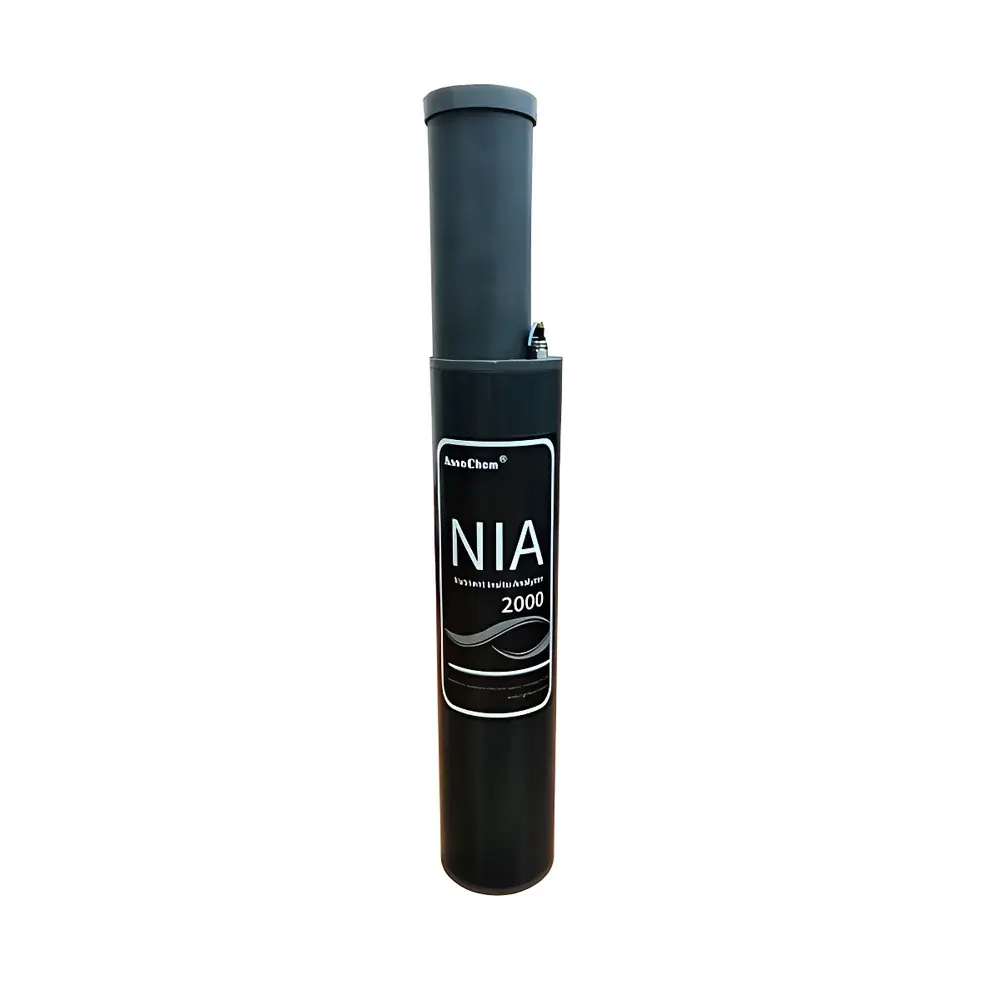
Lightsun μChem NIA 2000 In Situ Nutrient Analyzer
| Brand | Lightsun |
|---|---|
| Model | μChem NIA 2000 |
| Origin | Guangdong, China |
| Instrument Type | Online Water Quality Analyzer |
| Measured Parameters | Ammonia-N (N-NH₃), Orthophosphate-P (P-PO₄), Nitrate-N (N-NO₃), Nitrite-N (N-NO₂), Total Phosphorus (TP), Total Nitrogen (TN), Silicate (SiO₂), Hexavalent Chromium (Cr⁶⁺) |
| Detection Principle | Discrete Flow Analysis (DFA) coupled with Flow-Cell Photometry |
| Power Consumption | 8 W (operational), 1.2 W (standby) |
| Sampling Precision | ±0.1 µL |
| Structural Design | Integrated Cylindrical Housing, Tubeless Reaction Pathway |
| Compliance | ASTM D1426, ISO 7890-3, ISO 11908, USP <643>, EPA Method 353.2, HJ 636–2012, HJ 637–2012 |
Overview
The Lightsun μChem NIA 2000 In Situ Nutrient Analyzer is an advanced, field-deployable discrete flow analyzer engineered for continuous, unattended measurement of key nutrient species and trace contaminants in natural and engineered water systems. Unlike conventional continuous-flow or segmented-flow analyzers that rely on complex peristaltic tubing networks and fixed-range reagent delivery, the NIA 2000 implements a true discrete sampling architecture—precisely metering sub-microliter volumes of sample and reagents via high-accuracy syringe pumps and multi-position selection valves. Each analytical cycle isolates a discrete reaction segment within a temperature-stabilized optical flow cell, where spectrophotometric detection occurs under controlled kinetic conditions. This methodology replicates standardized laboratory wet-chemistry protocols—including those specified in EPA Method 353.2 (nitrate/nitrite), ASTM D1426 (ammonia), ISO 7890-3 (phosphate), and HJ 636–2012 (total nitrogen)—ensuring regulatory traceability and method equivalence across in situ and benchtop environments.
Key Features
- Discrete Flow Architecture: Eliminates carryover and cross-contamination through physical separation of each analytical sequence; enables independent optimization of reaction time, mixing ratio, and heating duration per parameter.
- Sub-Microliter Precision Delivery: Syringe-driven fluid handling achieves ±0.1 µL volumetric accuracy, minimizing reagent consumption by up to 70% versus conventional flow injection systems while maintaining calibration stability over extended deployment intervals.
- Multi-Parameter Flexibility: Standard configuration supports simultaneous quantification of ammonia-N, orthophosphate-P, nitrate-N, nitrite-N, total phosphorus, and total nitrogen; optional modules extend capability to silicate and hexavalent chromium without hardware modification.
- Optically Optimized Detection: Dual-wavelength LED source array with collimated beam path ensures high photometric linearity (R² > 0.9999 over 0–5 mg/L NO₃⁻-N range) and long-term spectral stability—critical for low-concentration nutrient monitoring in oligotrophic waters.
- Ruggedized Field Integration: Cylindrical monocoque housing (IP68-rated) features passive thermal management, low-power electronics (8 W operational draw), and battery-ready DC input (10–30 VDC), enabling seamless integration into buoys, autonomous surface vehicles, and remote trend stations.
- Adaptive Calibration & Range Switching: Software-controlled dilution and reagent volume modulation allows dynamic linear range adjustment—e.g., switching from 0–2 mg/L NH₃-N (high-sensitivity mode) to 0–20 mg/L (wastewater mode) without manual intervention.
Sample Compatibility & Compliance
The NIA 2000 is validated for direct analysis of raw, unfiltered water matrices including freshwater, estuarine, seawater, treated drinking water, municipal wastewater effluent, and groundwater. It meets performance criteria defined in ISO/IEC 17025-accredited laboratories for routine environmental monitoring and fulfills data integrity requirements under GLP and GMP-aligned workflows. All measurement protocols conform to internationally recognized standard methods: ammonia per ASTM D1426 and ISO 7150-1; phosphate per ISO 6878 and HJ 535–2009; nitrate/nitrite per ISO 11908 and EPA 353.2; total nitrogen per HJ 636–2012; total phosphorus per HJ 637–2012. The system supports full audit trail logging compliant with FDA 21 CFR Part 11 when integrated with Lightsun’s L-Link™ secure data gateway.
Software & Data Management
Instrument control, method sequencing, and diagnostics are managed via Lightsun L-View™ v4.2 firmware—deployed on an embedded ARM Cortex-A9 processor with real-time Linux OS. The interface supports configurable alarm thresholds, automatic zero/span verification cycles, and drift-compensated calibration curves updated via quadratic regression. Raw absorbance spectra, reaction kinetics logs, and pump actuation timestamps are stored locally on industrial-grade microSD (up to 32 GB) and synchronized via Modbus TCP, MQTT, or cellular LTE to central SCADA or cloud-based platforms such as AWS IoT Core or Microsoft Azure IoT Hub. All data exports include ISO/IEC 17025-compliant metadata: operator ID, calibration certificate reference, environmental sensor inputs (temperature, pressure, conductivity), and cryptographic hash signatures for chain-of-custody verification.
Applications
- Real-time eutrophication monitoring in lakes, reservoirs, and coastal zones using moored buoy networks
- Regulatory compliance reporting for wastewater treatment plant discharge points (NPDES, EU WFD)
- Early-warning detection of nutrient pulses during stormwater events or agricultural runoff episodes
- Long-term trend analysis in groundwater observation wells with minimal site visit frequency
- Mobile deployment on research vessels for transect-based mapping of nutrient gradients in estuaries and shelf seas
- Support of ISO 5667-3-compliant sampling programs through synchronized auto-sampling and on-board analysis
FAQ
What maintenance intervals are recommended for unattended operation?
Routine maintenance—including reagent cartridge replacement, waste container emptying, and optical window cleaning—is required every 30 days under typical freshwater monitoring conditions; extended to 60 days in low-turbidity, low-organic-load environments.
Can the NIA 2000 operate in seawater without corrosion risk?
Yes. All wetted components—including the flow cell, valve stator, and pump tubing—are constructed from marine-grade 316 stainless steel, PEEK, and chemically inert fluoropolymers certified to ASTM G48 for pitting resistance in chloride-rich media.
Is method validation documentation available for regulatory submissions?
Lightsun provides full method validation reports per ISO/IEC 17025 Annex A.2, including precision (RSD < 2.1% at 1× LOD), recovery (94–103%), limit of detection (LOD), and matrix interference assessments for each certified parameter.
How does the system handle particulate-laden samples?
The NIA 2000 incorporates an inline 10-µm sintered metal filter upstream of the sampling manifold; optional 1-µm ceramic pre-filters are available for highly turbid applications such as riverine sediment plumes or primary clarifier effluents.
Does the analyzer support remote firmware updates and diagnostic telemetry?
Yes. Over-the-air (OTA) firmware updates and bidirectional diagnostic telemetry—including pump current profiling, LED intensity decay tracking, and valve torque monitoring—are supported via TLS-encrypted L-Link™ Secure Tunnel protocol.







