
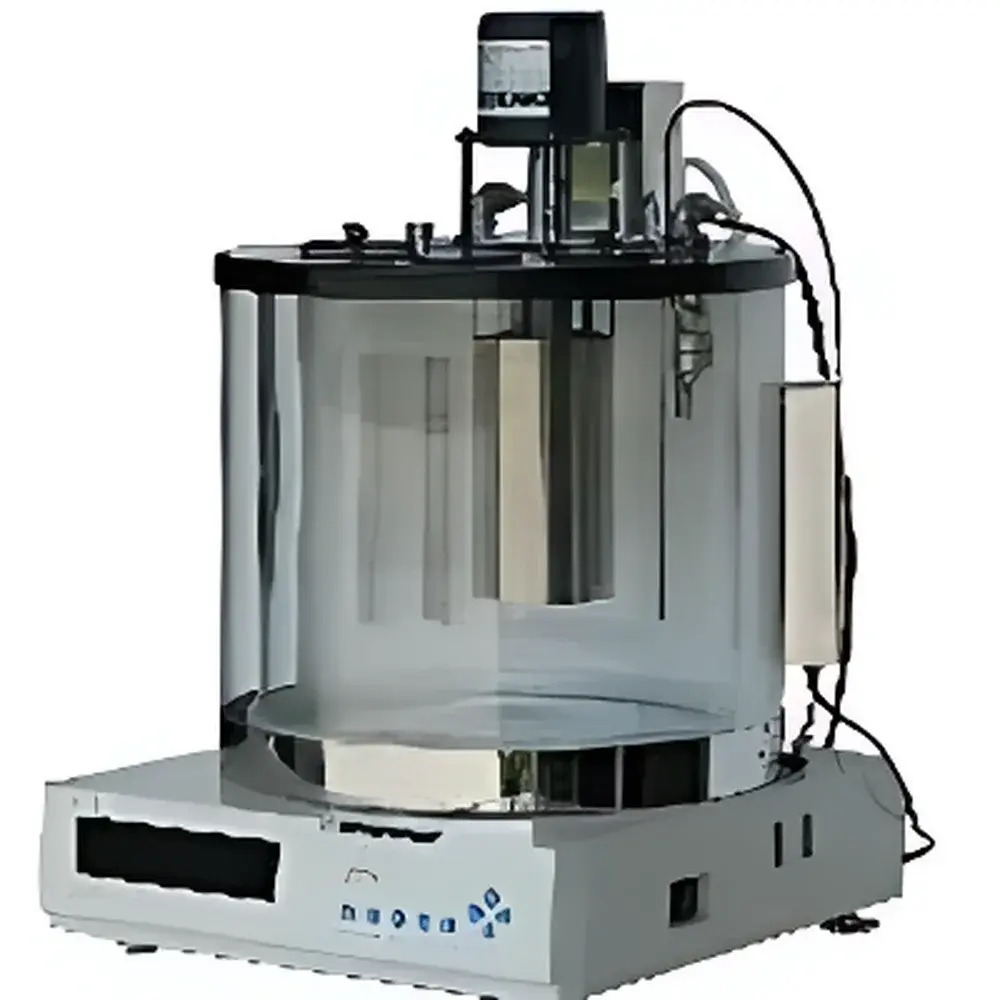
Xufeng KV-4 Kinematic Viscosity Constant-Temperature Bath
| Brand | Xufeng |
|---|---|
| Origin | Shanghai, China |
| Model | KV-4 |
| Temperature Range | 10°C to 100°C (with refrigeration) |
| Number of Test Ports | 4 |
| Temperature Stability | ±0.01°C |
| Temperature Uniformity | ±0.02°C |
| Heating Power | 1500 W |
| Bath Cylinder Dimensions | Ø300 × 300 mm (D × H) |
| Overall Dimensions | 380 × 400 × 620 mm (L × W × H) |
| Compliance | GB/T 265, ASTM D445, ISO 3104 |
Overview
The Xufeng KV-4 Kinematic Viscosity Constant-Temperature Bath is a precision-engineered thermal platform designed exclusively for standardized kinematic viscosity measurements of Newtonian petroleum liquids—primarily lubricating oils, fuel oils, base stocks, and distillates—per ASTM D445, ISO 3104, and GB/T 265. It functions as a thermostatically controlled immersion bath that maintains a highly stable and uniform temperature environment essential for capillary viscometry. The instrument does not measure viscosity directly; rather, it provides the critical thermal conditioning required for accurate timing of efflux through calibrated Ubbelohde or Cannon-Fenske (Ostwald-type) capillary viscometers. Its design centers on minimizing thermal gradients across all four test ports, ensuring reproducible efflux time acquisition—a prerequisite for calculating kinematic viscosity (ν, in mm²/s) via ν = C × t, where C is the viscometer constant and t is measured efflux time.
Key Features
- Four independent, thermally isolated test ports with individual timing channels—enabling parallel analysis of up to four samples under identical thermal conditions.
- Microprocessor-based temperature control system featuring VFD (Vacuum Fluorescent Display) interface for real-time monitoring of setpoint, actual bath temperature, and four-channel efflux timers (0.001 s resolution).
- High-stability thermal architecture delivering ±0.01°C temperature fluctuation and ±0.02°C spatial uniformity across the entire working volume—validated per ASTM D445 Annex A1 requirements for bath performance qualification.
- Comprehensive temperature calibration functionality: supports point-wise correction at nine predefined reference temperatures (e.g., 25°C, 40°C, 100°C), plus user-defined offset adjustment at any arbitrary setpoint within the operational range.
- Integrated diagnostics and safety logic: automatic detection of RTD sensor open-circuit faults and low-bath-fluid-level conditions, triggering audible alarm and on-screen fault code display.
- Non-volatile memory storage for up to 99 test records—including date/time stamp, target temperature, efflux durations per channel, and operator-assigned test ID—facilitating traceable data review prior to external export.
- Optional auto-print capability via RS-232 interface to compatible thermal or dot-matrix printers, supporting GLP-compliant hardcopy generation without manual transcription.
Sample Compatibility & Compliance
The KV-4 is validated for use with standard glass capillary viscometers conforming to ASTM D446 specifications (e.g., Cannon-Fenske Routine, Ubbelohde Dilution, and Suspended-Level types). It accommodates both transparent and opaque Newtonian fluids specified in ISO 3104, including mineral oils, synthetic lubricants, biodiesel blends (B5–B20), and hydrocarbon solvents. The bath’s thermal performance meets the stringent environmental control criteria outlined in Clause 6.2 of ASTM D445 and Clause 7.1 of ISO 3104, ensuring compliance during routine QC testing in refinery labs, third-party certification facilities, and OEM lubricant R&D centers. While the instrument itself is not FDA- or EU-IVDR-certified, its operational parameters support data integrity requirements under ISO/IEC 17025-accredited testing environments when paired with documented SOPs and periodic bath validation (e.g., using NIST-traceable thermometers and certified reference oils).
Software & Data Management
The KV-4 operates as a standalone hardware platform with embedded firmware—no PC dependency is required for core operation. All configuration, calibration, and data logging are managed locally via front-panel controls and the VFD display. Stored test records can be reviewed on-device or exported manually via serial output for integration into LIMS or Excel-based reporting workflows. For laboratories implementing 21 CFR Part 11 compliance, the unit supports audit-trail-ready documentation when used in conjunction with validated external software platforms that capture timestamped command logs and exported result files. Firmware updates (if issued) are delivered via USB-to-serial adapter and require authorized service technician intervention—ensuring configuration stability and regulatory defensibility.
Applications
- Quality control of finished lubricants per API RP 1529 and ASTM D3427.
- Batch release testing of transformer oils (IEC 60296) and turbine oils (ASTM D4310).
- Viscosity grading of SAE J300 engine oils at 100°C and 150°C (when coupled with optional external chiller).
- Research-grade characterization of bio-based hydraulic fluids under variable shear-thin conditions.
- Calibration verification of capillary viscometers using reference oils certified to ISO 12185.
- Supporting ASTM D7042 (HTHS viscosity) pre-conditioning protocols where thermal soak stability is critical.
FAQ
What capillary viscometers are compatible with the KV-4?
Standard Ubbelohde, Cannon-Fenske Routine, and Suspended-Level viscometers meeting ASTM D446 Type I–IV dimensional tolerances and calibration certificate requirements.
Does the KV-4 include a built-in chiller?
No—the unit achieves 10°C minimum temperature only when externally coupled to a recirculating chiller such as the S1-6RC or S1-20RC models; internal refrigeration is not integrated.
Can test data be exported digitally?
Yes—via RS-232 serial interface; raw ASCII-formatted output includes test ID, temperature, and four efflux times with millisecond resolution.
Is the KV-4 suitable for non-Newtonian fluid testing?
No—it is engineered strictly for Newtonian liquids per ASTM D445 scope; non-Newtonian behavior requires rotational rheometry per ASTM D4402.
How often should temperature uniformity be verified?
Per ISO/IEC 17025, verification is recommended before each shift or daily if operating continuously; use at least three calibrated NIST-traceable probes positioned at center and corners of the bath cylinder.







