
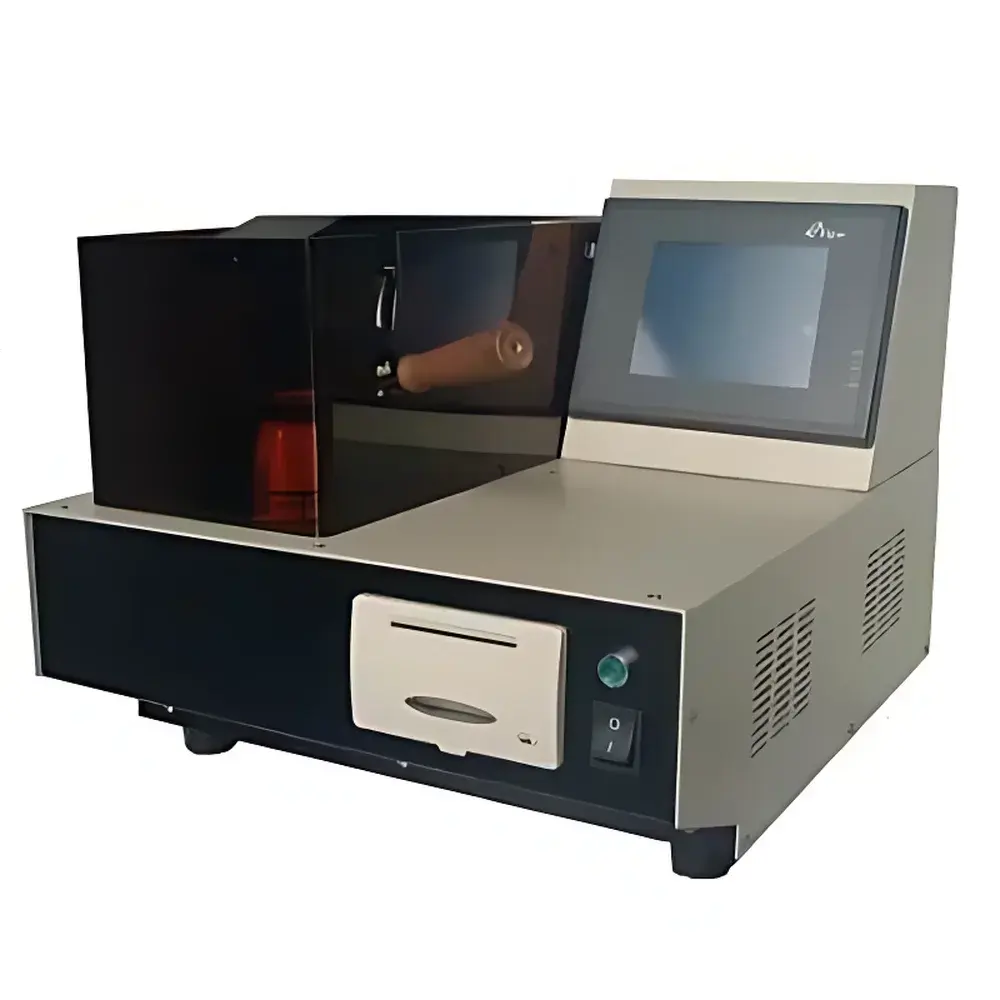
XuFeng XF-92 Automated Cleveland Open Cup Flash Point Tester
| Brand | XuFeng |
|---|---|
| Origin | Shanghai, China |
| Model | XF-92 |
| Detection Method | Open Cup (Cleveland) |
| Standards Compliance | ASTM D92, GB/T 3536-2008, GB/T 267 |
| Temperature Range | 0–400 °C |
| Control Accuracy | ±0.1 °C |
| Typical Test Range | 80–400 °C |
| Power Consumption | 2 × 800 W |
| Dimensions | 400 × 380 × 350 mm (W×D×H) |
| Weight | ~20 kg |
| Display | Full-touch LCD screen |
| Interface | RS-232C |
| Output | Integrated dot-matrix printer |
| Ignition | Automatic gas-fired or optional electronic igniter |
Overview
The XuFeng XF-92 Automated Cleveland Open Cup Flash Point Tester is a precision-engineered instrument designed for the accurate and repeatable determination of flash point and fire point of petroleum products, bituminous materials, lubricants, and other combustible liquids using the standardized Cleveland open cup method. Based on the fundamental principle of controlled heating and sequential ignition—where a test specimen is heated at a defined rate while an ignition source is periodically applied above the surface—the XF-92 delivers thermally stable, traceable results aligned with internationally recognized test protocols. Its operational foundation adheres strictly to ASTM D92 (“Standard Test Method for Flash and Fire Points by Cleveland Open Cup Tester”) and GB/T 3536-2008 (“Petroleum Products—Determination of Flash and Fire Points—Cleveland Open Cup Method”), ensuring regulatory acceptability in quality control laboratories across refining, petrochemical manufacturing, and third-party testing facilities.
Key Features
- Multi-standard programmability: User-selectable test modes for ASTM D92 and GB/T 3536, each with preconfigured heating ramps, dwell times, and ignition timing sequences to satisfy respective procedural requirements.
- Full automation: From temperature ramp initiation to automatic ignition cycle and endpoint detection via high-sensitivity thermocouple-based flame sensing, minimizing operator intervention and inter-test variability.
- Intuitive human-machine interface: A large-format full-touch LCD display provides real-time visualization of bath temperature, setpoint tracking, expected flash point, atmospheric pressure input, and diagnostic status—all accessible through logical menu navigation.
- Modular architecture: Optional expansion to multi-unit configurations (e.g., XF-2S/XF-4S parallel testing modules) enables simultaneous evaluation of identical or dissimilar samples under independent parameter sets—ideal for high-throughput QC environments.
- Robust construction: Benchtop design with full stainless-steel housing ensures mechanical stability, corrosion resistance, and long-term thermal integrity during repeated high-temperature operation.
- Integrated diagnostics & safety: Real-time self-diagnostic routines monitor heater function, sensor response, gas flow (if applicable), and ignition system performance, triggering audible/visual alerts upon anomaly detection.
- Connectivity & documentation: Standard RS-232C serial port supports bidirectional communication with LIMS or central QA servers; built-in dot-matrix printer generates hard-copy reports compliant with GLP documentation practices.
Sample Compatibility & Compliance
The XF-92 is validated for use with viscous and non-viscous petroleum derivatives—including base oils, asphalt binders, transformer oils, industrial lubricants, and heavy fuel oils—within the standard-defined viscosity limits for Cleveland open cup testing. It meets the physical and procedural specifications outlined in ASTM D92, GB/T 3536-2008, and legacy GB/T 267. While not intrinsically certified for hazardous area installation, its design incorporates fail-safe thermal cutoffs, sealed electrical compartments, and flame-retardant internal cabling. When deployed in regulated environments (e.g., ISO/IEC 17025-accredited labs or facilities subject to FDA 21 CFR Part 11), the instrument supports audit-ready data logging when paired with compliant software platforms that enforce user authentication, electronic signatures, and immutable record retention.
Software & Data Management
The XF-92 operates autonomously without embedded PC software but provides deterministic ASCII-formatted output via RS-232C, enabling seamless integration into laboratory information management systems (LIMS) or custom SCADA interfaces. All test parameters—including ambient pressure correction values, final flash point, fire point (if determined), ramp rate, and pass/fail flags—are transmitted as structured data fields. The integrated printer outputs time-stamped reports containing instrument ID, operator code (manually entered), sample ID, test standard identifier, atmospheric pressure, observed flash point (°C), and system diagnostic summary. For enhanced traceability, external software solutions may be configured to append digital signatures and generate PDF archives meeting ALCOA+ (Attributable, Legible, Contemporaneous, Original, Accurate, Complete, Consistent, Enduring, Available) principles.
Applications
This instrument serves critical roles in refinery process control (e.g., monitoring distillation cut integrity), specification conformance testing for ASTM D975 (diesel fuel), ASTM D396 (fuel oils), and ASTM D86 (distillation range), as well as compliance verification for transportation and storage regulations (e.g., UN TDG Class 3 flammability classification). It is routinely employed in R&D labs evaluating oxidative stability of biofuels, in contract testing laboratories supporting API RP 99 or ISO 8217 certification, and in municipal infrastructure departments assessing asphalt binder safety during hot-mix production. Its ability to resolve flash points up to 400 °C makes it uniquely suitable for high-boiling residuals and modified bitumens where closed-cup methods are thermally inadequate.
FAQ
Does the XF-92 require an external gas supply for ignition?
Yes—standard configuration uses a propane or butane gas source connected via supplied inlet tubing; however, an optional electronic igniter module is available for gas-free operation.
Can the instrument correct for barometric pressure automatically?
It accepts manual atmospheric pressure input prior to test initiation; no integrated barometer is included, but correction algorithms per ASTM D92 are applied internally during result calculation.
Is calibration traceable to NIST or other national standards?
The unit supports calibration using certified reference materials (e.g., NIST SRM 2620a); temperature sensors are calibrated against PT100 references with documented uncertainty budgets per ISO/IEC 17025.
What maintenance intervals are recommended for long-term reliability?
Annual verification of temperature uniformity across the cup zone and thermocouple drift assessment are advised; cleaning of the Cleveland cup and ignition nozzle after every 20 tests prevents carbon buildup and ensures reproducible flame geometry.
Can test data be exported in CSV or Excel format?
Direct export is not supported onboard, but RS-232C output can be captured by terminal emulation software (e.g., Tera Term) and parsed into spreadsheet-compatible formats using scripting or LIMS middleware.






