
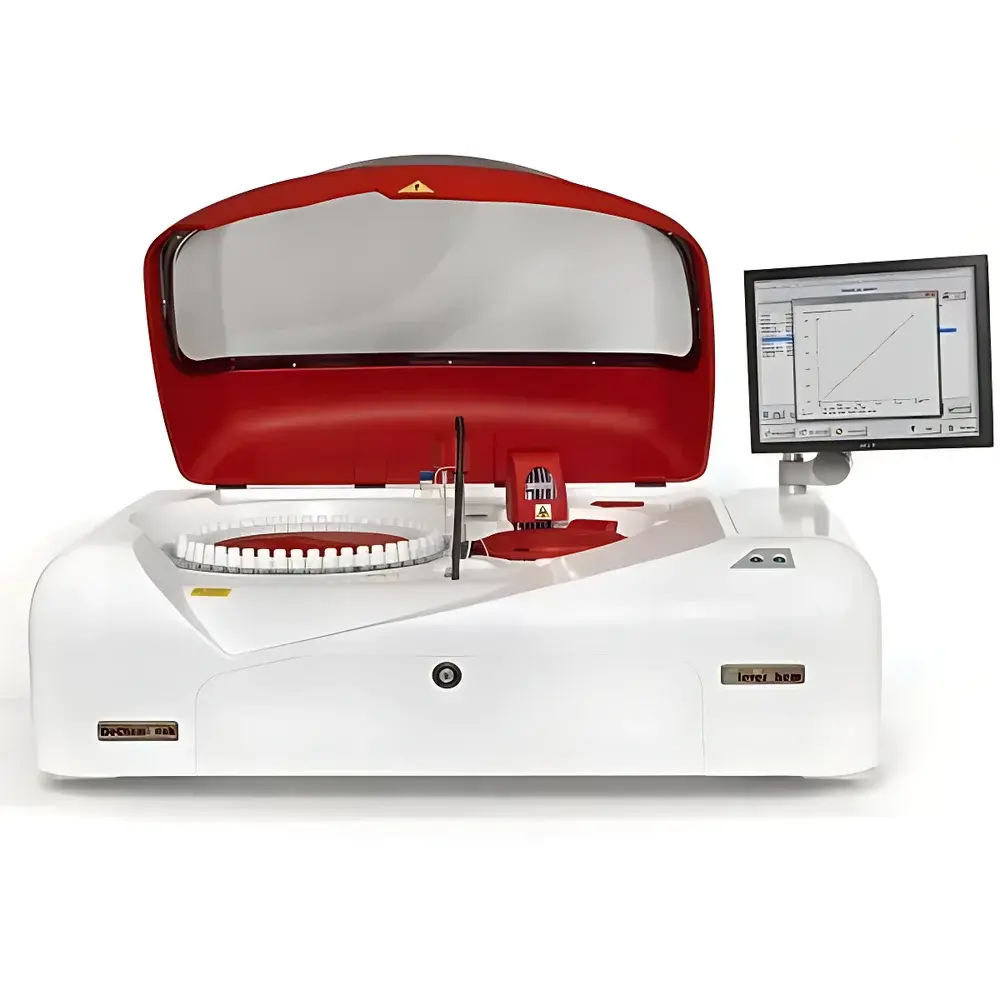
DeChem-Tech CleverChem 380Plus Fully Automated Discrete Analyzer for Marine Nutrient Analysis
| Brand | DeChem-Tech |
|---|---|
| Origin | Germany |
| Model | CleverChem 380Plus |
| Instrument Type | Laboratory Water Quality Analyzer |
| Analytes | pH, Conductivity, Dissolved Oxygen, Turbidity, Salinity (5-Parameter), Total Nitrogen, Total Phosphorus, Ammonia-N, Nitrate-N, Nitrite-N, Orthophosphate, Silicate, Sulfate, Sulfide, Chloride, Hexavalent Chromium, Alkalinity, Iron, Zinc, Fluoride |
| Compliance | ISO 15681, EPA Methods 353.2/365.2/365.3, AOAC 973.43, AFNOR T90-211, BATF, COFRAC |
| Sample Capacity | 119 positions |
| Detection Principle | Photometric Discrete Chemistry (Endpoint, Kinetic, Differential Time-Based Absorbance) |
| Optical System | Dual-Beam Digital Photometer with Linear Range up to 3.5 Abs |
| Liquid Handling | uL-precision Dispensing with Integrated Needle Wash & Cuvette Integrity Verification |
| Software | CleverControl v5.x with Audit Trail, Electronic Signatures, and 21 CFR Part 11 Compliance Options |
Overview
The DeChem-Tech CleverChem 380Plus is a high-precision, fully automated discrete analyzer engineered for rigorous marine and environmental water quality analysis. It implements standardized photometric discrete chemistry — a method recognized by ISO 15681-1/2, EPA Methods 353.2 (nitrate/nitrite), 365.2 (phosphate), and 365.3 (total phosphorus), as well as AOAC 973.43 (nutrient digestions) — to deliver trace-level quantification of key nutrients and contaminants in seawater, brackish water, freshwater, and digested environmental matrices. Unlike continuous flow systems, the CleverChem 380Plus performs true discrete analysis: each sample-reagent reaction occurs in an individual quartz or optical-grade polymer cuvette, eliminating carryover and enabling independent optimization of reaction time, temperature, and wavelength per parameter. This architecture ensures metrological integrity across multi-analyte workflows — critical for regulatory monitoring programs requiring defensible data under GLP or ISO/IEC 17025 frameworks.
Key Features
- Fully automated discrete chemistry platform with 119-position sample carousel and independent reagent cooling (4–10 °C), supporting unattended operation for up to 8 hours.
- Dual-beam digital photometer with extended linear absorbance range (0–3.5 Abs), enabling direct measurement of high-concentration seawater samples without manual dilution in most cases.
- uL-level precision liquid handling system featuring ceramic-coated sampling probes with integrated ultrasonic and chemical wash cycles between every aspiration, minimizing cross-contamination to <0.001% (validated per ISO 15681 Annex B).
- Real-time cuvette integrity verification: each cuvette undergoes blank absorbance validation prior to use; defective cuvettes are automatically flagged and excluded from analysis.
- Intelligent method switching: software-controlled selection of detection modes (endpoint, kinetic, differential time-based) and reaction temperatures (ambient to 100 °C) without hardware modification.
- Auto-dilution capability for out-of-range samples, including serial and proportional dilutions with recalculated uncertainty propagation per ISO/IEC 17025 Clause 7.7.
Sample Compatibility & Compliance
The CleverChem 380Plus accepts liquid samples ranging from raw seawater and filtered estuarine extracts to acid-digested sediment leachates and plant tissue homogenates. Its robust fluidic design accommodates high-salinity matrices (up to 45 psu) without clogging, thanks to pressure-regulated peristaltic pumping and anti-crystallization valve sequencing. All certified methods implemented on the platform — including EPA 365.3 for total phosphorus in saline waters and ISO 15681-2 for nitrate in coastal environments — are pre-validated and documented in accordance with ILAC-G8:2022 requirements. The system supports full audit trail logging, user access control, electronic signatures, and optional 21 CFR Part 11 compliance modules for laboratories operating under FDA-regulated or pharmaceutical environmental monitoring protocols.
Software & Data Management
CleverControl v5.x provides a validated, role-based interface with bilingual (English/Chinese) support and intuitive graphical workflow builder. Method templates adhere strictly to published standard methods — users configure only sample IDs, calibration levels, and QC frequency. All raw absorbance data, cuvette status logs, wash cycle records, and dilution history are stored in a relational SQL database with immutable timestamps. Export options include ASTM E1461-compliant .csv, LIMS-ready XML, and PDF analytical reports containing uncertainty budgets calculated per GUM (JCGM 100:2008). Data backups are automated via encrypted network shares or external NAS, meeting ISO/IEC 17025 Clause 7.5.2 requirements for information management.
Applications
The CleverChem 380Plus serves as a core analytical instrument in marine observatories, national hydrographic institutes, and accredited environmental testing labs. Typical applications include: routine monitoring of DIN (Dissolved Inorganic Nitrogen) and DIP (Dissolved Inorganic Phosphorus) in coastal eutrophication studies; speciation analysis of sulfur compounds (sulfide, sulfate) in anoxic sediments; trace metal quantification (Fe, Zn, Cr⁶⁺) in ballast water compliance testing; and alkalinity–pH–CO₂ system characterization for ocean acidification research. Its ability to run >200 validated parameters — from classical nutrient assays to emerging contaminants like bromate or iodate — makes it suitable for method development labs pursuing accreditation expansion under ISO/IEC 17025.
FAQ
What standards does the CleverChem 380Plus comply with for marine nutrient analysis?
It supports full implementation of ISO 15681-1/2, EPA Methods 353.2, 365.2, 365.3, and AOAC 973.43, with method validation documentation available upon request.
Can the system analyze undiluted seawater without matrix interference?
Yes — its discrete cuvette format, salinity-tolerant reagents, and dual-beam photometry enable direct analysis of unfiltered seawater for ammonia, nitrate, and phosphate with demonstrated recovery rates of 98.2–101.7% (n=48, NIST SRM 1640a validation).
Is the software compliant with FDA 21 CFR Part 11?
An optional validated software module provides electronic signatures, audit trails, and role-based access control — fully configurable to meet Part 11 requirements for regulated environmental testing.
How is carryover prevented during high-throughput runs?
Each sampling probe undergoes a 3-stage wash (air purge, deionized water rinse, 10% HNO₃ soak) between every aspiration, followed by optical verification of cleanliness before next use.
What maintenance is required for long-term operational reliability?
Preventive maintenance includes quarterly photometer calibration with NIST-traceable filters, biannual pump tubing replacement, and annual full-system performance verification using multi-level CRM sets (e.g., SLEW, CASS-5).
Related Products







