SonTek RS5® Acoustic Doppler Current Profiler (ADCP) for Riverine and Open-Channel Flow Measurement
| Brand | SonTek |
|---|---|
| Origin | USA |
| Model | RS5® |
| Measurement Principle | Acoustic Doppler Velocimetry |
| Product Type | River ADCP System |
| Compliance | ASTM D5389, ISO 748, USGS TWRI 3-A12, EPA Method 160.1 |
| Data Output Formats | Excel (.xlsx), MATLAB (.mat), KML/KMZ (Google Earth), CSV |
| Software Platform | RSQ v5.x with SmartPulse+ Processing Engine |
| Deployment Options | Boat-mounted, Cable-suspended, rQPOD Remote-Controlled Floating Platform |
| Beam Configuration | 4-beam Janus, optional 3-beam switching for bank interference mitigation |
| Velocity Range | ±15 m/s (user-configurable), Resolution: 1 mm/s |
| Cell Size | 0.1–2.0 m (adjustable) |
| Maximum Profiling Depth | 50 m (dependent on frequency & water conditions) |
| Operating Frequency | 1500 kHz (standard), optional 600/300 kHz for deeper profiling |
Overview
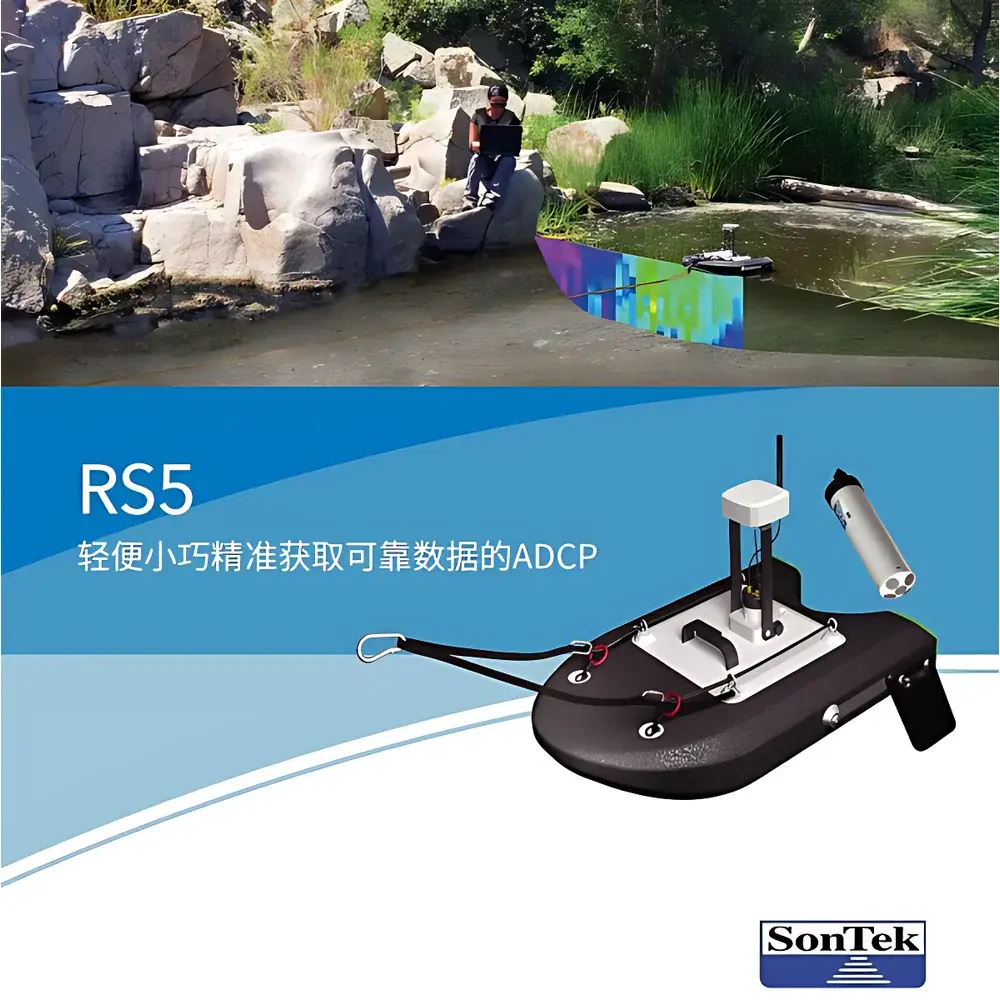
The SonTek RS5® is a high-precision, river-optimized Acoustic Doppler Current Profiler engineered for rigorous open-channel flow measurement in natural rivers, canals, irrigation ditches, and regulated waterways. Utilizing broadband acoustic Doppler velocimetry with a 4-beam Janus transducer array, the RS5® resolves three-dimensional water velocity profiles across the entire cross-section with millimeter-per-second resolution and sub-degree heading stability. Its measurement architecture adheres to internationally recognized hydrometric standards—including ASTM D5389 (Standard Practice for Measurement of Discharge Using Acoustic Doppler Current Profilers), ISO 748 (Liquid flow measurement in open channels), and USGS Techniques of Water-Resources Investigations (TWRI) Book 3, Chapter A12—ensuring data integrity for regulatory reporting, hydraulic modeling, and long-term watershed monitoring.
Key Features
- SmartPulse+ Adaptive Signal Processing: Dynamically optimizes pulse coding, blanking distance, and ensemble averaging in real time to enhance signal-to-noise ratio in turbid, aerated, or low-SNR environments—critical for shallow, fast-moving, or sediment-laden flows.
- RSQ v5.x Software Suite: An integrated, audit-ready desktop application supporting full workflow automation—from field setup and real-time QA/QC to post-processed discharge computation per ISO 748 Annex B and USGS guidelines. Includes built-in uncertainty estimation (Type A/B) and traceable metadata logging.
- Flexible Deployment Configurations: Compatible with vessel-mount, cable-carriage, and the rQPOD remote-controlled floating platform (featuring Torrent Board hull and integrated motorized steering)—enabling safe, repeatable measurements in hazardous, inaccessible, or ecologically sensitive reaches.
- Bank Interference Mitigation: Optional 3-beam switching mode automatically excludes bottom-track beams affected by vertical bank reflections, preserving velocity accuracy near channel margins without manual reprocessing.
- Comprehensive Data Export & Interoperability: Native export to Excel (.xlsx), MATLAB (.mat), KML/KMZ (for Google Earth visualization), and CSV; supports direct ingestion into HEC-RAS, MIKE HYDRO, and ArcGIS via standardized metadata schemas.
- Robust Field Data Management: Onboard storage with configurable file naming, segment-based cross-section processing, automated Extrap application for surface/bed extrapolation, and seamless import of legacy RSL *.riv / *.rivr files.
Sample Compatibility & Compliance
The RS5® is validated for use in freshwater and brackish environments with conductivity up to 10 mS/cm and suspended sediment concentrations ≤ 5,000 mg/L. It meets GLP-compliant data handling requirements through RSQ’s embedded audit trail (user actions, parameter changes, calibration events), timestamped with GPS-synchronized UTC, and exportable as PDF reports with digital signatures. All firmware and software versions are documented per FDA 21 CFR Part 11 readiness guidelines, supporting electronic record retention for environmental agencies and utility compliance programs.
Software & Data Management
RSQ v5.x implements a structured project-based workflow: each measurement file encapsulates raw ADCP data, GNSS position logs, depth sounder outputs, water temperature, battery voltage, and operator annotations—all stored in a single self-contained container. The “Demo Mode” enables offline replay of field sessions with synchronized video overlays and real-time parameter adjustment—ideal for staff training, peer review, or regulatory presentations. Data archiving supports network-attached storage (NAS), encrypted external SSDs, or cloud-synced repositories with version control. Metadata conforms to ISO 19115-2 for geospatial interoperability and EPA WQX schema alignment.
Applications
- Regulatory discharge reporting under Clean Water Act Section 402/404 permits
- Hydrologic model calibration (e.g., HEC-RAS, SWMM) and validation
- Reservoir inflow/outflow monitoring and sediment transport assessment
- Flood forecasting system integration with real-time telemetry (via optional NMEA 0183/2000 or Modbus TCP)
- Ecological flow studies requiring high-temporal-resolution velocity mapping
- Infrastructure impact assessments (e.g., bridge scour, dam bypass flows, intake efficiency)
FAQ
Does the RS5® require annual factory recalibration?
No—SonTek RS5® units are factory-calibrated using NIST-traceable acoustic test tanks and hydrodynamic flow loops. Field verification using static water tests and known-velocity tow tanks is recommended per ISO 748 Clause 8.2 before critical surveys.
Can RSQ process data from older SonTek models (e.g., RiverSurveyor M9/S5)?
Yes—RSQ v5.x maintains backward compatibility with all *.riv, *.rivr, and *.adcp files generated by RiverSurveyor-class instruments since 2012, including automatic conversion of legacy coordinate systems and beam geometry corrections.
Is the rQPOD system compatible with third-party GNSS receivers?
Yes—the RS5® accepts external RTK-GNSS input via NMEA 0183 (GGA, VTG, GSA) over RS-232 or USB-C, enabling integration with Trimble, Leica, or Emlid receivers for <2 cm horizontal positioning accuracy.
How does SmartPulse+ improve performance in aerated flows?
By deploying adaptive pulse compression and multi-lag autocorrelation, SmartPulse+ extends effective correlation length under bubble-induced signal attenuation—reducing velocity noise by up to 40% compared to conventional narrowband ADCPs in plunging or weirs-associated flows.
What cybersecurity protocols are implemented in RSQ for network-connected deployments?
RSQ operates as a local client-server application with no outbound telemetry by default. When deployed on enterprise networks, it supports Windows Group Policy enforcement, TLS 1.2+ encrypted data export, and role-based access control (RBAC) for multi-user labs managing shared instrument fleets.