
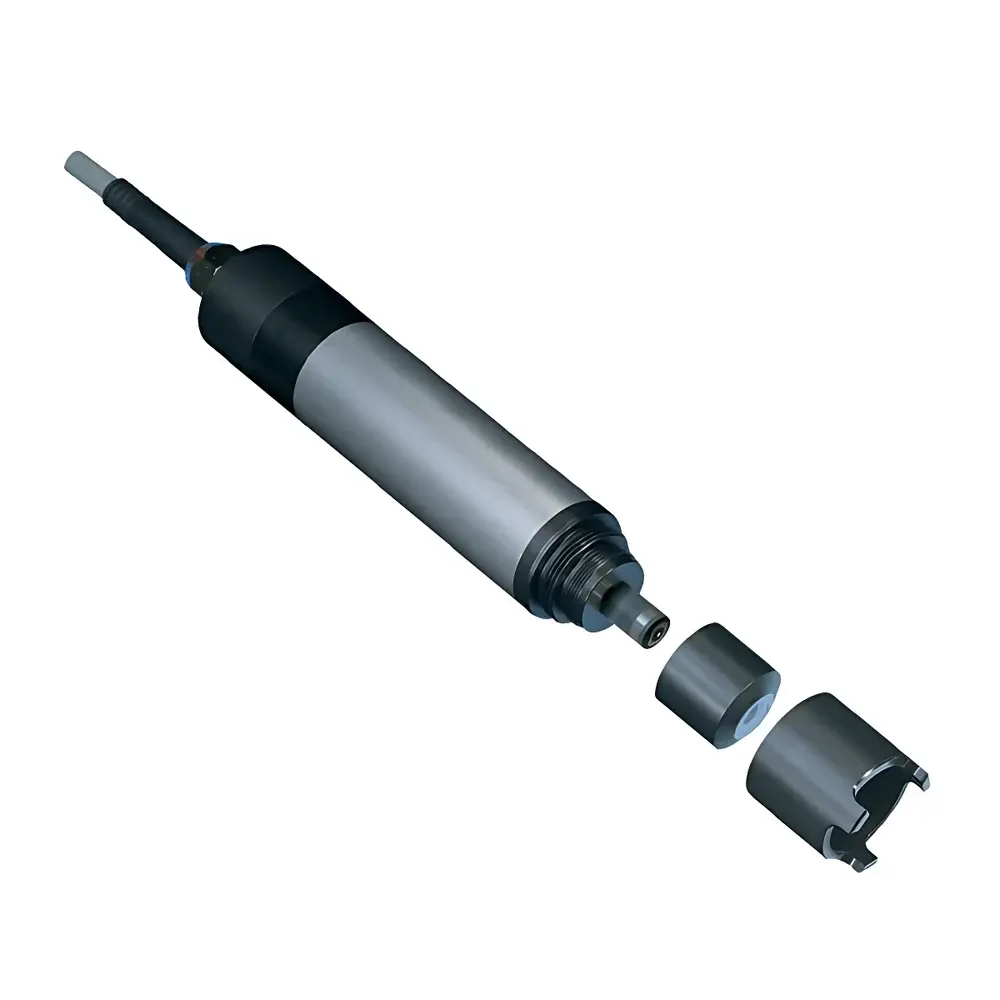
WTW TriOxmatic Electrochemical Dissolved Oxygen Sensor
| Brand | WTW |
|---|---|
| Origin | Germany |
| Model | TriOxmatic |
| Instrument Type | Online Water Quality Analyzer |
| Measured Parameter | Dissolved Oxygen (DO) |
| O₂ Concentration Ranges | 0.0–60.0 mg/L (TriOxmatic® 700 IQ), 0.00–20.00 mg/L (701 IQ), 0.001–2.000 mg/L (702 IQ) |
| O₂ Saturation Ranges | 0–600 %, 0.0–200.0 %, 0–110 % |
| Resolution | 0.1 mg/L / 0.01 mg/L / 0.001 mg/L |
| Response Time (t₉₀) | 180 s (700 IQ), 30 s (701/702 IQ) |
| Minimum Flow Rate | 0.05–0.3 m/s |
| Temperature Compensation | Integrated NTC, –5 to +60 °C |
| Accuracy | ±0.1 mg/L or ±1% of reading |
| Electrode Materials | Stainless Steel 316, Titanium, POM (for seawater) |
| Max. Pressure Rating | 10 bar (standard), 1 bar (F-type) |
| Power Consumption | 0.2 W |
| Diagnostics | SensReg (electrolyte depletion alarm), SensLeck (membrane breach detection) |
Overview
The WTW TriOxmatic series represents a line of electrochemical dissolved oxygen (DO) sensors engineered for continuous, high-reliability online water quality monitoring in demanding industrial and environmental applications. Based on the Clark-type polarographic principle, each TriOxmatic sensor employs a three-electrode system — comprising a gold working electrode (A), a silver/silver chloride reference electrode (R), and an auxiliary counter electrode — operating under a precisely controlled constant potential. This design eliminates polarization of the reference electrode, significantly improving long-term signal stability and measurement reproducibility. Unlike amperometric sensors relying on diffusion-limited current alone, the TriOxmatic architecture ensures robust performance across variable flow conditions and temperature gradients, making it suitable for both wastewater treatment bioreactors and ultra-pure water systems where trace-level DO control is critical.
Key Features
- Three-electrode polarographic configuration with active potential control for minimized drift and enhanced electrochemical stability
- Integrated high-performance SMD前置 amplifier enabling noise-immune analog signal transmission over distances up to 100 meters without signal degradation
- Long service life (>5 years theoretical) due to low electrolyte consumption and large internal reservoir volume
- Patented Teflon-based gas-permeable membrane offering exceptional resistance to fouling, biofilm adhesion, and chemical contamination — eliminating routine cleaning requirements in most applications
- Modular, field-replaceable membrane cap and electrolyte cartridge for rapid maintenance with minimal downtime
- Real-time diagnostic functions including SensReg (electrolyte level monitoring) and SensLeck (membrane integrity verification), supporting predictive maintenance and GLP-compliant recordkeeping
- Pressure-rated housing (up to 10 bar) and corrosion-resistant materials (316 stainless steel, titanium, POM for seawater variants) ensuring durability in aggressive media
Sample Compatibility & Compliance
The TriOxmatic sensor family is validated for use across diverse aqueous matrices, including activated sludge effluent, raw and treated municipal wastewater, boiler feedwater, ultrapure water (UPW), and seawater (SW). Its low-flow operation capability (minimum 0.05 m/s for 700 IQ) supports installation in low-velocity pipelines and open-channel applications. All models comply with ISO 5814:2012 (Water quality — Determination of dissolved oxygen — Electrochemical probe method) and meet functional requirements outlined in ASTM D888 and EN 25814. The integrated diagnostics and stable zero-point behavior support adherence to regulatory data integrity standards, including FDA 21 CFR Part 11 when paired with compatible WTW IQ Sensor Systems or third-party SCADA platforms configured for audit-trail logging.
Software & Data Management
TriOxmatic sensors interface seamlessly with WTW’s IQ SensorNet platform, enabling centralized configuration, calibration tracking, diagnostic reporting, and real-time DO trend visualization. Firmware updates, sensor identification, and calibration history are stored locally within the sensor’s EEPROM, ensuring traceability independent of host system uptime. When integrated into automated process control loops — such as aeration optimization in biological nutrient removal (BNR) plants — the sensor delivers stable, low-drift analog (4–20 mA) or digital (Modbus RTU/ASCII) outputs compliant with IEC 61131-3 PLC environments. Data export formats (CSV, XML) facilitate integration with LIMS and enterprise asset management (EAM) systems for QA/QC documentation and regulatory reporting.
Applications
- Real-time DO monitoring and feedback control in aerobic bioreactors and oxidation ditches
- Trace-level DO surveillance in high-purity steam generation circuits and pharmaceutical water-for-injection (WFI) systems
- Process safety monitoring in deaerator outlets and condensate return lines
- Environmental compliance reporting for discharge permits requiring continuous DO records
- Seawater aquaculture and desalination pretreatment monitoring
- Research-grade dissolved oxygen profiling in limnological and marine studies
FAQ
What is the recommended calibration frequency for TriOxmatic sensors in continuous operation?
Calibration interval depends on application severity; WTW recommends initial 24-hour stabilization followed by zero/span verification every 7–30 days in municipal wastewater, and monthly in UPW or boiler feedwater applications. Automatic calibration routines are supported via IQ SensorNet.
Can TriOxmatic sensors be used in seawater without special preparation?
Yes — the TriOxmatic® 700 IQ (SW) variant features titanium housing and POM components specifically engineered for chloride resistance and biofouling mitigation in marine environments.
Does the sensor require flow compensation during measurement?
While not strictly required, maintaining minimum flow velocity (0.05–0.3 m/s depending on model) is essential to ensure consistent diffusion-layer thickness and avoid boundary-layer stagnation artifacts.
How does the SensLeck diagnostic function detect membrane damage?
SensLeck continuously monitors baseline current deviation and electrolyte conductivity anomalies, triggering an alarm when membrane breach or seal failure compromises the oxygen diffusion path.
Is temperature compensation fully automatic?
Yes — all models incorporate a built-in NTC thermistor calibrated to ±0.2 °C accuracy across –5 to +60 °C, enabling real-time, algorithmic compensation of oxygen solubility and diffusion rate per ISO 5814 Annex B.







