
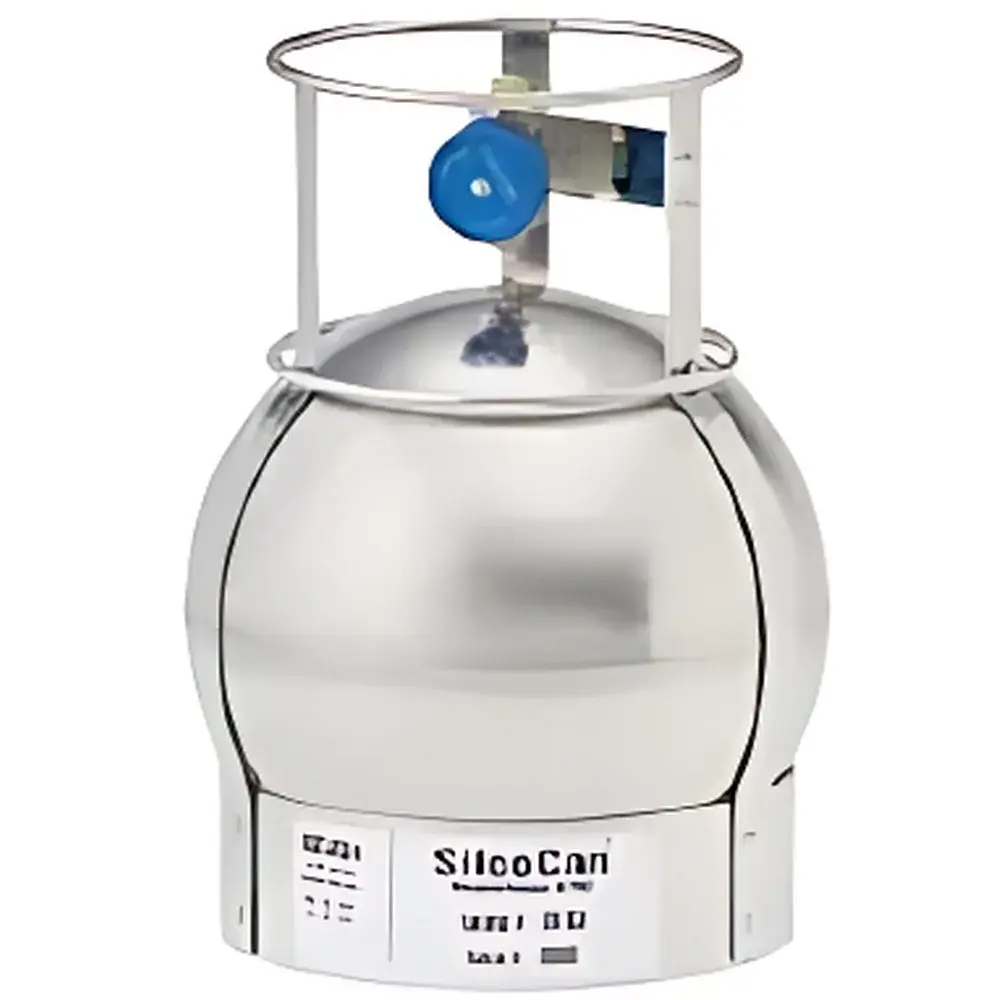
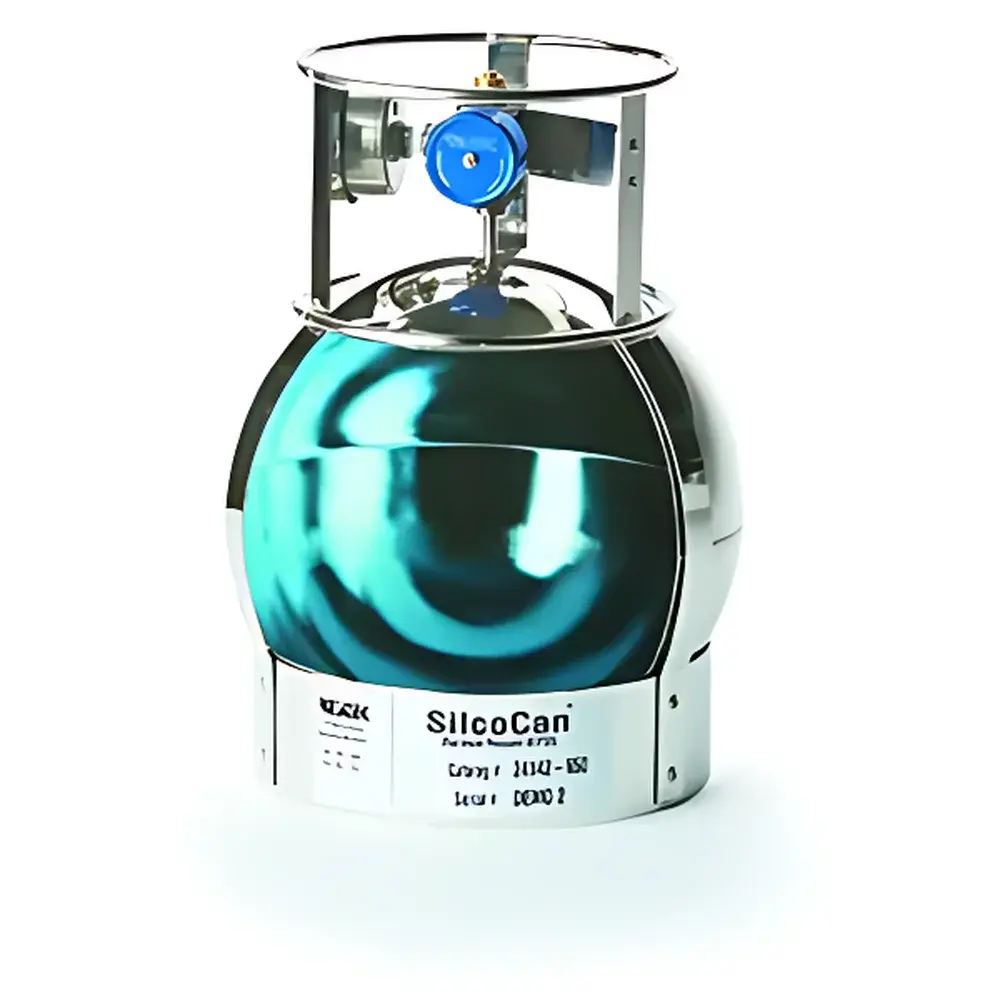
Restek SilcoCan Sulfur-Resistant Air Sampling Canister
| Brand | Restek |
|---|---|
| Origin | USA |
| Model | SilcoCan |
| Capacity Options | 1 L, 3 L, 6 L, 15 L |
| Surface Treatment | Siltek®-coated interior and all wetted surfaces |
| Valve Options | Parker diaphragm valve (standard or Siltek®-treated), with or without integrated pressure gauge |
| Compliance | Designed for EPA TO-14A and TO-15 compliance |
| Application Focus | Ultra-trace sulfur compound sampling (1–20 ppb) |
Overview
The Restek SilcoCan Sulfur-Resistant Air Sampling Canister is an engineered solution for the quantitative collection, stabilization, and transport of ultra-low-concentration volatile sulfur compounds (VSCs) — including hydrogen sulfide (H₂S), carbonyl sulfide (OCS), methyl mercaptan (CH₃SH), dimethyl sulfide (DMS), and other reactive sulfur species — from ambient air, stack emissions, and fugitive sources. Unlike conventional electropolished stainless-steel canisters, the SilcoCan features a proprietary Siltek® deactivation coating applied uniformly to the interior surface of the canister body and all internal wetted components (e.g., valve seats, stems, and diaphragms). This chemically inert, silicon-based passivation layer eliminates catalytic adsorption, surface oxidation, and irreversible binding commonly observed with sulfur-containing analytes — thereby preserving sample integrity over extended storage periods (up to 30 days at ambient temperature, per EPA validation studies). The device operates on passive, pressure-driven sampling principles and is fully compatible with standard canister-based analytical workflows, including automated thermal desorption (ATD) coupled to gas chromatography–pulsed flame photometric detection (GC–PFPD) or GC–mass spectrometry (GC–MS).
Key Features
- Siltek®-coated interior and all wetted surfaces — proven to reduce sulfur loss by >95% compared to standard electropolished canisters in 1–20 ppb concentration ranges
- Available in four standardized volumes: 1 L, 3 L, 6 L, and 15 L — enabling flexible sampling duration and sensitivity optimization across regulatory and research applications
- Multiple valve configurations: Parker diaphragm valves (standard or Siltek®-treated), optionally integrated with calibrated analog pressure gauges for real-time fill verification
- Trace-metal-free construction using low-outgassing, high-purity 316L stainless steel — certified to meet ASTM D5504 and EPA Method TO-15 material compatibility requirements
- No internal welds or crevices in the flow path — minimizing dead volume and enhancing quantitative recovery during thermal desorption
- Validated for use in EPA-compliant ambient monitoring networks, landfill gas characterization, refinery perimeter monitoring, and odor investigation protocols
Sample Compatibility & Compliance
The SilcoCan is specifically validated for stability-critical sulfur analytes under EPA TO-14A (determination of volatile organic compounds in ambient air using specially prepared canisters) and TO-15 (determination of volatile organic compounds in air collected in specially prepared canisters and analyzed by gas chromatography/mass spectrometry). Its Siltek® surface meets the stringent inertness criteria outlined in ASTM D6196-22 (Standard Practice for Selecting Air Monitoring Methods for Volatile Organic Compounds) for reactive species. All units are supplied with individual certification documents confirming residual sulfur reactivity testing (via spiked recovery studies at ≤5 ppb levels), helium leak rate <1×10⁻⁸ atm·cm³/s, and vacuum integrity verified to <10 mtorr after 24-hour hold. The canisters support GLP-compliant field deployment when used with documented chain-of-custody procedures and calibrated pressure verification logs.
Software & Data Management
While the SilcoCan itself is a passive hardware component, its integration into regulated environmental data workflows relies on interoperability with industry-standard laboratory information management systems (LIMS) and electronic field data capture platforms. Each canister is assigned a unique serial number traceable to its surface treatment batch and pressure-test record. When paired with Restek’s CanisterLog™ companion software (sold separately), users can digitally log fill times, ambient conditions, operator IDs, and valve configuration metadata — generating audit-ready PDF reports compliant with 21 CFR Part 11 requirements for electronic records and signatures. Raw GC–PFPD/MS chromatographic data generated from SilcoCan samples retains full traceability to the physical canister via embedded LIMS sample IDs and instrument method parameters.
Applications
- Ambient air monitoring for odorant sulfur compounds near wastewater treatment plants, composting facilities, and pulp/paper mills
- Fugitive emission screening at petrochemical sites using summa canister grab sampling and subsequent lab analysis
- Method validation and reference standard preparation for sulfur-species calibration gases
- Long-term stability studies of VSCs under varying humidity and temperature conditions
- Regulatory compliance reporting under Clean Air Act Subpart OOOO (Quad O) and state-level odor control ordinances
- Research on atmospheric sulfur cycling and secondary particulate formation mechanisms
FAQ
What sulfur compounds are most effectively preserved using the SilcoCan?
Hydrogen sulfide (H₂S), carbonyl sulfide (OCS), methyl mercaptan (CH₃SH), ethyl mercaptan (C₂H₅SH), dimethyl sulfide (DMS), and dimethyl disulfide (DMDS) — particularly in the 1–20 ppb range.
Is Siltek® coating compatible with humid or high-moisture air samples?
Yes. Siltek® demonstrates stable performance at relative humidity levels up to 80% when sampled at ambient temperatures; however, condensation inside the canister must be avoided via proper field handling and dew-point control.
Can SilcoCan canisters be reused?
Yes — provided they undergo full evacuation (<10 mtorr), bake-out at 150°C for ≥2 hours, and post-bake spike recovery verification per EPA TO-15 Appendix B protocols.
Do I need special thermal desorption parameters when analyzing SilcoCan samples?
No. Standard TO-15 ATD methods apply; however, cold trap focusing at −30°C is recommended to maximize recovery of highly volatile sulfur species such as H₂S.
Are pressure gauges factory-calibrated?
Yes. Integrated analog pressure gauges are NIST-traceably calibrated prior to shipment and include a certificate of calibration valid for 12 months.







