
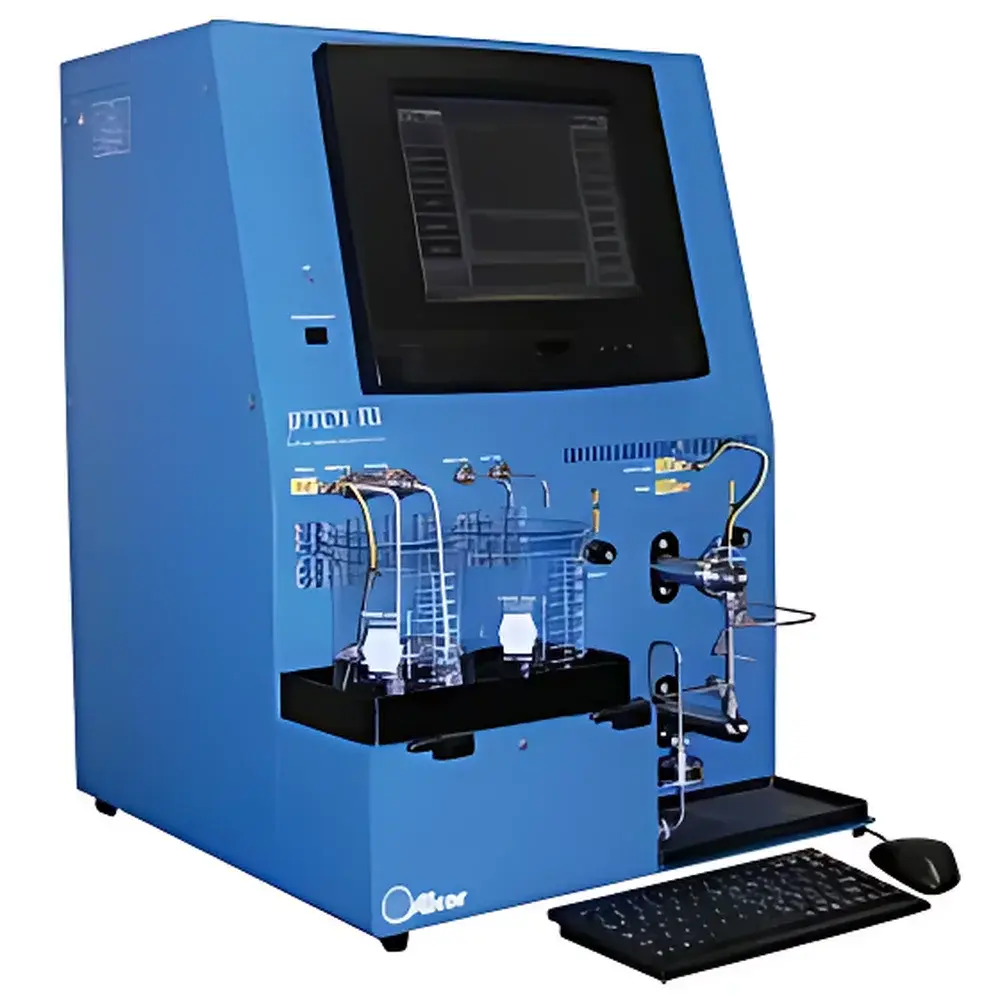
EMCEE JFTOT MARKIII Jet Fuel Thermal Oxidation Tester
| Brand | EMCEE |
|---|---|
| Origin | USA |
| Model | JFTOT MARKIII |
| Compliance | ASTM D3241, GB/T 9169 |
| Consumables | Heating Rod & MNKJG0605 Filter Assembly |
| Supply Channel | Authorized Distributor |
Overview
The EMCEE JFTOT MARKIII Jet Fuel Thermal Oxidation Tester is a precision-engineered benchtop instrument designed to evaluate the thermal oxidative stability of aviation turbine fuels under controlled, accelerated conditions. It operates on the principle of forced-flow, high-temperature fuel exposure in a heated stainless-steel tube—mimicking the critical heat-soak conditions encountered in aircraft fuel systems, particularly near engine fuel nozzles and heat exchangers. The test method—standardized as ASTM D3241 “Standard Test Method for Thermal Oxidation Stability of Aviation Turbine Fuels” and equivalently adopted as GB/T 9169 in China—quantifies fuel degradation by measuring the amount and morphology of insoluble deposits formed on a standardized heated rod surface after a defined exposure period (typically 150 minutes at 260 °C). This measurement serves as a key indicator of a fuel’s propensity to form carbonaceous deposits that may impair fuel system operability, restrict flow, or compromise combustion efficiency.
Key Features
- Temperature-controlled quartz-lined heating tube with precise PID regulation, maintaining ±1 °C stability at setpoints up to 260 °C
- Integrated thermocouple monitoring at multiple axial positions along the heated zone for real-time thermal profile validation
- Automated flow control system delivering consistent fuel throughput (typically 20 mL/min) via calibrated capillary tubing and back-pressure regulation
- Stainless-steel heating rod assembly (ASTM-specified geometry and surface finish) with reproducible insertion depth and orientation
- Modular filter housing compatible with MNKJG0605 certified glass-fiber filter discs (0.8 µm pore size), enabling quantitative gravimetric deposit analysis
- Robust mechanical architecture with corrosion-resistant components and CE-compliant electrical safety design
Sample Compatibility & Compliance
The JFTOT MARKIII is validated for use with all standard aviation turbine fuels, including Jet A, Jet A-1, JP-5, and JP-8, as well as synthetic hydrocarbon blends (e.g., Fischer–Tropsch derived fuels) and hydrotreated esters and fatty acids (HEFA) blends up to 50% v/v. All operational parameters—including temperature ramp rate, hold time, fuel flow rate, and rod exposure geometry—strictly adhere to the procedural requirements of ASTM D3241 and GB/T 9169. Instrument calibration and performance verification are traceable to NIST-certified reference materials and documented per ISO/IEC 17025 guidelines. Routine operation supports GLP-compliant data integrity when paired with audit-trail-enabled software (see Software & Data Management section).
Software & Data Management
While the JFTOT MARKIII operates as a standalone hardware platform, it integrates seamlessly with optional EMCEE DataLink™ software (v3.2+), which provides full instrument control, real-time parameter logging (temperature, pressure, flow), and automated report generation compliant with FDA 21 CFR Part 11 requirements. The software enforces user role-based access control, electronic signatures, and immutable audit trails for all test runs, calibration events, and method modifications. Raw data files are stored in vendor-neutral CSV and XML formats, facilitating import into LIMS environments or third-party statistical analysis tools such as JMP or Minitab. All firmware updates and calibration certificates are digitally signed and version-controlled.
Applications
- Quality assurance testing of refinery-produced jet fuel prior to release and certification
- Formulation screening for antioxidant additives (e.g., hindered phenols, aromatic amines) and metal deactivators
- Compatibility assessment of bio-derived blendstocks under thermal stress conditions
- Root-cause investigation of field-reported fuel system fouling incidents
- Regulatory compliance verification for military and civil aviation fuel procurement specifications (e.g., MIL-DTL-83133, DEF STAN 91-91)
- Research into oxidation kinetics and deposit formation mechanisms using coupled FTIR or SEM-EDS post-test analysis of recovered rods and filters
FAQ
What is the required sample volume per test?
A minimum of 150 mL of conditioned, particulate-free fuel is required to complete one full ASTM D3241 cycle.
Is the MNKJG0605 filter assembly certified for regulatory submissions?
Yes—the MNKJG0605 filter disc assembly is manufactured to ASTM D3241 Annex A2 specifications and supplied with individual lot-specific certificate of conformance.
Can the JFTOT MARKIII be used for diesel or marine fuel testing?
No—it is specifically engineered and validated for aviation turbine fuels per ASTM D3241; alternative methods (e.g., ASTM D2274 or D6445) apply to distillate fuels.
How often must the heating rod be replaced?
Heating rods are single-use per test per ASTM D3241; reuse invalidates compliance and introduces cross-contamination risk.
Does EMCEE provide installation qualification (IQ) and operational qualification (OQ) documentation?
Yes—comprehensive IQ/OQ protocols, including temperature mapping reports and flow calibration records, are available upon request and support GMP-aligned laboratory validation processes.






