
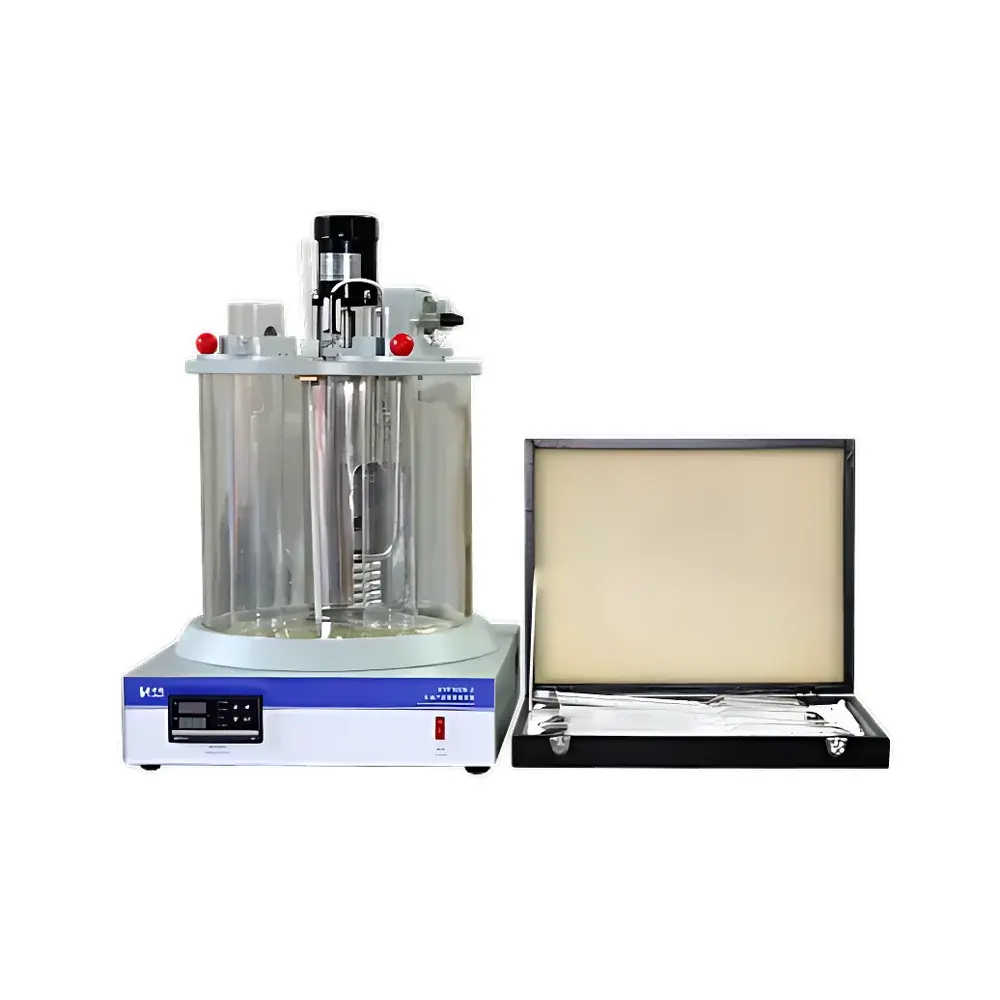
Shenkai SYP1026-II Petroleum Product Density Tester
| Brand | Shenkai |
|---|---|
| Origin | Shanghai, China |
| Model | SYP1026-II |
| Application Standard | ASTM D1298, ISO 3675, GB/T 1884 |
| Temperature Range | 15–100 °C (with optional chiller) |
| Temperature Stability | ±0.2 °C |
| Bath Capacity | Φ300 × 300 mm |
| Density Measurement Method | Glass Hydrometer Immersion (20 °C Reference) |
| Bath Stirring | 15 W Motor, 1250 rpm, Φ50 mm Impeller |
| Thermometer Accuracy | ±0.1 °C (calibrated traceable to NIM), 0.2 °C Graduation |
| Power Supply | 220 VAC ±10%, 50 Hz |
| Heating Power | 800 W |
| Cylinder Volume | 500 mL |
Overview
The Shenkai SYP1026-II Petroleum Product Density Tester is a precision-engineered laboratory instrument designed for the gravimetric determination of density in liquid petroleum products and related hydrocarbon mixtures at the standard reference temperature of 20 °C. It operates in strict compliance with internationally recognized test methods—including ASTM D1298 (Standard Test Method for Density, Relative Density (Specific Gravity), or API Gravity of Crude Petroleum and Liquid Petroleum Products by Hydrometer Method), ISO 3675 (Crude Petroleum and Liquid Petroleum Products — Laboratory Determination of Density — Hydrometer Method), and GB/T 1884 (Laboratory Determination of Density of Crude Oil and Liquid Petroleum Products—Hydrometer Method). The system utilizes calibrated glass hydrometers immersed in thermally stabilized samples within a dual-station constant-temperature bath. Its measurement principle relies on Archimedean buoyancy: the depth of immersion of a standardized hydrometer correlates directly with the sample’s density under controlled thermal equilibrium conditions. This method remains the primary reference technique for custody transfer, quality control, and regulatory reporting across upstream, midstream, and downstream petroleum operations.
Key Features
- Dual independent test stations enabling simultaneous density determinations of two samples—enhancing throughput without compromising thermal uniformity or measurement integrity.
- Intelligent PID-based temperature controller with rapid thermal response (<15 min to stabilize at 20 °C from ambient) and high stability (±0.2 °C over 30 min), verified per ASTM E77 and ISO/IEC 17025 calibration protocols.
- Stainless-steel insulated bath vessel (Φ300 × 300 mm) with integrated axial stirring system: 15 W brushless motor driving a Φ50 mm impeller at 1250 rpm to ensure homogeneous temperature distribution and eliminate thermal stratification.
- Optional refrigeration module extends operational range to 15–100 °C, supporting low-temperature density evaluation for waxy crudes or high-viscosity distillates per ASTM D4052 requirements.
- Compliance-ready design: includes dedicated mounting brackets for certified ASTM/IP/GB-compliant 500 mL graduated cylinders and support for traceable NIST/NIM-calibrated thermometers (–20 to +102 °C, 0.2 °C graduation).
Sample Compatibility & Compliance
The SYP1026-II accommodates a broad spectrum of liquid petroleum matrices including crude oil, gasoline, diesel, jet fuel, lubricating oils, base stocks, biodiesel blends (B5–B20), and non-petroleum hydrocarbon solvents—provided their Reid Vapor Pressure (RVP) remains below 100 kPa to prevent volatile loss during immersion testing. It excludes highly volatile, corrosive, or polymer-containing fluids requiring alternative techniques (e.g., digital oscillating U-tube densitometry per ASTM D4052). All mechanical and thermal performance parameters align with GLP documentation requirements; the unit supports audit-ready operation when paired with laboratory-controlled calibration records, thermometer verification logs, and hydrometer certification certificates (per ASTM E100 or ISO 4787). No embedded software or data storage is present—ensuring full compatibility with external LIMS integration and 21 CFR Part 11-compliant electronic record workflows.
Software & Data Management
The SYP1026-II is a hardware-only, analog-operated instrument with no onboard firmware, display interface, or internal memory. Density values are manually recorded from calibrated hydrometer scales and referenced thermometers, then transcribed into laboratory notebooks or LIMS platforms per institutional SOPs. This architecture eliminates cybersecurity vulnerabilities, firmware obsolescence, and validation overhead associated with embedded controllers. Users maintain full traceability through physical calibration certificates (thermometer, hydrometer, cylinder), temperature stability logs, and environmental monitoring records. Optional accessories include a Class A mercury-in-glass thermometer (NIM-traceable), ASTM-certified hydrometer sets (API gravity ranges 10–70°), and ISO 4787-compliant 500 mL volumetric cylinders—all supplied with individual calibration reports.
Applications
- Custody transfer verification of crude oil and refined products prior to pipeline injection or marine loading.
- QC release testing of lubricating base oils against ASTM D287 or ISO 3104 specifications.
- Blending optimization in refinery operations using density as a proxy for hydrocarbon composition and aromaticity.
- Regulatory compliance testing for sulfur content estimation (via density–sulfur correlation models per EPA Method IP 540).
- Educational laboratories conducting ASTM D1298 proficiency exercises and interlaboratory comparison studies.
FAQ
Does the SYP1026-II meet ASTM D1298 and ISO 3675 requirements for density bath performance?
Yes—the bath achieves ±0.2 °C stability over 30 minutes at 20 °C with uniformity ≤0.1 °C across both test wells, satisfying Clause 6.2 of ASTM D1298 and Annex A of ISO 3675.
Can it be used for samples with RVP >100 kPa, such as light naphthas?
No—volatile loss during hydrometer immersion compromises accuracy; such samples require vapor pressure correction or alternate methods like digital densimetry (ASTM D4052).
Is third-party calibration support available for the bath temperature system?
Yes—Shenkai provides optional NIM-accredited calibration services for the integrated thermometer and bath stability profile, delivered with ISO/IEC 17025-compliant certificates.
What maintenance intervals are recommended for long-term reliability?
Biannual inspection of heater elements, stirrer motor bearings, and thermostat calibration; annual verification of bath fluid level and thermal insulation integrity.
Are replacement parts—such as calibrated thermometers or ASTM hydrometers—available through Shenkai?
Yes—original-specification accessories are stocked globally via authorized distributors, each accompanied by valid calibration documentation and conformity statements.






