
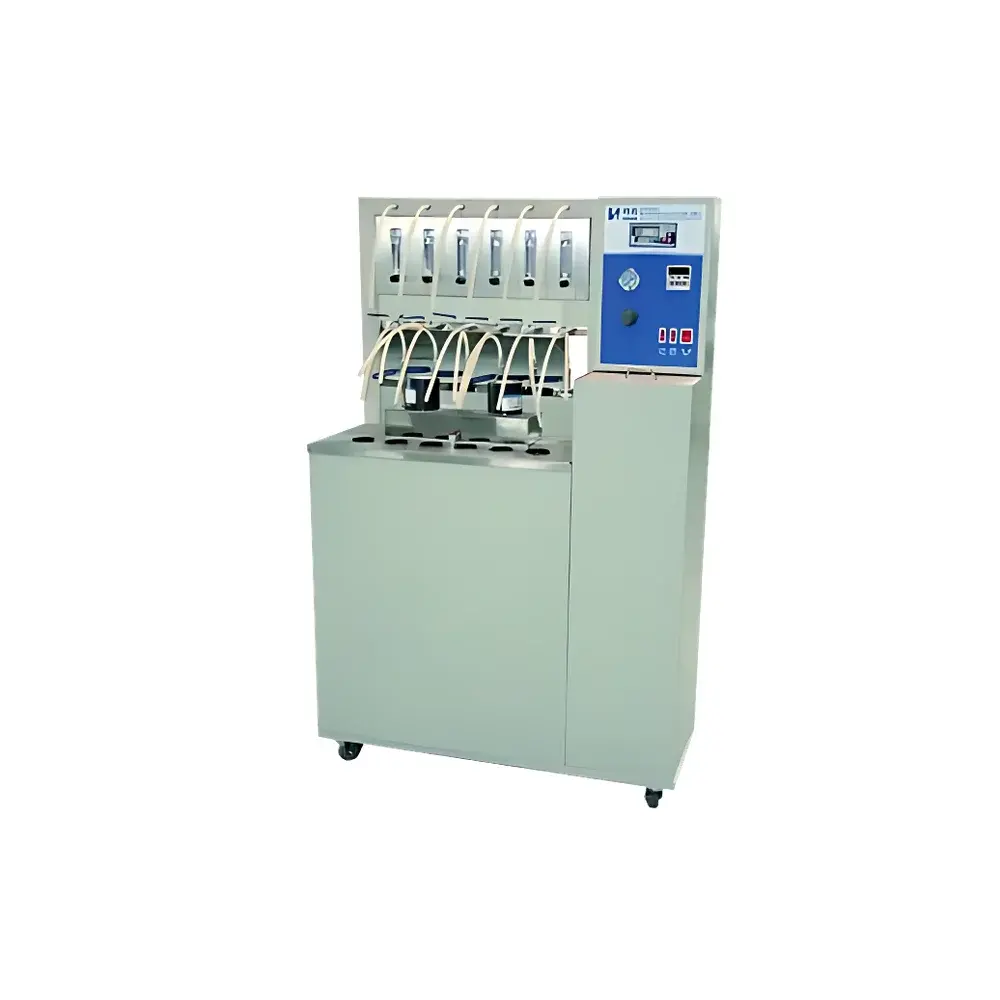
Shenkai SYP2006 Distillate Fuel Oxidation Stability Tester (Accelerated Method)
| Brand | Shenkai |
|---|---|
| Origin | Shanghai, China |
| Model | SYP2006 |
| Compliance | SH/T 0175, ASTM D2274 |
| Oxygen Flow Rate | 50 ± 5 mL/min (per channel) |
| Temperature Control | 95 ± 0.2 °C |
| Temperature Sensor | GB/T 514 compliant, 80–100 °C range, 0.1 °C graduation |
| Oxidation Duration | Programmable up to 16 h |
| Sample Capacity | 6 parallel oxidation tubes |
| Oxidation Tube Material | Borosilicate glass per SH/T 0175–94 |
| Filter Membrane | Cellulose ester, 50 mm diameter, 0.8 µm pore size |
| Evaporation Vessel | Borosilicate glass tall-form beaker, 200 mL |
| Heating Power | 3 kW (4 × 750 W tubular heaters) |
| Oxygen Stabilization | Integrated pressure-regulating valve upstream of flowmeters |
| Drying & Filtration System | Cylindrical assembly with stainless-steel mesh, silica gel, and degreased cotton |
| Dark Storage Cabinet | Metal enclosure for post-oxidation tube cooling |
| Footprint | Floor-standing configuration with four swivel leveling feet |
Overview
The Shenkai SYP2006 Distillate Fuel Oxidation Stability Tester (Accelerated Method) is a dedicated benchtop instrument engineered for the quantitative assessment of inherent oxidative stability in middle-distillate petroleum fuels—specifically those with an initial boiling point ≥175 °C and a 90% distillation temperature ≤370 °C. It operates on the principle of accelerated oxidation under controlled atmospheric oxygen exposure at elevated temperature, simulating long-term storage degradation mechanisms without catalytic interference from water, active metal surfaces, or particulate contaminants. The system implements the gravimetric methodology defined in SH/T 0175 (Chinese national standard) and ASTM D2274 (Standard Test Method for Oxidation Stability of Distillate Fuel Oil—Accelerated Method), enabling reproducible measurement of insoluble sediment formation following prescribed oxidation, evaporation, and solvent rinsing steps. Its design emphasizes metrological integrity, thermal uniformity, and operational repeatability across six independent test channels—critical for quality control laboratories conducting routine fuel specification compliance testing per refinery, terminal, or regulatory mandates.
Key Features
- Six-channel parallel oxidation architecture with individually adjustable rotameters, each calibrated to deliver 50 ± 5 mL/min of medical-grade oxygen—ensuring consistent oxidative stress across all samples.
- Precision thermostatic bath with high thermal mass and optimized insulation, maintaining 95 ± 0.2 °C throughout the 16-hour test cycle—validated per GB/T 514 specifications using a 0.1 °C graduation immersion thermometer.
- Borosilicate glass oxidation tubes manufactured to SH/T 0175–94 dimensional and compositional tolerances, secured via radial clamping mechanism for leak-free, vibration-resistant mounting.
- Integrated oxygen conditioning train comprising a pressure-regulating valve, cylindrical drying column (stainless-steel mesh, silica gel, degreased cotton), and inline particulate filtration—minimizing moisture and hydrocarbon carryover.
- Automated timing sequence governed by industrial-grade time relay: initiates oxygen flow, monitors duration, triggers audible alarm, and actuates solenoid cutoff upon completion of the 16-hour oxidation period.
- Dark metal storage cabinet for post-test tube handling—prevents photochemical artifacts during ambient cooling prior to gravimetric analysis of sediment mass.
- Floor-standing mechanical architecture with four height-adjustable swivel casters—facilitating stable positioning and safe relocation within laboratory or QC facility environments.
Sample Compatibility & Compliance
The SYP2006 is validated for use with diesel fuels, heating oils, jet fuels (e.g., Jet A-1), and other middle-distillate hydrocarbon blends meeting the volatility criteria outlined in SH/T 0175 and ASTM D2274. All wetted components—including oxidation tubes, evaporation vessels (200 mL borosilicate tall-form beakers), and filtration assemblies—are chemically inert to aliphatic/aromatic hydrocarbons and oxidation intermediates. The instrument supports full traceability in regulated environments: temperature setpoints, oxygen flow rates, and test durations are manually recorded per GLP-compliant documentation protocols. While the unit itself does not embed electronic audit trails, its mechanical timer and analog flow control align with FDA 21 CFR Part 11 Annex B expectations for non-computerized systems in GMP-aligned fuel testing workflows.
Software & Data Management
The SYP2006 operates as a fully manual, electromechanical system with no embedded firmware, touchscreen interface, or digital data logging capability. All operational parameters—including bath temperature verification, oxygen flow calibration, and oxidation timing—are monitored and recorded externally by laboratory personnel using standardized paper-based or LIMS-integrated worksheets. This architecture eliminates software validation requirements while ensuring compatibility with legacy QA documentation practices. Users are advised to maintain calibration logs for thermometers and rotameters per ISO/IEC 17025 Clause 6.4, and to perform periodic verification of pressure regulator output stability and bath temperature homogeneity across all six tube positions.
Applications
- Routine quality assurance testing of refinery-produced diesel and heating oil batches against internal specifications or national standards (e.g., GB 19147, EN 590).
- Stability benchmarking of biodiesel blends (B5–B20) to assess additive efficacy and long-term storage behavior.
- Research investigations into antioxidant package performance under accelerated aging conditions.
- Third-party certification testing for fuel distributors and terminal operators subject to SH/T 0175 reporting requirements.
- Educational use in petroleum engineering laboratories for hands-on instruction in fuel degradation kinetics and standard test methodology.
FAQ
What standards does the SYP2006 explicitly support?
It is designed and verified for SH/T 0175 (China) and ASTM D2274 (USA), with hardware conforming to the physical and procedural requirements of both methods.
Can the instrument accommodate alternative test durations?
Yes—the mechanical time relay is field-adjustable; however, deviations from the standard 16-hour protocol require method validation per ISO/IEC 17025 Clause 7.2.2 before implementation in accredited testing.
Is the oxygen flow rate traceable to national standards?
Rotameters are factory-calibrated using NIST-traceable flow standards; users must perform periodic recalibration using a primary bubble meter or mass flow calibrator per ASTM E29.
What maintenance is required for long-term reliability?
Monthly inspection of silica gel desiccant color indicator, quarterly cleaning of metal mesh filters, annual verification of heater element resistance, and biannual recalibration of temperature sensor and flowmeters.
Does the unit include sediment quantification tools?
No—the SYP2006 performs only the oxidation and evaporation stages; gravimetric analysis of filtered sediment residue requires external analytical balance (0.1 mg readability) and vacuum filtration apparatus per SH/T 0175 Section 9.
Related Products





