
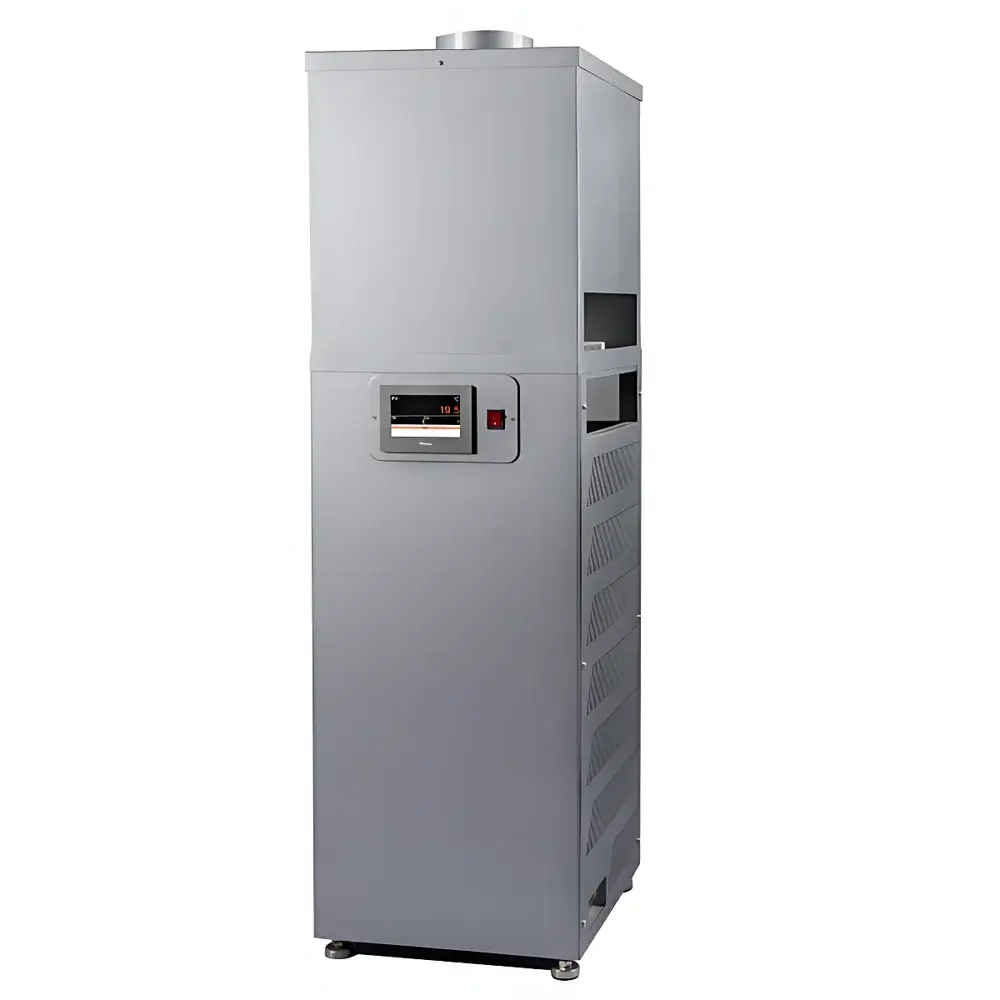
Shenkai SKY2103BT-II Air Conditioning Unit for Octane Rating Test Systems
| Brand | Shenkai |
|---|---|
| Origin | Shanghai, China |
| Manufacturer Type | Authorized Distributor |
| Country of Origin | China |
| Model | SKY2103BT-II |
| Quotation | Upon Request |
| Cooling Temperature Range | 0–4 °C |
| Condenser Fluid Temperature Control Range | 1–8 °C (circulating glycol-water solution) |
| Inlet Air Temperature | 52 ± 1 °C (RON mode), 38 ± 2.8 °C (MON mode) |
| Inlet Air Humidity | 3.56–7.12 g/kg (water per dry air) |
| Coolant | Ethylene glycol–water mixture |
| Refrigeration Method | Hermetic scroll compressor |
| Power Consumption | < 450 W |
| Dimensions (L×W×H) | 420 × 420 × 1433 mm |
| Net Weight | 90 kg |
| Electrical Supply | 200–240 VAC, 50/60 Hz |
| Display | 5″ color touchscreen interface |
| Integrated Control | Compatible with iSKvator™ engine management platform |
| Air Filtration | Particulate removal via multi-stage coalescing and particulate filter |
| Auxiliary Function | Dedicated cooling loop for volatile fuel samples |
Overview
The Shenkai SKY2103BT-II Air Conditioning Unit is a precision-engineered environmental conditioning system specifically designed to support ASTM D2699 (RON) and ASTM D2700 (MON) gasoline octane rating determinations in cooperative laboratory test engines. Unlike general-purpose HVAC equipment, this unit operates as a critical subsystem within the octane testing workflow—regulating both temperature and moisture content of combustion air to meet strict method-defined inlet conditions. Its core function relies on refrigerated condensation: ambient air is drawn through a high-efficiency particulate filtration stage, then passed across a precisely controlled evaporator coil operating between 0 °C and 4 °C. This induces dew-point depression sufficient to reduce absolute humidity to 3.56–7.12 g/kg (water per kilogram of dry air), corresponding to a stable relative humidity range of 30–35 % RH at specified inlet temperatures. Simultaneously, the unit maintains dual thermal zones: one for conditioned air delivery (at 52 ± 1 °C for RON or 38 ± 2.8 °C for MON), and another for auxiliary cooling of volatile fuel specimens via an isolated glycol–water circulation loop regulated between 1 °C and 8 °C.
Key Features
- Refrigeration architecture based on a hermetically sealed scroll compressor, delivering consistent cooling capacity with low vibration transmission and extended service life under continuous duty cycles.
- Integrated 5″ full-color touchscreen HMI enabling local parameter configuration—including setpoint adjustment for evaporator temperature, condenser fluid temperature, and airflow monitoring thresholds.
- Native interoperability with Shenkai’s iSKvator™ digital engine control platform, allowing synchronized start-up sequencing, real-time status feedback, and automated calibration alignment with octane tester operational modes (RON/MON).
- Dual-path thermal management: primary air stream conditioned for combustion; secondary closed-loop circuit dedicated to sample cooling—preventing vapor loss and ensuring representative fuel volatility during injection and combustion phases.
- Multi-stage air purification comprising coalescing pre-filter (removes oil aerosols and liquid entrainment) followed by HEPA-grade particulate filtration (≥99.97% @ 0.3 µm), minimizing contamination risk to carburetor jets and combustion chamber surfaces.
- Thermal insulation optimized for vertical tower geometry (1433 mm height), reducing ambient heat gain and maintaining uniform temperature gradients across internal ductwork and heat exchanger surfaces.
Sample Compatibility & Compliance
The SKY2103BT-II is validated for use with standard reference fuels (SRFs), commercial gasoline blends, oxygenated fuels (e.g., ethanol-gasoline mixtures), and research-grade hydrocarbon formulations. It complies with the environmental conditioning requirements stipulated in ASTM D2699, ASTM D2700, and ISO 5164. All thermal control loops incorporate NIST-traceable RTD sensors with ±0.1 °C accuracy, and humidity output is verified against gravimetric standards per ISO 4677. The unit supports GLP-compliant operation through configurable audit trails (when integrated with iSKvator™), including timestamped parameter changes, alarm logs, and system health diagnostics—all exportable in CSV format for regulatory review.
Software & Data Management
While the SKY2103BT-II operates autonomously via its embedded microcontroller, full integration with the iSKvator™ software suite enables centralized supervision across multi-instrument octane testing laboratories. Logged parameters—including evaporator temperature, condenser fluid setpoint deviation, inlet air temperature/humidity trends, and compressor runtime—are archived with millisecond-resolution timestamps. Data retention follows FDA 21 CFR Part 11 principles when deployed in pharmaceutical-adjacent fuel additive development labs, supporting electronic signatures, role-based access control, and immutable record generation. Remote diagnostics are accessible via Ethernet (RJ45) or optional Wi-Fi module (IEEE 802.11n), facilitating predictive maintenance alerts based on compressor cycle analysis and thermal drift modeling.
Applications
- Primary application: Continuous conditioning of intake air for Cooperative Fuel Research (CFR) engines used in motor and research octane number determination.
- Secondary application: Stabilization of volatile fuel samples (e.g., light naphthas, reformulated gasoline fractions) prior to metering into CFR engine carburetors—reducing flash vaporization and improving repeatability of knock intensity measurements.
- Research extension: Controlled humidity exposure studies evaluating fuel oxidation stability, deposit formation kinetics, and injector fouling mechanisms under reproducible air-moisture environments.
- Quality assurance: Routine verification of octane testing system compliance during method validation, instrument qualification (IQ/OQ/PQ), and annual re-certification per ASTM E2915 guidelines.
FAQ
What is the purpose of the auxiliary cooling loop?
It provides regulated thermal conditioning (1–8 °C) to volatile fuel samples prior to injection, preventing premature vaporization and ensuring consistent fuel metering and combustion phasing.
Does the unit meet ISO/IEC 17025 requirements for accredited testing laboratories?
Yes—the temperature and humidity control subsystems are calibrated using traceable standards, and documentation packages include uncertainty budgets, as-built schematics, and verification reports aligned with ILAC-G8:2022.
Can the SKY2103BT-II operate independently of the iSKvator™ platform?
Yes; all core functions—including temperature regulation, dehumidification, and filtration—are fully operational via the local touchscreen interface without external connectivity.
What maintenance intervals are recommended for the air filtration system?
Coalescing pre-filters require replacement every 500 hours of operation; HEPA filters every 2,000 hours or quarterly—whichever occurs first—under typical laboratory ambient conditions (ISO Class 8 cleanroom equivalent).
Is the refrigerant compliant with current F-Gas regulations?
The scroll compressor uses R-410A refrigerant, which is permitted under EU Regulation (EU) No 517/2014 for laboratory-scale equipment with annual charge < 3 kg; full safety data sheets and leak detection protocols are provided in the installation manual.




