
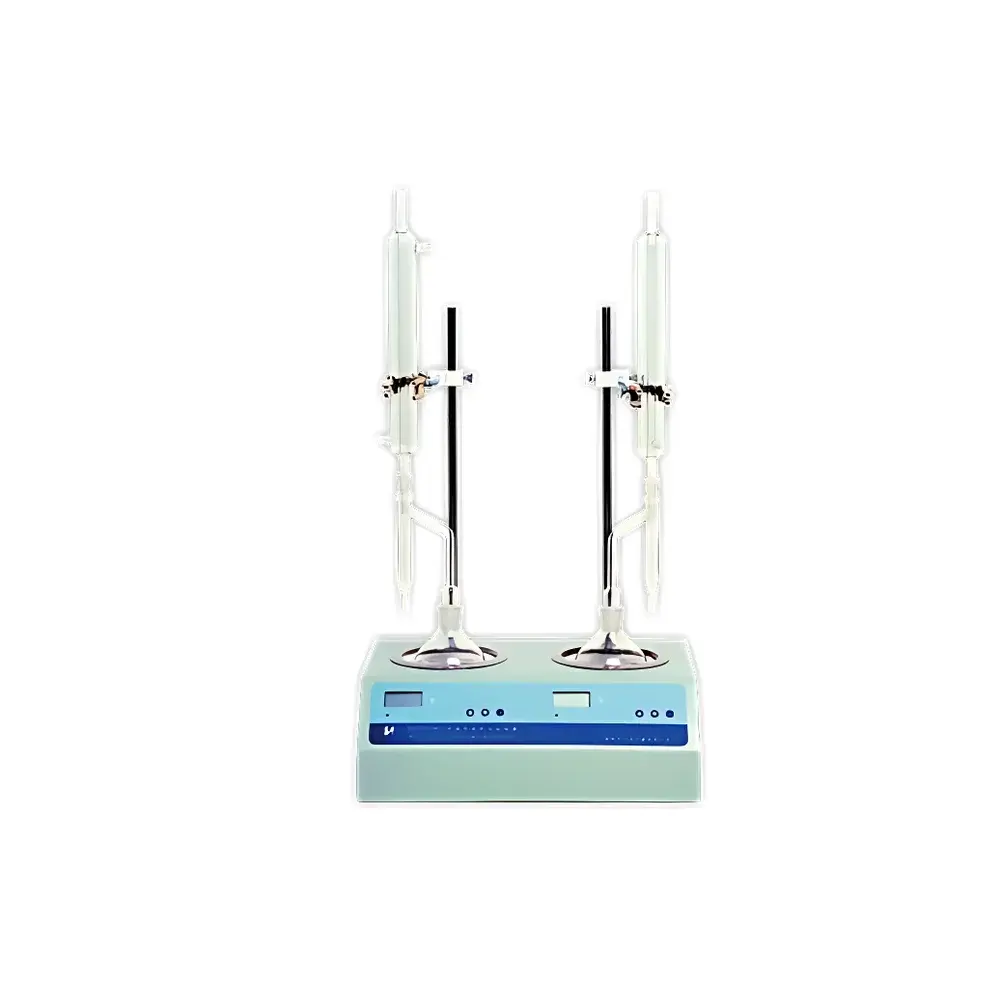
Shenkai SYP1015-III Petroleum Product Water Content Tester (Distillation Method)
| Brand | Shenkai |
|---|---|
| Model | SYP1015-III |
| Standard Compliance | GB/T 260, ASTM D95 |
| Heating System | Dual independent 350 W electric furnaces |
| Control Architecture | 8-bit microcontroller with real-time mains voltage monitoring and zero-crossing thyristor power control |
| Display | 3.5-digit segmented LCD |
| Adjustable Equivalent Output Voltage | 0–220 VAC |
| Input Power | 220 ±10% VAC, 50 ±1 Hz |
| Operating Environment | Ambient room temperature |
| Mains Compensation | Enabled |
| Power Control Mode | Zero-crossing triggered phase-angle control |
| Power Rating | 350 W × 2 |
Overview
The Shenkai SYP1015-III Petroleum Product Water Content Tester is a dedicated distillation-based analytical instrument engineered for precise quantification of water content in crude oils, lubricants, fuels, and other petroleum-derived liquids. It operates in strict accordance with the standardized distillation methodology defined in GB/T 260 (Chinese National Standard) and ASTM D95 (Standard Test Method for Water in Petroleum Products by Distillation). The instrument separates water from the sample via controlled thermal vaporization and condensation, followed by volumetric collection and measurement in a calibrated receiver. Unlike gravimetric or coulometric alternatives, this method remains the reference procedure for heterogeneous, high-boiling, or emulsified petroleum matrices where solvent compatibility and phase separation behavior are critical. Its dual-furnace architecture enables parallel or differential heating profiles, supporting method validation, operator training, or comparative analysis across sample batches.
Key Features
- Dual independent 350 W electric heating furnaces—each controllable separately to accommodate asymmetric sample volumes or differing volatility profiles.
- Microcontroller-based closed-loop temperature regulation with real-time mains voltage sensing and automatic compensation, ensuring consistent thermal output despite grid fluctuations (±10% input tolerance).
- Zero-crossing triggered thyristor power control—minimizes electromagnetic interference (EMI), eliminates harmonic distortion, and extends heater life by switching only at AC voltage zero points.
- Programmable equivalent output voltage range (0–220 VAC) enabling fine-grained adjustment of heating intensity for optimized distillation kinetics and condensate recovery.
- 3.5-digit segmented LCD display presenting setpoint voltage, real-time furnace status, and operational mode—designed for legibility under laboratory lighting and glove-compatible operation.
- No external PC or proprietary software required; all configuration and execution managed via front-panel membrane keyboard with tactile feedback.
Sample Compatibility & Compliance
The SYP1015-III accepts standard ASTM D95 glassware assemblies—including 5 mL or 10 mL graduated receivers, 500 mL round-bottom flasks, and condensers conforming to Type I or II specifications. It supports samples with boiling ranges up to 350 °C and viscosity classes from gasoline to residual fuel oil (ASTM D445-compliant kinematic viscosities up to 1500 cSt at 40 °C). All operational parameters align with GLP documentation requirements: manual entry logs, non-volatile setting retention, and traceable voltage/temperature correlation. While not inherently 21 CFR Part 11 compliant (as it lacks electronic audit trails), its deterministic control logic and fixed calibration intervals support IQ/OQ validation protocols in regulated refinery QC labs.
Software & Data Management
This is a standalone hardware instrument with no embedded operating system or network interface. All user interaction occurs via physical keypad and local display; no firmware updates, cloud connectivity, or data export functions are implemented. Measurement results are recorded manually into laboratory notebooks or LIMS using printed or handwritten entries derived from the receiver scale. For digital integration, users may employ external time-lapse imaging systems or calibrated digital calipers interfaced via USB or RS-232 to capture receiver volume readings—though such configurations fall outside factory validation scope.
Applications
- Refinery quality control: verification of dehydration efficiency post-treatment in crude desalting units.
- Fuel certification: batch release testing for aviation turbine fuel (Jet A-1) per ASTM D1744 and diesel per EN 590 Annex B.
- Lubricant manufacturing: monitoring moisture ingress during blending, storage, or packaging stages.
- Research laboratories: method comparison studies between distillation, Karl Fischer titration (ASTM D6304), and near-infrared spectroscopy (ASTM D7415).
- Educational use: hands-on instruction in petroleum ASTM standard practices, distillation thermodynamics, and metrological traceability.
FAQ
Does the SYP1015-III meet ISO/IEC 17025 calibration requirements?
Yes—when operated with NIST-traceable glassware and verified using certified reference materials (e.g., water-in-kerosene standards), its measurement uncertainty can be documented per ISO/IEC 17025 Clause 6.4.
Can it be used for biodiesel (FAME) according to EN 14103?
No—EN 14103 specifies a different distillation apparatus geometry and receiver calibration; ASTM D95 compliance does not imply EN 14103 equivalence.
Is the heating control programmable for ramp/soak cycles?
No—the unit implements fixed-setpoint voltage control only; it does not support time-based thermal profiling.
What maintenance is required for long-term stability?
Annual verification of furnace output voltage accuracy using a calibrated multimeter and visual inspection of glassware seating surfaces for thermal seal integrity.
Is third-party validation support available?
Shenkai provides factory test reports and mechanical drawings; IQ/OQ protocol templates are available upon request for qualified laboratory auditors.





