
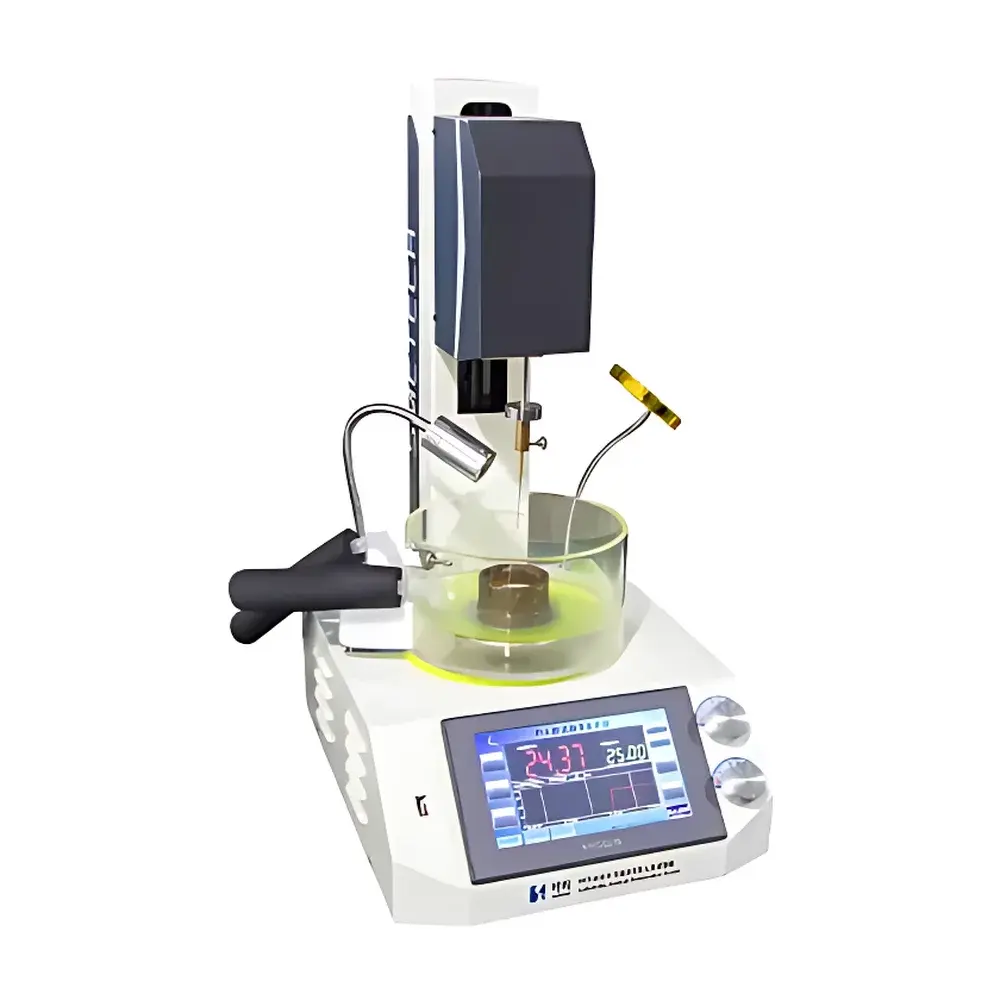
Shenkai SYP4302-II Automatic Wax Penetrometer
| Brand | Shenkai |
|---|---|
| Origin | Shanghai, China |
| Model | SYP4302-II |
| Penetration Measurement Range | ≤620 dmm |
| Standard Needle Mass | 2.5 g ±0.05 g |
| Rod Mass | 47.5 g ±0.05 g |
| Standard Weight | 50 g ±0.05 g |
| Temperature Control Range (Water Bath) | 0.00–50.00 °C (with cooling up to 20 °C below ambient) |
| Temperature Stability | ≤±0.1 °C |
| Timing Range | 0–9 min 59 s |
| Timing Accuracy | ±0.1 s |
| Data Storage Capacity | 200 test records |
| Interface | USB port + thermal printer integrated |
| Sample Stage | Adjustable leveling mechanism |
| Illumination | Integrated focused LED lamp + magnifier |
Overview
The Shenkai SYP4302-II Automatic Wax Penetrometer is a precision-engineered instrument designed for standardized determination of penetration depth in petroleum waxes and semi-solid materials under controlled temperature and loading conditions. It operates on the fundamental principle of static needle penetration—measuring the vertical displacement (in tenths of a millimeter, dmm) of a standardized needle assembly into a sample under specified mass, time, and thermal conditions. This method conforms to gravimetric and kinematic requirements defined in GB/T 4985 and ASTM D 1321, both of which specify identical mechanical configurations for the penetrometer system: a 2.5 g needle, 47.5 g rod, and optional 50 g weight to achieve total loads of 100 g or 150 g. The device integrates a self-contained refrigerated/heated water bath, enabling precise thermal conditioning of samples prior to and during testing—a critical requirement for wax characterization where phase behavior and crystallinity are highly temperature-sensitive.
Key Features
- Integrated thermostatic water bath with dual-mode temperature control: heating up to 50.00 °C and active cooling down to 20 °C below ambient—ensuring compliance with ASTM D 1321’s 25.0 ±0.1 °C test condition and GB/T 4985’s specified ranges.
- High-resolution timing system with ±0.1 s accuracy over 0–9 min 59 s intervals, meeting the strict duration tolerance required for standard penetration tests (e.g., 5 s default, extendable per method).
- Dual-speed actuation mechanism: rapid positioning mode for coarse alignment and micro-motion mode for precise needle surface contact—minimizing operator-induced variability during initial contact.
- Optical assistance system comprising an adjustable LED spotlight and built-in 10× magnifier, facilitating visual verification of needle-sample interface prior to test initiation.
- Full-color touchscreen interface with intuitive navigation, real-time depth readout, and on-device data review—designed for operation in laboratory environments with variable lighting and glove use.
- Mechanically isolated sample platform with three-point leveling adjustment, ensuring consistent vertical alignment between needle axis and sample surface across repeated setups.
Sample Compatibility & Compliance
The SYP4302-II is validated for use with petroleum-based waxes (paraffin, microcrystalline), but its mechanical design and load configuration also support testing of other temperature-sensitive semi-solids including food-grade fats (butter, margarine, cheese curd), pharmaceutical ointments, polymer gels, and colloidal dispersions. All mechanical components—including needle geometry, rod mass, and auxiliary weights—strictly comply with dimensional and mass tolerances mandated by GB/T 4985 and ASTM D 1321. The instrument supports GLP-aligned workflows through timestamped test records, user-defined sample IDs, and audit-ready export functionality. While not certified for FDA 21 CFR Part 11 compliance out-of-the-box, its data export architecture (CSV via USB) enables integration with validated LIMS or ELN systems requiring electronic record integrity.
Software & Data Management
The embedded firmware provides local storage of up to 200 complete test records, each containing penetration value (dmm), test temperature (°C), duration (s), operator ID, date/time stamp, and calibration status flag. Data export is performed via standard USB-A interface to FAT32-formatted flash drives in plain-text CSV format—compatible with Excel, MATLAB, and statistical process control (SPC) platforms. A built-in thermal printer delivers immediate hard-copy output with header information (model, serial number, standards referenced) and traceable test metadata. No proprietary software installation is required; all operations are executed directly from the front-panel interface without external PC dependency.
Applications
- Quality control of refined paraffin wax batches in petrochemical refineries and candle manufacturing facilities.
- Batch release testing of microcrystalline waxes used in hot-melt adhesives and packaging coatings.
- Routine hardness profiling of edible fats during dairy processing and confectionery R&D.
- Stability assessment of topical pharmaceutical formulations (e.g., petrolatum-based ointments) under accelerated aging protocols.
- Comparative analysis of gelation kinetics in food hydrocolloids (e.g., pectin, agar) at fixed thermal set points.
- Method development and inter-laboratory validation studies requiring high repeatability (RSD < 2% typical for replicate wax measurements).
FAQ
What standards does the SYP4302-II fully support?
It meets all mechanical, thermal, and procedural requirements of GB/T 4985 and ASTM D 1321 for petroleum wax penetration testing.
Can the instrument operate without external water circulation?
Yes—the integrated water bath is self-contained with internal refrigeration and Peltier-based heating; no external chiller or circulator is required.
Is calibration traceable to national metrology institutes?
The unit accepts NIST-traceable penetrometer calibration blocks (e.g., SRM 2461); field verification procedures are documented in the operator manual.
How is temperature uniformity verified within the bath?
A calibrated PT100 sensor monitors bath temperature at the sample cup location; stability is confirmed via continuous logging during 30-minute equilibration checks.
Does the system support automated reporting templates?
No native template engine is included, but exported CSV files contain all fields necessary for custom report generation in third-party analytics tools.




