
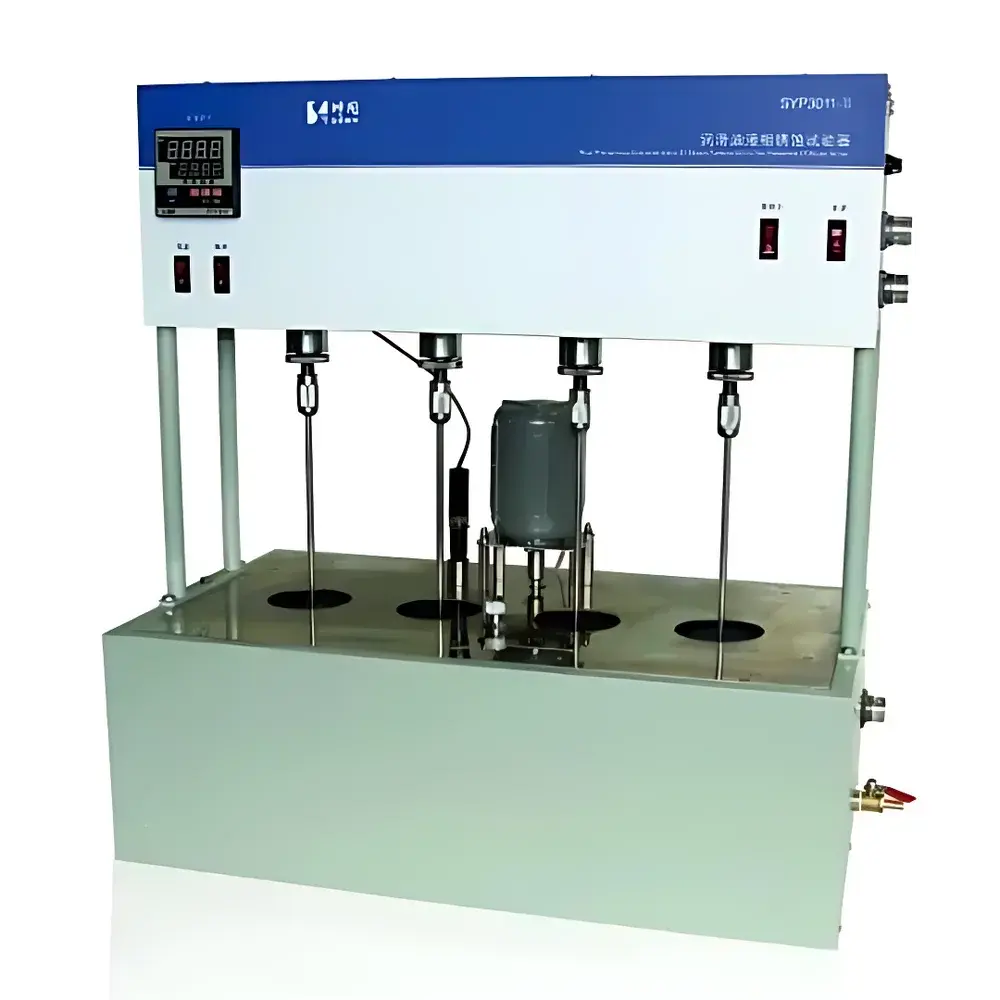
Shenkai SYP3011-II Liquid-Phase Rust Testing Apparatus for Lubricating Oils
| Brand | Shenkai |
|---|---|
| Origin | Shanghai, China |
| Model | SYP3011-II |
| Application Standard Compliance | GB/T 11143, ASTM D665, IP 135 |
| Test Temperature | 60 ± 1 °C |
| Stirring Speed | 1000 ± 50 rpm |
| Stirrer Geometry | Inverted "T"-shaped blade (25 × 6 × 0.6 mm) |
| Test Specimen Rod | Conforms to GB/T 11143 / ASTM D665 / IP 135 specifications |
| Sample Cup | Φ70 × 127 mm, 400 mL tall-form beaker (no spout) |
| Thermometer Range | 50–70 °C, graduation 0.5 °C |
| Bath Capacity | High-volume constant-temperature water bath |
| Parallel Testing Capacity | 4 samples simultaneously |
| Stirring Mechanism | Synchronous belt-driven, vertically adjustable shafts with quick-release clamps |
Overview
The Shenkai SYP3011-II Liquid-Phase Rust Testing Apparatus is a precision-engineered laboratory instrument designed to evaluate the rust-inhibiting performance of lubricating oils—particularly turbine oils, hydraulic fluids, and circulating system oils—when exposed to water under controlled thermal and mechanical conditions. It operates on the fundamental principle of simulating real-world corrosion challenges in oil-lubricated systems where water ingress occurs, leading to interfacial degradation at ferrous metal surfaces. The apparatus implements standardized immersion testing protocols defined in GB/T 11143 (China), ASTM D665 (United States), and IP 135 (United Kingdom), ensuring cross-regional method equivalence and regulatory acceptability for quality control laboratories, OEM technical centers, and third-party testing facilities.
Key Features
- Four-channel parallel testing configuration enables simultaneous evaluation of up to four samples, significantly improving throughput without compromising test integrity.
- High-capacity thermostatic water bath maintains stable temperature control at 60 ± 1 °C over extended durations (typically 24 h), minimizing thermal drift and ensuring repeatability across replicates.
- Synchronous belt-driven stirring mechanism delivers uniform rotational motion to all four inverted “T”-shaped stirrers (25 × 6 × 0.6 mm), eliminating gear backlash and reducing mechanical noise or vibration-induced artifacts.
- Vertically adjustable stirrer shafts—secured via ergonomic quick-release clamps—allow precise positioning relative to the test specimen rod and liquid meniscus, accommodating minor dimensional variances in sample cups or rods while maintaining consistent hydrodynamic shear profiles.
- Rigid box-frame chassis provides structural stability during prolonged operation, mitigating resonance effects that could otherwise influence rust pattern formation on polished steel test rods.
- Calibrated 50–70 °C thermometer (0.5 °C graduation) is integrated into the bath assembly for independent verification of setpoint accuracy, supporting internal calibration documentation and audit readiness.
Sample Compatibility & Compliance
The SYP3011-II supports a broad range of petroleum-based fluids beyond turbine oils, including hydraulic oils (mineral and synthetic), industrial circulating oils, and other water-immiscible liquids denser than water. All test specimens must be evaluated using standardized polished steel test rods specified in GB/T 11143, ASTM D665, and IP 135—ensuring surface finish, composition, and pre-test cleaning procedures are rigorously controlled. The apparatus accommodates standard 400 mL tall-form beakers (Φ70 × 127 mm, no spout) to maintain consistent liquid volume, air–oil–water interface geometry, and immersion depth. Its design facilitates full alignment with ISO/IEC 17025 requirements for test method validation, including documented uncertainty budgets for temperature and rotational speed parameters.
Software & Data Management
While the SYP3011-II operates as a benchtop manual instrument without embedded microprocessor control, its operational workflow integrates seamlessly into GLP- and GMP-compliant environments. Laboratories routinely pair it with digital data loggers (e.g., calibrated PT100 probes and tachometers) to record time-stamped temperature and stirring speed traces for each test run. These records support 21 CFR Part 11–compliant electronic lab notebooks (ELNs) when coupled with audit-trail-enabled software platforms. Full traceability—including operator ID, lot numbers of reference oils and test rods, environmental chamber logs, and photographic documentation of rust rating per ASTM D665 Annex A1—is maintained through standardized SOPs aligned with ISO 9001 and API RP 541 practices.
Applications
- Quality assurance of rust-inhibited turbine oils prior to commissioning in power generation facilities.
- Formulation screening for additive packages containing amine-based or carboxylate corrosion inhibitors.
- Batch release testing of hydraulic oils used in aerospace ground support equipment and offshore drilling rigs.
- Root-cause analysis of field failures involving rust-related bearing seizure or servo-valve stiction.
- Contract testing services accredited to CNAS (China) or UKAS (UK) for third-party certification reports.
- Academic research on interfacial electrochemical behavior of oil–water–metal triphasic systems.
FAQ
What standards does the SYP3011-II directly support?
It is engineered to meet the mechanical, thermal, and geometric requirements of GB/T 11143, ASTM D665, and IP 135—enabling direct use in accredited testing labs.
Can the apparatus be used for non-petroleum-based lubricants?
Yes, provided the test fluid is immiscible with water and exhibits sufficient density to allow stable stratification or emulsification under agitation; validation per ASTM D665 Annex B is recommended.
Is the water bath compatible with corrosion-resistant glycol mixtures?
No—the bath is configured exclusively for deionized water service; glycol-based heat transfer fluids may compromise temperature uniformity and violate standard-specified test conditions.
How is rust rating performed after testing?
Visual assessment is conducted per ASTM D665 Section 8, using standardized rust rating charts (e.g., “A”, “B”, “C”, “D”, or “E”) based on extent and morphology of surface discoloration and pitting on the cleaned test rod.
Does the unit include certified reference materials?
No—reference oils and test rods must be sourced separately from NIST-traceable suppliers or certified reference material providers meeting ISO Guide 34 requirements.





