
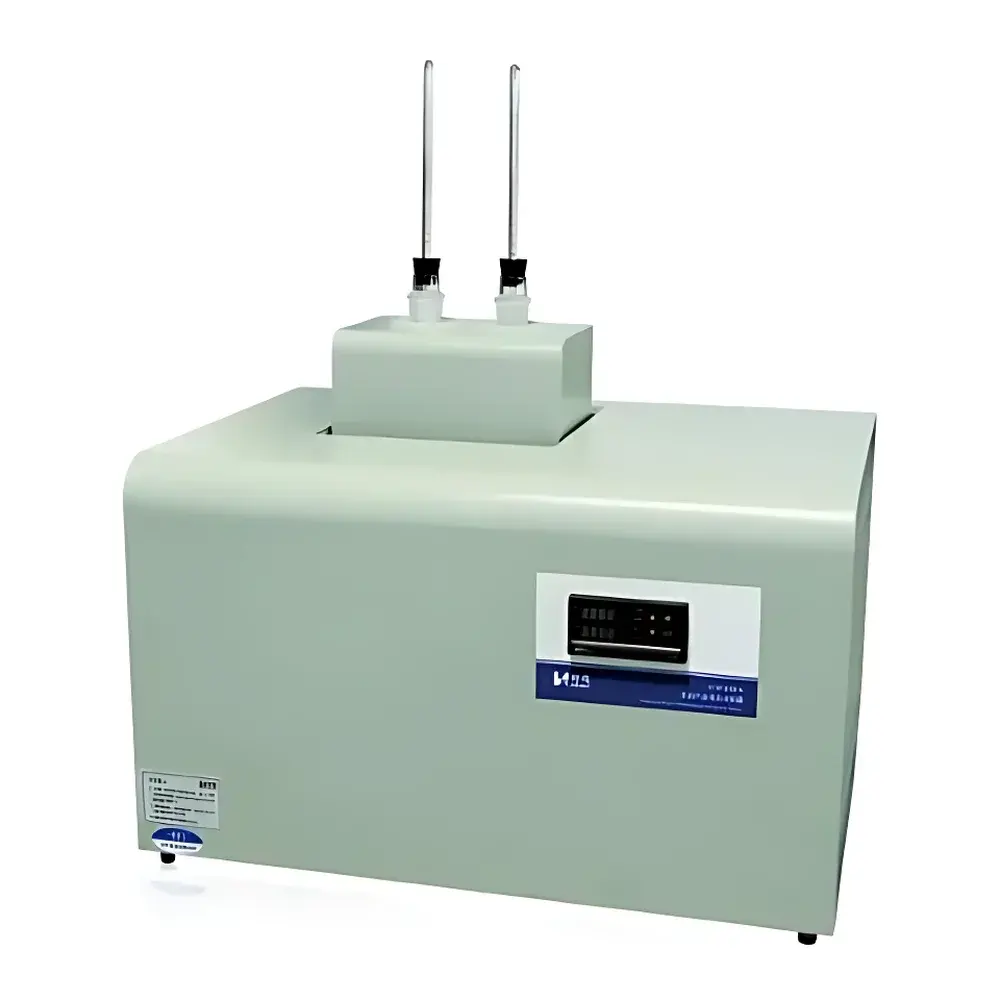
Shenkai SYP1008-V Petroleum Pour Point Tester
| Brand | Shenkai |
|---|---|
| Origin | Shanghai, China |
| Model | SYP1008-V |
| Temperature Control Range | 0 °C to –68 °C |
| Temperature Stability | ±0.5 °C |
| Bath Type | Metal Cooling Bath (No Cryogenic Fluid Required) |
| Sample Positions | 2 |
| Tilt Angle | 45° |
| Tilt-Activated Timer | Auto-starts at 45° tilt |
| Rated Power | 650 W |
| Dimensions (L×W×H) | 620 mm × 440 mm × 460 mm |
| Net Weight | 52 kg |
Overview
The Shenkai SYP1008-V Petroleum Pour Point Tester is a precision-engineered instrument designed in strict compliance with ASTM D97 and GB/T 510—standard test methods for determining the pour point of petroleum products, including distillate fuels, residual fuels, lubricating oils, and crude oil fractions. The pour point is defined as the lowest temperature at which a sample remains fluid under specified cooling and observation conditions—specifically, the temperature at which movement ceases upon tilting the test jar through a 45° angle for six seconds after holding at that temperature for one minute. This measurement is critical for assessing low-temperature operability, cold-flow behavior, and wax crystallization onset in hydrocarbon-based fluids. Unlike bath-type systems requiring flammable cryogenic media (e.g., ethanol or acetone), the SYP1008-V employs a solid-state metal cooling bath with integrated Peltier and forced-air heat exchange, enabling rapid thermal response, stable sub-ambient operation down to –68 °C, and elimination of hazardous coolant handling.
Key Features
- Direct metal cooling bath architecture—no external cryogenic liquids required, reducing operational risk and maintenance overhead.
- Dual independent sample wells with synchronized temperature control and individual tilt-sensing mechanisms for concurrent testing per ASTM D97 protocol.
- Automated tilt detection: Integrated inclinometer triggers precise 60-second countdown upon reaching 45° inclination—ensuring repeatability aligned with standard timing requirements.
- Digital PID temperature controller with real-time display, resolution of 0.1 °C, and stability maintained within ±0.5 °C across the full operating range (0 °C to –68 °C).
- Robust mechanical design with vibration-damped base and thermal isolation between cooling module and housing to minimize ambient interference.
- Front-panel interface with intuitive navigation, programmable hold times, and status indicators for power, cooling, tilt, and alarm states.
Sample Compatibility & Compliance
The SYP1008-V accommodates standard ASTM D97 and GB/T 510 sample containers (typically 34-mL cylindrical glass jars with calibrated necks). It supports routine testing of diesel fuel, jet fuel (Jet A/A-1), marine distillates, engine oils, gear oils, and base stocks. With optional accessory kits—including SH/T 0248-compliant Cold Filter Plugging Point (CFPP) adapters and ASTM D2500-compliant cloud point modules—the system extends functionality to multi-parameter low-temperature characterization without hardware replacement. All operational parameters are traceable and configurable to support GLP-compliant workflows, including audit-ready event logging of temperature setpoints, tilt events, and timer activations. While not inherently 21 CFR Part 11 compliant, the instrument’s deterministic logic and non-volatile parameter storage facilitate integration into validated laboratory information management systems (LIMS) where electronic records are required.
Software & Data Management
The SYP1008-V operates as a standalone benchtop unit with embedded firmware; no PC connection is required for basic operation. However, an optional RS-232 serial interface enables bidirectional communication with external data acquisition software or LIMS platforms. Timestamped test logs—including start time, final pour point determination, maximum cooling rate, and any tilt-related alarms—can be exported in CSV format. Firmware updates are performed via USB port using manufacturer-provided utilities, ensuring long-term alignment with evolving national and international standard revisions (e.g., updates to GB/T 510–2023 or ASTM D97–22). All user-modifiable settings (e.g., hold duration, alarm thresholds) are password-protected to maintain method integrity in regulated environments.
Applications
- Quality assurance laboratories in refineries and blending facilities verifying conformance to product specifications (e.g., ASTM D97 limits for No. 2 diesel).
- Research and development of low-temperature additives (e.g., pour point depressants) where comparative pour point shifts must be quantified with high inter-laboratory reproducibility.
- Contract testing laboratories serving third-party certification bodies requiring documented adherence to ISO/IEC 17025 technical competence criteria.
- Marine fuel testing per ISO 8217 Annex B, where pour point is a mandatory reporting parameter for distillate and residual marine fuels.
- Educational institutions conducting standardized petroleum physical property experiments in chemical engineering and fuel science curricula.
FAQ
What standards does the SYP1008-V directly support?
It is fully configured for GB/T 510 and ASTM D97. Optional accessories enable SH/T 0248 (CFPP), ASTM D2500 (cloud point), and ISO 3016 (pour point of petroleum products) testing.
Is calibration traceable to national standards?
Yes—temperature sensors are factory-calibrated against NIST-traceable references; users receive a calibration certificate with each unit. Annual recalibration is recommended using certified dry-block calibrators.
Can the instrument operate continuously at –68 °C?
Yes, but sustained operation below –50 °C requires adequate ventilation and ambient temperatures ≤25 °C to maintain thermal efficiency and compressor longevity.
Does it meet explosion-proof requirements for hazardous areas?
No—it is rated for general laboratory use only (IP20 enclosure) and must be installed outside classified zones per IEC 60079 guidelines.
What maintenance is required?
Routine cleaning of the metal bath surface and air intake filters every 100 operating hours; annual inspection of Peltier module thermal interface compound and fan performance.






