
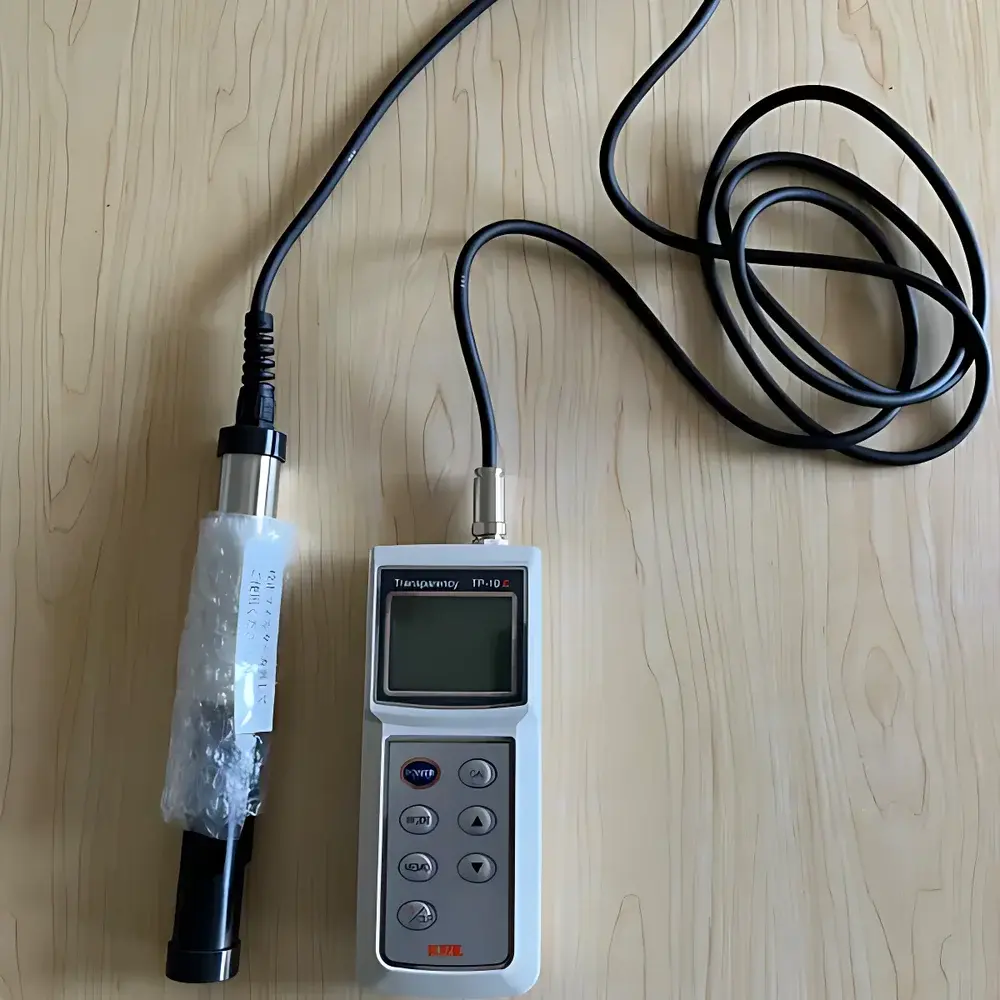
Rikorika TP-10Z Portable Transmittance & Absorbance Analyzer for Water Clarity Assessment
| Brand | Rikorika |
|---|---|
| Origin | Japan |
| Model | TP-10Z |
| Measurement Wavelength | 880 nm (NIR) |
| Transmittance Range | 2.0–200 cm |
| Absorbance Range | 0.000–2.000 Abs/60 mm |
| Resolution | 0.1 cm (2.0–99.9 cm), 1 cm (100–200 cm), 0.001 Abs |
| Repeatability | ±3% FS or better |
| Operating Temperature | 0–40 °C, ≤95% RH |
| IP Rating | IP67 (when probe fully mated) |
| Power Supply | 4.5 V DC (3×AAA alkaline batteries) |
| Dimensions | 70×170×36 mm |
| Weight | ~270 g (including batteries) |
| Standard Accessories | Fluoride ion sensor, shock-absorbing rubber cap, PVC sample cell, calibration filter, user manual |
Overview
The Rikorika TP-10Z is a handheld, probe-type transmittance and absorbance analyzer engineered for rapid, field-deployable assessment of water clarity and optical attenuation in environmental and municipal water quality monitoring applications. Utilizing near-infrared (NIR) photometry at a fixed wavelength of 880 nm, the instrument measures both path-length-corrected transmittance (expressed as apparent path length in centimeters) and linear absorbance (Abs/60 mm) under standardized 60 mm optical path conditions. Its NIR detection principle minimizes interference from ambient visible light, enabling stable operation in outdoor or unshielded environments without requiring darkroom conditions. The device operates on a dual-signal acquisition architecture: one channel quantifies transmitted light intensity through the sample using a silicon photodiode detector with integrated anti-vibration rubber mounting; the second channel monitors reference intensity via an internal reference path—ensuring drift compensation and long-term signal stability. Designed to ISO 7027-compliant optical geometry principles (though not certified), it delivers traceable, repeatable readings aligned with established turbidity and clarity correlation frameworks used in limnology and wastewater effluent reporting.
Key Features
- Compact, battery-powered design (270 g) optimized for field use and routine grab sampling in rivers, reservoirs, treatment plants, and coastal zones.
- IP67-rated probe housing ensures dust-tight and immersion-resistant performance up to 1 m for 30 minutes—critical for wetland surveys and stormwater outfall inspections.
- Dual-parameter output: simultaneous display of transmittance (cm) and absorbance (Abs/60 mm) on a 4-digit LCD—enabling cross-validation and empirical conversion to Secchi depth or turbidity units (NTU/FNU) using site-specific calibration curves.
- Integrated fluoride ion sensor (standard) supports concurrent halide interference screening during clarity measurements—particularly relevant in groundwater and industrial discharge monitoring where F⁻ affects colloidal stability.
- Two-point calibration protocol: factory-aligned using a certified neutral-density calibration filter (included); optional traceable standard solutions (250 mL, sold separately) enable metrological traceability to NIST-traceable absorbance references.
- Auto-power-off function conserves battery life; typical operational runtime exceeds 200 hours per set of AAA alkaline cells.
Sample Compatibility & Compliance
The TP-10Z accepts liquid samples in its supplied 60 mm-pathlength PVC cuvette, accommodating turbid waters, colored dissolved organic matter (CDOM)-rich surface waters, and low-conductivity freshwater matrices. It is unsuitable for highly viscous fluids, suspended solids >500 mg/L without pre-filtration, or samples containing air bubbles or particulates >100 µm that may obstruct the optical path. While not certified to ASTM D1889 or ISO 7027 for turbidity, its 880 nm NIR measurement aligns with EPA Method 180.1 spectral recommendations for minimizing color interference. Data integrity meets GLP documentation requirements: all measurements are timestamped and stored locally (30-sample memory), with no cloud dependency. For regulated laboratories, the instrument supports audit-ready manual logging compatible with 21 CFR Part 11–compliant electronic record systems when paired with validated data transfer protocols.
Software & Data Management
The TP-10Z operates as a standalone instrument with no embedded firmware updates or proprietary software dependencies. All data are displayed and retained locally in non-volatile memory. Users export results manually via recorded values or integrate readings into LIMS or Excel-based QA/QC workflows using standardized nomenclature (e.g., “TP_10Z_Tx_cm”, “TP_10Z_Abs_60mm”). The included calibration filter provides a stable 0.500 Abs reference point traceable to manufacturer-certified optical density standards. Optional standard solutions (Cat. No. TP-CAL-250) are supplied with CoA specifying certified absorbance values at 880 nm ±0.005 Abs, supporting ISO/IEC 17025-compliant method validation.
Applications
- Field verification of drinking water filtration efficiency in distribution networks.
- Monitoring seasonal changes in lake transparency (e.g., spring algal bloom onset, autumn turnover).
- Wastewater treatment plant effluent compliance checks against local clarity thresholds (e.g., 100 cm transmittance).
- Stormwater BMP (Best Management Practice) performance evaluation—assessing sediment retention in retention ponds and bioswales.
- Educational field labs for environmental science curricula focusing on optical water quality parameters.
FAQ
Does the TP-10Z require annual recalibration by the manufacturer?
No—routine calibration is performed by the user using the included filter or optional standard solutions. Factory recalibration is recommended only after physical damage or if repeatability degrades beyond ±3% FS across three consecutive validations.
Can the instrument measure seawater without salinity correction?
Yes—the 880 nm NIR wavelength exhibits minimal refractive index dependence on salinity; however, users should establish local correlation curves between TP-10Z readings and salinity-compensated turbidity meters for high-precision marine work.
Is the fluoride sensor interchangeable with other Rikorika probes?
No—the fluoride sensor is permanently integrated into the TP-10Z probe assembly and not designed for modular replacement; it functions solely as a qualitative interference indicator, not a quantitative F⁻ analyzer.
What is the maximum allowable temperature gradient during measurement?
The instrument must be thermally equilibrated to sample temperature prior to reading; rapid gradients (>2 °C/min) may induce condensation on optical windows—users should acclimate the probe for ≥2 minutes in ambient water before measurement.
Does the IP67 rating apply when the battery compartment is open?
No—IP67 protection is valid only when both the probe connector and battery cover are fully sealed and latched. Always verify O-ring integrity and seating before submersion.







