
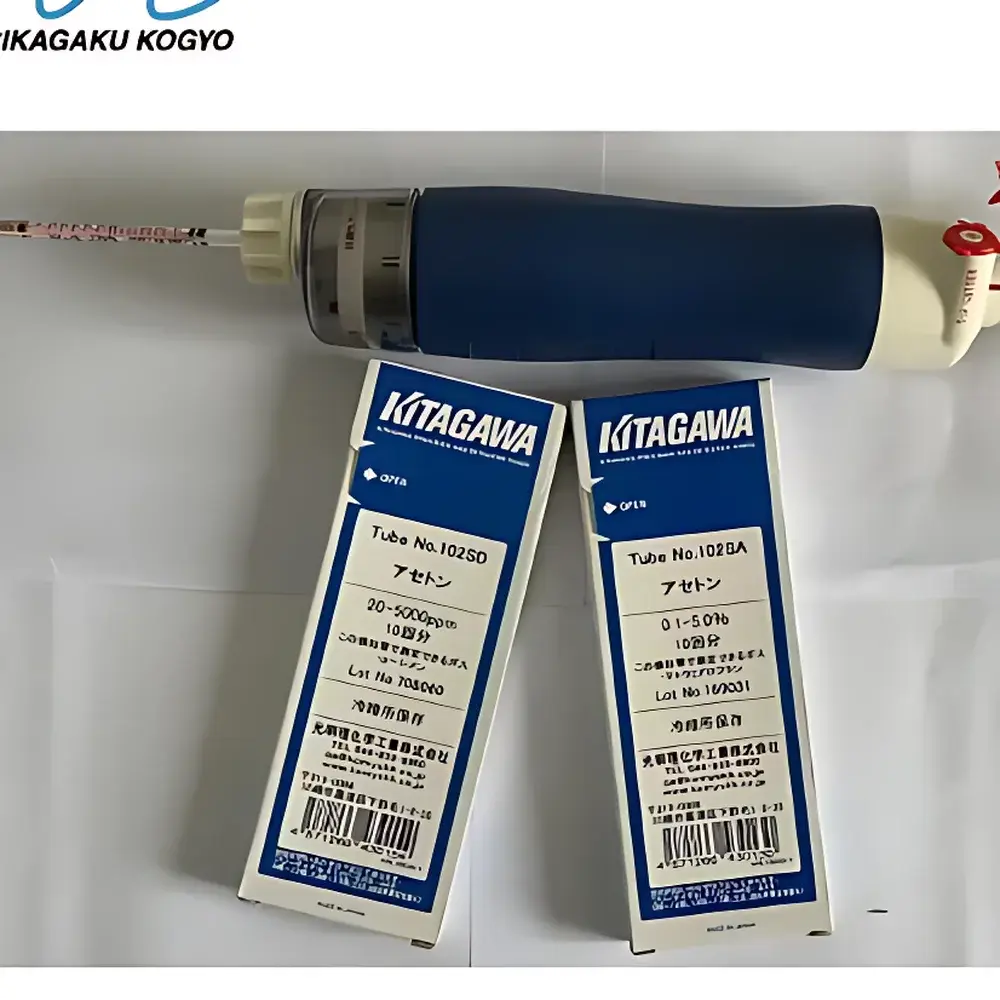
Koki Chemical 102SA Acetone Gas Detection Tube
| Brand | Koki Chemical |
|---|---|
| Origin | Japan |
| Model | 102SA |
| Detection Principle | Colorimetric Reaction via Chromium Oxide Reduction |
| Measuring Range (Acetone) | 0.1–2.0% (100 mL sampling) / 1.0–5.0% (50 mL sampling, Scale I) |
| Measuring Range (THF) | 0.2–3.0% (100 mL, Scale II) / 0.1–2.0% (50 mL, Scale III) |
| Detection Time | 1.5 min per 100 mL |
| LOD | 200 ppm (acetone), 20 ppm (THF) |
| Color Change | Orange → Dark Brown |
| Operating Temperature | 0–40 °C (temperature correction required) |
| Temperature Correction Factor | ×0.2 per 10 °C deviation from 20 °C |
| Interferents | Alcohols, esters, ketones, aromatic hydrocarbons (>0.5% halogenated hydrocarbons cause positive bias) |
| Humidity Effect | None |
| Pressure Correction | Required — apply formula: corrected ppm = measured ppm × 1013 hPa ÷ actual barometric pressure (hPa) |
| Compliance | Designed for field use in accordance with JIS K 0804 and ISO 8518 (colorimetric gas detection tubes) |
Overview
The Koki Chemical 102SA Acetone Gas Detection Tube is a precision-engineered, single-use colorimetric indicator tube designed for rapid, on-site quantification of acetone vapor in ambient air. Based on the established principle of selective chromogenic oxidation-reduction chemistry, the tube employs a pre-impregnated solid-phase reagent bed containing chromium oxide (CrO3) as the active sensing agent. Upon exposure to acetone, CrO3 is reduced stoichiometrically, generating a visible color transition from orange to dark brown proportional to analyte concentration. The length of the stained zone along the calibrated glass tube provides direct readout in volume percent (% v/v), with traceable calibration validated against gravimetric and dynamic dilution standards. Unlike electronic sensors, this passive method requires no power, zero calibration drift, and delivers immediate results within 90 seconds per 100 mL sample—making it ideal for emergency response, industrial hygiene surveys, laboratory fume hood verification, and routine workplace exposure monitoring where portability, speed, and operational simplicity are critical.
Key Features
- Two-tier dual-range capability: Simultaneous support for high-sensitivity (0.1–2.0% v/v, 100 mL draw) and extended-range (1.0–5.0% v/v, 50 mL draw) acetone detection using dedicated scale markings
- Cross-reactivity utility: Integrated conversion scales enable semi-quantitative estimation of tetrahydrofuran (THF) concentrations—0.2–3.0% v/v (100 mL, Scale II) and 0.1–2.0% v/v (50 mL, Scale III)—leveraging shared chemical reactivity pathways
- Rigorous temperature compensation protocol: Includes empirically derived correction tables for both acetone and THF across 0–40 °C, with linear scaling factor (×0.2 per 10 °C deviation from 20 °C reference)
- Barometric pressure adjustment: Built-in correction formula ensures accuracy under non-standard atmospheric conditions (corrected ppm = measured ppm × 1013 hPa ÷ local pressure)
- Robust mechanical design: Borosilicate glass construction with laser-etched graduations; optimized for compatibility with standard hand-pump samplers (e.g., Gastec, Dräger, Sensidyne)
- Defined interference profile: Documented response to common co-volatiles—including alcohols, esters, ketones, aromatics, and halogenated hydrocarbons—enabling informed interpretation in complex matrices
Sample Compatibility & Compliance
The 102SA tube is validated for use with ambient air samples collected via manual piston or bellows-type sampling pumps. It is not intended for direct insertion into process streams, high-humidity condensate environments, or aerosol-laden exhaust ducts without prior particulate filtration. While humidity exhibits no measurable effect on performance, users must perform mandatory temperature and pressure corrections when operating outside 20 °C and 1013 hPa reference conditions. The tube conforms to Japanese Industrial Standard JIS K 0804 (“Gas Detection Tubes — General Rules”) and aligns with ISO 8518:2017 (“Air quality — Determination of gases and vapours — Use of detector tubes”). Though not certified for regulatory compliance reporting under OSHA PEL or ACGIH TLV® frameworks, its measurement uncertainty (±15% at mid-range) supports qualitative screening and tier-1 exposure assessment in accordance with NIOSH Manual of Analytical Methods (NMAM) Chapter 5.2. All lot-specific calibration certificates and stability data are provided by Koki Chemical Co., Ltd. (Tokyo, Japan), and batch traceability is maintained through printed lot numbers on each tube packaging.
Software & Data Management
This is a standalone analog detection device requiring no software interface, firmware updates, or digital connectivity. Quantitative results are obtained manually via visual comparison of stain length against printed scales. For documentation purposes, users may record readings in paper-based field logs, Excel spreadsheets, or LIMS-compatible templates. No electronic audit trail or 21 CFR Part 11 compliance features are incorporated—consistent with the instrument class definition of disposable, non-electronic gas detection tubes. However, the inclusion of standardized correction protocols (temperature, pressure) supports GLP-aligned data handling when integrated into structured environmental monitoring programs.
Applications
- Industrial hygiene assessments in paint manufacturing, pharmaceutical solvent recovery units, and adhesive formulation facilities
- Routine verification of fume hood containment efficiency during acetone-based cleaning operations
- Emergency leak response in storage areas, transport vehicles, or laboratory spill scenarios
- Pre-operational checks prior to confined space entry where acetone or THF residues may persist
- Educational demonstrations of gas-phase redox chemistry and occupational exposure principles
- Complementary screening tool alongside GC-FID or PID instruments to triage sampling priorities
FAQ
How do I correct for temperature when reading the tube?
Apply the published temperature correction table specific to acetone or THF. For deviations from 20 °C, multiply the observed % value by the corresponding correction factor (e.g., at 30 °C, multiply by 0.86 for acetone at 2.0% reading).
Can I use this tube for continuous monitoring?
No. The 102SA is a single-use, discrete sampling device. Each tube is designed for one measurement only and must be discarded after reading.
What pump volume should I use for accurate results?
Standard operation uses 100 mL at 1.5 minutes. For higher concentrations, draw 50 mL four times consecutively (total 200 mL) and apply Scale I or III accordingly—see instruction manual for sequence details.
Does humidity affect the result?
No. The reagent system is formulated to remain insensitive to relative humidity across 10–95% RH.
How should I store unused tubes?
Store unopened tubes at 10–30 °C in original desiccated packaging, away from direct sunlight and organic solvent vapors. Shelf life is 24 months from manufacture date when stored properly.
Related Products







