
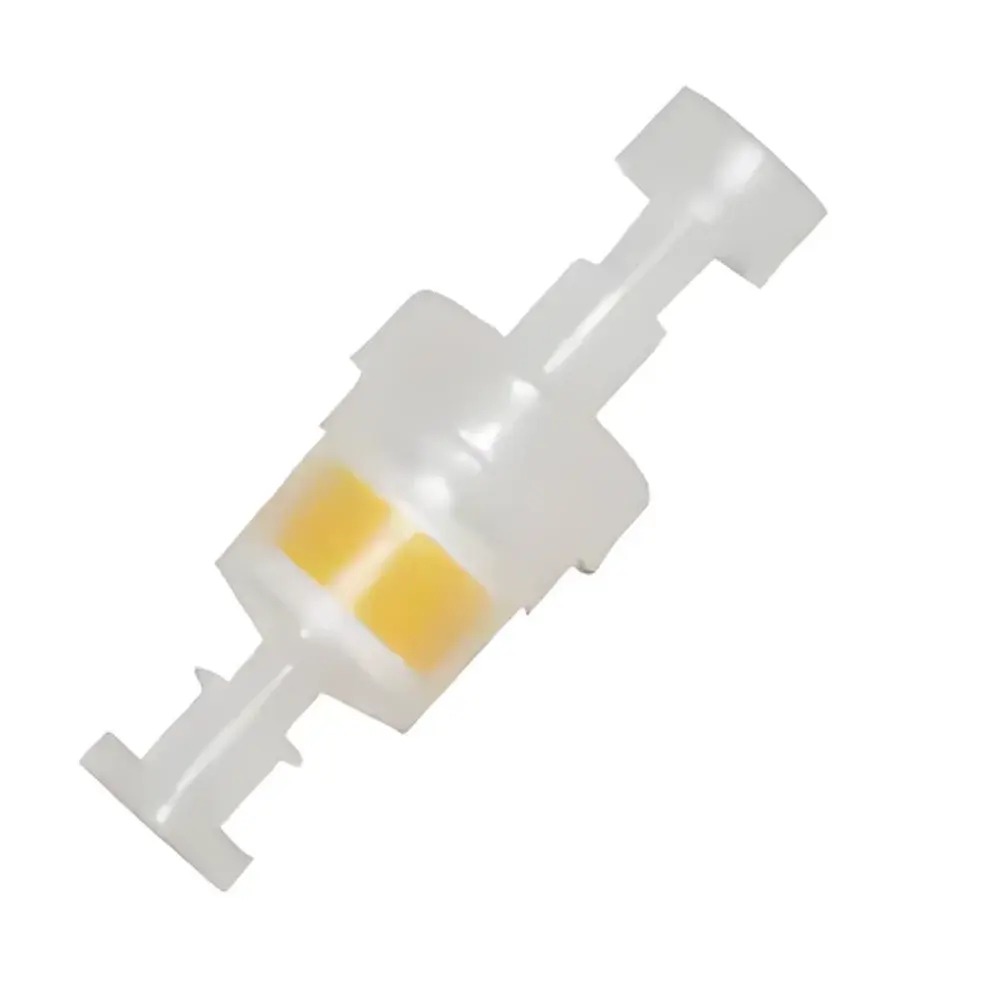
DNPH 815H Aldehyde and Ketone Sampling Cartridge – Guangming Lihua (Imported from Japan)
| Brand | Guangming Lihua |
|---|---|
| Origin | Japan |
| Model | DNPH 815H |
| Type | Single-Channel Handheld Air Sampling Cartridge for Carbonyl Compounds |
| Flow Rate | 0.2 L/min |
| Pressure Drop | 0.3 kPa at 0.2 L/min |
| Flow Stability | ±5% |
| Flowmeter Accuracy | ±5% |
| Service Life at Max Flow & Backpressure | 100 h |
| Continuous Operation at Max Flow & Backpressure | 2 min |
| DNPH Coating Mass | ~1 mg |
| Sorbent Mass | ~400 mg Silica Gel Impregnated with DNPH |
| Blank Levels (Factory Tested) | Formaldehyde <0.03 µg, Acetaldehyde <0.03 µg, Acetone <0.10 µg |
| Carbonyl Collection Capacity | 2.3 µmol (e.g., ~70 µg formaldehyde) |
| Recovery Rates (Reported) | Formaldehyde 99.3%, Acetaldehyde 102.6%, Acetone 95.4% |
| Shelf Life | 12 months (refrigerated storage required) |
| Package | 10 units per bag |
Overview
The DNPH 815H Aldehyde and Ketone Sampling Cartridge is a pre-packed, chemically impregnated solid-phase sorbent tube engineered for the quantitative collection of airborne carbonyl compounds—including formaldehyde, acetaldehyde, acetone, and other low-molecular-weight aldehydes and ketones—in ambient air, indoor environments, and occupational settings. It operates on the principle of derivatization-based sampling: carbonyls in the sampled air stream react selectively with 2,4-dinitrophenylhydrazine (DNPH) immobilized on high-purity silica gel to form stable hydrazone derivatives. This chemical trapping ensures minimal analyte loss during sampling, transport, and storage—enabling high-fidelity quantification via subsequent HPLC-UV analysis (typically at 360 nm). Designed for compatibility with standard low-flow personal and area air sampling pumps (e.g., ASP-1200 or ASP-250), the cartridge delivers reproducible performance under regulated flow conditions (0.2 L/min), with low pressure drop (<0.3 kPa) and rigorously controlled blank levels—critical for compliance with ISO 16000-3, EPA TO-11A, and JIS K 0321 methodologies.
Key Features
- Pre-calibrated DNPH loading (~1 mg) on ~400 mg high-surface-area silica gel matrix for consistent derivatization efficiency
- Ultra-low factory-measured blanks: formaldehyde & acetaldehyde <0.03 µg; acetone <0.10 µg—reducing detection limit constraints in trace-level monitoring
- Validated recovery rates exceeding 95% across key target analytes (formaldehyde: 99.3%; acetaldehyde: 102.6%; acetone: 95.4%), supporting quantitative accuracy per ISO/IEC 17025 requirements
- Stable post-sampling integrity: derivatized carbonyls remain intact for ≥14 days at room temperature and ≥12 months when refrigerated (2–8 °C)
- Optimized hydrodynamic design: pressure drop remains ≤0.3 kPa at 0.2 L/min and ≤2.8 kPa at 1.5 L/min—minimizing pump load and enabling use with compact, battery-powered sampling systems
- Single-channel configuration with standardized 3.5 mm OD × 85 mm length format—compatible with all major HPLC autosampler racks and thermal desorption accessories
Sample Compatibility & Compliance
The DNPH 815H cartridge is validated for use in human exposure assessment, indoor air quality (IAQ) surveys, workplace air monitoring (per OSHA and ACGIH TLV® guidelines), and ambient atmospheric studies. Its performance aligns with internationally recognized analytical protocols, including EPA Method TO-11A (for formaldehyde and C2–C13 carbonyls), ISO 16000-3 (indoor air—determination of formaldehyde), and JIS K 0321 (Japanese Industrial Standard for carbonyl compound measurement). All lots undergo batch-certified blank testing and recovery verification prior to release. The cartridge supports GLP-compliant workflows when paired with audit-trail-enabled sampling pumps and LIMS-integrated HPLC data systems meeting FDA 21 CFR Part 11 requirements.
Software & Data Management
While the DNPH 815H is a passive sampling medium and does not incorporate embedded electronics or firmware, its integration into regulated analytical workflows relies on interoperability with validated chromatographic data systems (CDS). When used with HPLC platforms such as Hitachi LaChrom Elite equipped with UV/VIS detectors (360 nm), the cartridge enables automated peak integration, calibration curve generation (linear or quadratic), and report generation compliant with ISO/IEC 17025 documentation standards. Raw chromatographic data (e.g., .cdf or .u2 files) may be archived alongside field logs—including pump serial number, flow rate, duration, temperature, and relative humidity—to support full traceability and audit readiness.
Applications
- Occupational hygiene monitoring for formaldehyde in plywood manufacturing, textile finishing, and healthcare sterilization facilities
- Indoor air quality assessments in schools, offices, and residential buildings following renovation or furniture installation
- Urban and roadside ambient air monitoring networks targeting secondary organic aerosol (SOA) precursors
- Method validation and reference material preparation in accredited environmental testing laboratories
- Field-deployable screening for carbonyl emissions from building materials, adhesives, and coatings per EN 717-1 and ASTM D6007
FAQ
What is the recommended sampling flow rate and duration for occupational exposure assessment?
The validated flow rate is 0.2 L/min; typical sampling durations range from 15 min (short-term exposure limit evaluation) to 8 h (full-shift TWA assessment), yielding collection volumes of 0.18–9.6 L.
Can the cartridge be used for formaldehyde only, or does it capture other carbonyls?
It captures a broad spectrum of aliphatic and aromatic carbonyls—including formaldehyde, acetaldehyde, propionaldehyde, butyraldehyde, acetone, methyl ethyl ketone (MEK), and benzaldehyde—provided they are volatile and reactive toward DNPH.
How should used cartridges be stored before analysis?
Immediately after sampling, seal both ends with supplied caps, store at 2–8 °C in the dark, and analyze within 14 days. For extended hold times, freeze at −20 °C (validated up to 30 days).
Is derivatization complete upon sampling, or is post-extraction reaction required?
Derivatization occurs in real time during sampling. No additional reaction step is needed; extracted hydrazones are directly injectable into HPLC after acetonitrile elution and filtration.
Does the cartridge meet regulatory requirements for reporting to national air quality databases?
Yes—when deployed per EPA TO-11A or ISO 16000-3 protocols and analyzed using accredited methods, data generated with the DNPH 815H satisfies reporting criteria for EEA, US EPA AIRS, and Japan’s Ministry of the Environment.
Related Products







