
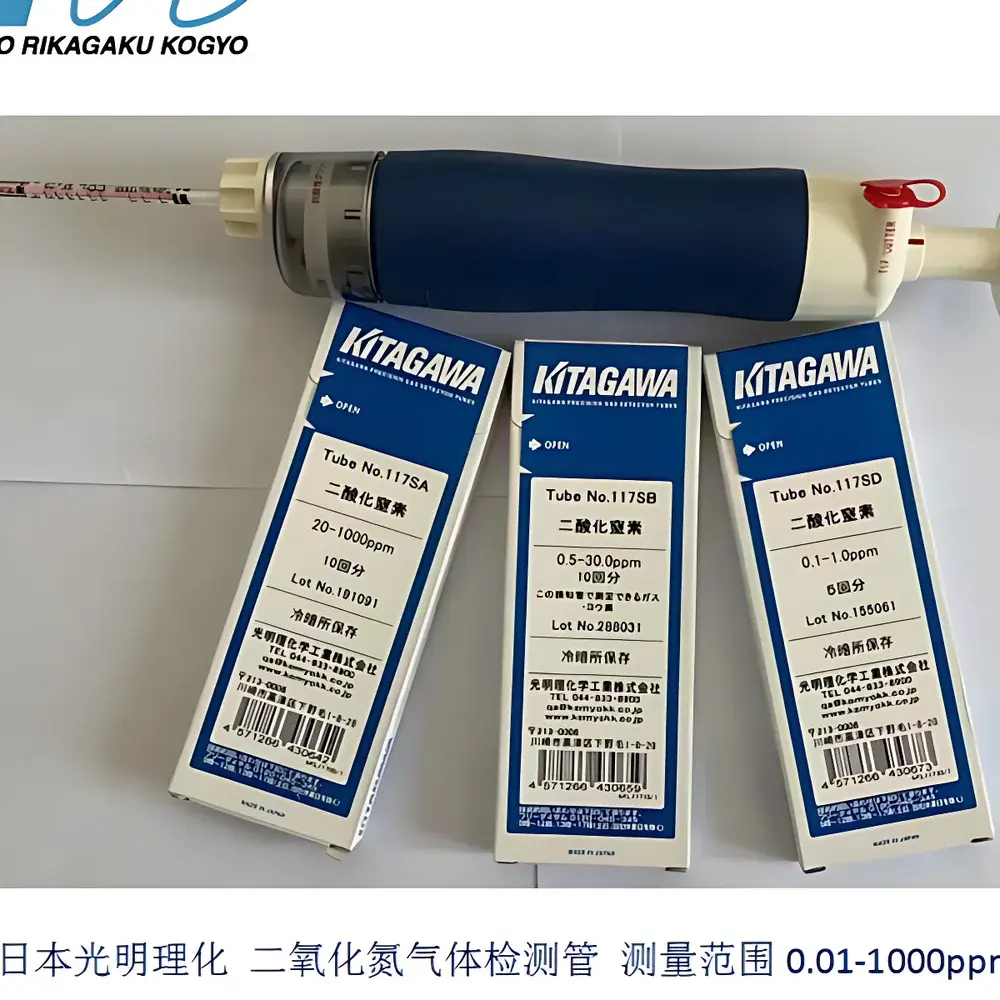
NorthKawakami NO₂ Gas Detection Tubes 117SA / 117SB / 117SD
| Brand | Meikun Rikagaku |
|---|---|
| Origin | Japan |
| Type | Imported |
| Models | 117SA (20–1000 ppm), 117SB (0.5–30 ppm), 117SD (0.1–1.0 ppm), 740 (0.01–0.1 ppm / 0.02–0.2 ppm) |
| Pack Size | 117SA/117SB: 10 tubes/box |
| 117SD | 5×2 tubes/box |
| 740 | 10 tubes/box |
| Compatible Pump | AP-20 hand pump (standard), ASP-1200 electric pump (required for Model 740) |
| Principle | Colorimetric reaction via impregnated reagent layer |
| Measurement Method | Visual readout of stain front position against calibrated scale |
| Safety | Battery-free, spark-free, intrinsically safe for field use |
Overview
The NorthKawakami NO₂ Gas Detection Tubes (Models 117SA, 117SB, 117SD, and 740) are precision-calibrated, single-use colorimetric devices engineered for rapid, on-site quantification of nitrogen dioxide (NO₂) in ambient air, workplace atmospheres, and industrial exhaust streams. Based on the well-established length-of-stain principle, each tube contains a chemically impregnated silica gel or glass bead matrix that undergoes a stoichiometric, irreversible color reaction upon exposure to NO₂. The resulting stain front advances linearly along the tube’s calibrated scale in proportion to the integrated concentration–time product (C × t), enabling direct concentration determination when used with a defined sampling volume and flow rate. This method complies with fundamental principles outlined in ISO 8518:2021 (Air quality — Determination of gases — Use of detector tubes) and serves as a validated screening tool aligned with OSHA and NIOSH interim guidance for short-term exposure assessment.
Key Features
- Four distinct measurement ranges optimized for diverse operational scenarios: 117SA (20–1000 ppm) for high-concentration leak detection or stack monitoring; 117SB (0.5–30 ppm) for general industrial hygiene and process control; 117SD (0.1–1.0 ppm) for low-level occupational exposure evaluation; and Model 740 (0.01–0.1 ppm / 0.02–0.2 ppm) for ultra-trace environmental baseline or indoor air quality (IAQ) surveys.
- Intrinsically safe design: No electrical components, batteries, or ignition sources required—ideal for Zone 0/1 hazardous areas per IEC 60079-0.
- Standardized compatibility with the AP-20 dual-stroke hand pump (100 mL stroke volume, ±5% volumetric accuracy per ISO 8518 Annex B); Model 740 requires the ASP-1200 programmable electric pump for precise low-flow delivery (10–100 mL/min).
- Pre-calibrated linear scales with dual-end readability; stain front is sharp and stable for ≥5 minutes post-sampling, minimizing parallax error.
- Individually sealed in aluminum-laminated foil pouches with desiccant, ensuring shelf life of ≥24 months when stored at 5–30 °C and <60% RH.
Sample Compatibility & Compliance
These tubes are validated for use in clean, dry air matrices. High humidity (>80% RH), aerosols, or coexisting gases such as Cl₂, SO₂, or ozone may interfere with the selective NO₂ reaction and require documented correction factors or pre-sampling filtration (e.g., KI-coated particulate filter for ozone removal). Each lot undergoes batch certification per JIS K 0111 and includes traceable calibration certificates referencing NIST-traceable NO₂ standard gas mixtures. The system supports GLP-aligned documentation when paired with standardized sampling logs and pump calibration records. While not a replacement for reference-grade chemiluminescence analyzers (per EPA Method 7E), it meets ASTM D5466–22 criteria for field screening and triage applications.
Software & Data Management
As analog, visual-read instruments, the 117-series tubes do not interface with digital software. However, quantitative results are fully compatible with laboratory information management systems (LIMS) and electronic field notebooks via manual entry or barcode-assisted logging (each box carries a unique batch ID and expiration date). For audit readiness, users are advised to retain used tubes for ≥30 days alongside completed sampling forms documenting date, time, location, pump strokes, observer ID, and environmental conditions—satisfying basic FDA 21 CFR Part 11 record retention expectations for non-automated measurements.
Applications
- Routine workplace exposure monitoring during welding, nitric acid handling, or diesel engine maintenance.
- Emergency response screening following chemical spills or confined-space entry assessments.
- Verification of local exhaust ventilation (LEV) performance in plating or semiconductor fabrication facilities.
- Baseline IAQ surveys in schools, hospitals, or near traffic corridors where chronic NO₂ exposure is a regulatory concern (e.g., EU Directive 2008/50/EC limit values).
- Educational demonstrations of gas-phase stoichiometry and diffusion-controlled reaction kinetics in analytical chemistry laboratories.
FAQ
What is the recommended sampling protocol for Model 117SB?
Use the AP-20 hand pump with two full strokes (200 mL total volume) at a steady rate (~1 stroke/second); read the stain front within 2 minutes after completion.
Can these tubes be reused?
No—each tube is a single-use, disposable device. Reuse compromises accuracy due to irreversible reagent depletion and potential cross-contamination.
Is temperature compensation required?
Yes. Readings must be corrected using the temperature coefficient provided in the batch-specific instruction sheet (typically –1.2%/°C deviation from 20 °C reference).
How does Model 740 differ from the 117-series in analytical performance?
Model 740 employs a higher-sensitivity reagent formulation and extended tube geometry, enabling sub-ppm resolution; its use mandates the ASP-1200 pump to maintain laminar flow and prevent breakthrough error.
Are calibration gases traceable to international standards?
Yes—Meikun Rikagaku certifies all calibration against NIST SRM 2691a (NO₂ in nitrogen) and participates in annual interlaboratory comparison programs accredited to ISO/IEC 17043.







