
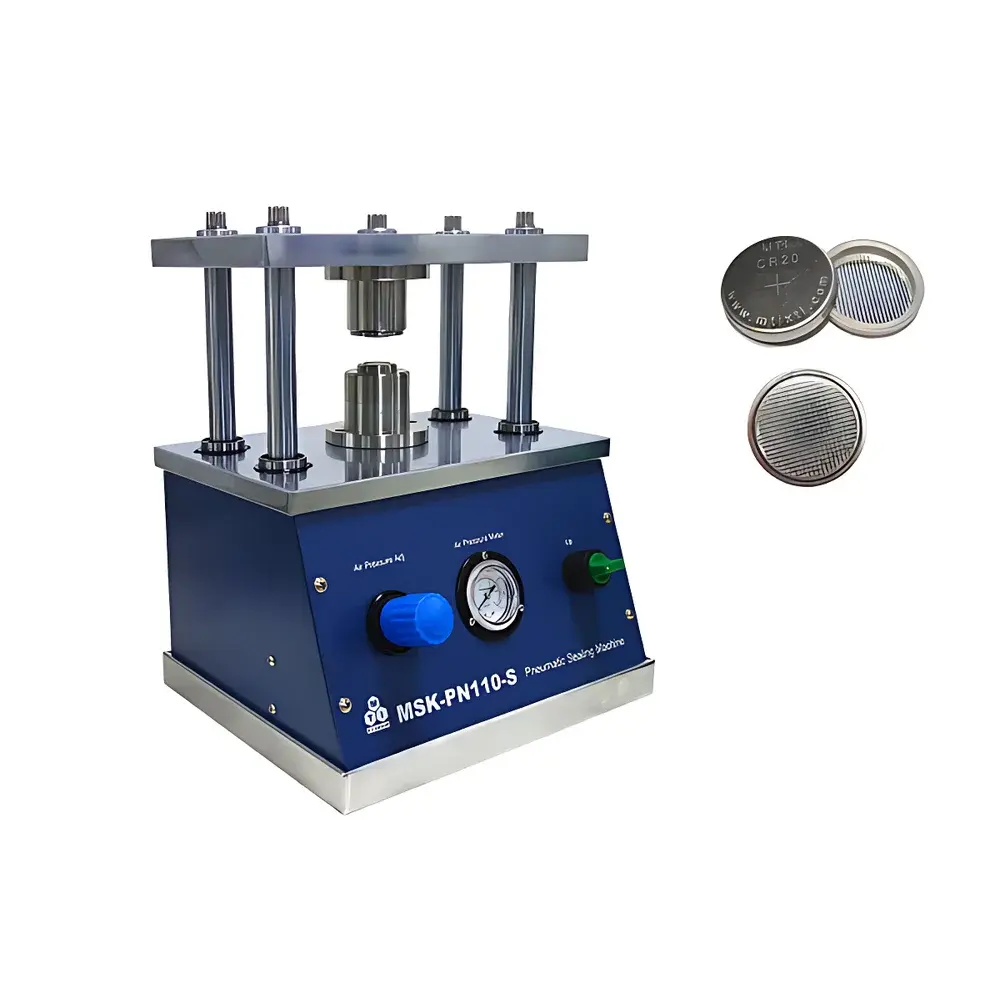
MSK-PN110-S Small Pneumatic Button Cell Crimping Press
| Brand | MTI Corporation (formerly Hefei Kejing) |
|---|---|
| Origin | Anhui, China |
| Model | MSK-PN110-S |
| Drive Gas Pressure Range | 0.7–1.2 MPa (recommended: 0.9 MPa) |
| Stroke Distance | 20 mm |
| Gas Consumption per Cycle | 490 mL |
| Standard Die Set | 20-series (2016, 2025, 2032) |
| Optional Dies | 24-series, Disassembly Dies |
| Die Material | Hardened Tool Steel |
| Housing Material | Heavy-Duty Steel |
| Dimensions (L×W×H) | 290 × 260 × 350 mm |
| Weight | ~28 kg |
| Warranty | 12 months, lifetime technical support |
| Compliance | Designed for inert-atmosphere glovebox integration (O₂/H₂O < 1 ppm), compatible with ISO 14644-1 Class 5 cleanroom practices when installed in controlled enclosures |
Overview
The MSK-PN110-S is a compact, pneumatically actuated crimping press engineered specifically for the reproducible and contamination-free assembly of laboratory-scale lithium-ion and solid-state button cells. Unlike hydraulic or mechanical crimpers, it utilizes regulated inert gas (e.g., Ar or N₂) as the sole actuation medium—eliminating lubricants, hydraulic fluids, or moving parts prone to particulate shedding. This architecture ensures intrinsic compatibility with high-purity glovebox environments (O₂/H₂O < 1 ppm), where even trace hydrocarbon or moisture contamination can compromise electrode/electrolyte interfacial stability. The device operates on the principle of controlled gas-driven linear displacement: pressurized gas enters a sealed cylinder, generating repeatable axial force transmitted via a hardened steel plunger to the crimp die set. Force magnitude is directly proportional to input pressure and effective piston area—enabling sub-bar resolution in pressure tuning and thus precise control over crimp height, shell deformation, and internal cell resistance. Its design prioritizes metrological integrity: all load paths are fully constrained, minimizing lateral deflection and ensuring uniform radial compression across the battery can perimeter.
Key Features
- Pneumatic actuation with manual pressure regulator (0.7–1.2 MPa range), enabling fine-tuned, non-damaging crimp force application without thermal drift or hysteresis
- Hardened tool steel die sets (standard 20-series: 2016, 2025, 2032; optional 24-series and disassembly dies available) for dimensional repeatability and long-term wear resistance
- Glovebox-ready construction: zero oil, zero grease, zero volatile organics; gas inlet/outlet ports fitted with standard Φ6 pneumatic quick-connect fittings
- Fixed 20 mm stroke with mechanical end-stop, preventing over-compression and ensuring consistent crimp geometry across batches
- Heavy-duty steel frame with vibration-damped base, supporting stable operation on benchtops or integrated glovebox platforms
- Gas consumption optimized at 490 mL per full cycle—minimizing inert gas usage and operational cost in continuous lab workflows
Sample Compatibility & Compliance
The MSK-PN110-S accommodates standard CR20xx and BR20xx coin cell configurations (2016, 2025, 2032) using interchangeable, precision-ground dies. Optional 24-series dies extend compatibility to larger-format research cells. All dies maintain ±2 µm parallelism tolerance and surface roughness Ra < 0.4 µm—critical for achieving uniform electrolyte wetting and low interfacial impedance. The system complies with fundamental safety and environmental requirements for electrochemical R&D: it contains no hazardous substances per RoHS Directive 2011/65/EU; its inert-gas-only operation meets ASTM D6184-22 guidelines for handling air-sensitive battery materials; and its sealed-force transmission path satisfies GLP documentation prerequisites for traceable cell fabrication protocols. When deployed inside argon-filled gloveboxes, it requires no external venting—gas exhaust is recirculated through the box’s purification loop.
Software & Data Management
The MSK-PN110-S is a manually operated, analog-control instrument with no embedded microprocessor or digital interface. Pressure regulation is performed via calibrated mechanical gauge and needle valve—ensuring deterministic, drift-free operation without firmware dependencies or cybersecurity vulnerabilities. For laboratory quality systems requiring audit trails, users integrate the device into documented SOPs: crimp pressure, batch ID, die lot number, and operator signature are recorded manually in bound logbooks or electronic lab notebooks (ELNs) compliant with 21 CFR Part 11. Optional pressure data logging is achievable via external industrial-grade pressure transducers (e.g., Honeywell PX2EF series) connected to DAQ systems running LabVIEW or Python-based acquisition scripts.
Applications
This press serves core functions in academic and industrial battery development labs: prototype cell assembly for half-cell and full-cell electrochemical testing; parameter screening of separator compression effects on ionic conductivity; validation of novel current collector adhesion under controlled crimp stress; and fabrication of reference electrodes for in-situ XRD or operando EIS studies. Its reproducibility supports statistical design of experiments (DoE) involving crimp pressure as an independent variable—enabling correlation of mechanical sealing integrity with cycle life, Coulombic efficiency, and gas evolution rates measured by differential electrochemical mass spectrometry (DEMS). It is routinely employed in labs adhering to IEEE 1625 and IEC 62133 prequalification protocols for portable energy storage devices.
FAQ
Can the MSK-PN110-S be used outside a glovebox?
Yes—though inert gas actuation is strongly recommended for Li-metal or sulfide-based electrolytes; compressed air may be used for non-air-sensitive chemistries (e.g., aqueous Zn-ion), provided local ventilation and corrosion mitigation are implemented.
What maintenance does the unit require?
Monthly inspection of O-rings and pneumatic fittings; cleaning of die surfaces with anhydrous ethanol after each use to prevent electrolyte residue buildup; annual calibration of the pressure gauge against a NIST-traceable reference standard.
Is the crimp force quantitatively measurable?
Force is derived from applied pressure and known piston area (calculated per manufacturer datasheet); for direct force measurement, users mount a calibrated load cell between plunger and die holder.
Does MTI provide ISO/IEC 17025-accredited calibration certificates?
Calibration services are offered upon request; certificates include uncertainty budgets traceable to national metrology institutes (NMI) and conform to ILAC-MRA requirements.
Can custom dies be fabricated for non-standard cell geometries?
Yes—MTI accepts dimensional drawings and material specifications for bespoke die sets, subject to minimum order quantity and lead time confirmation.





