
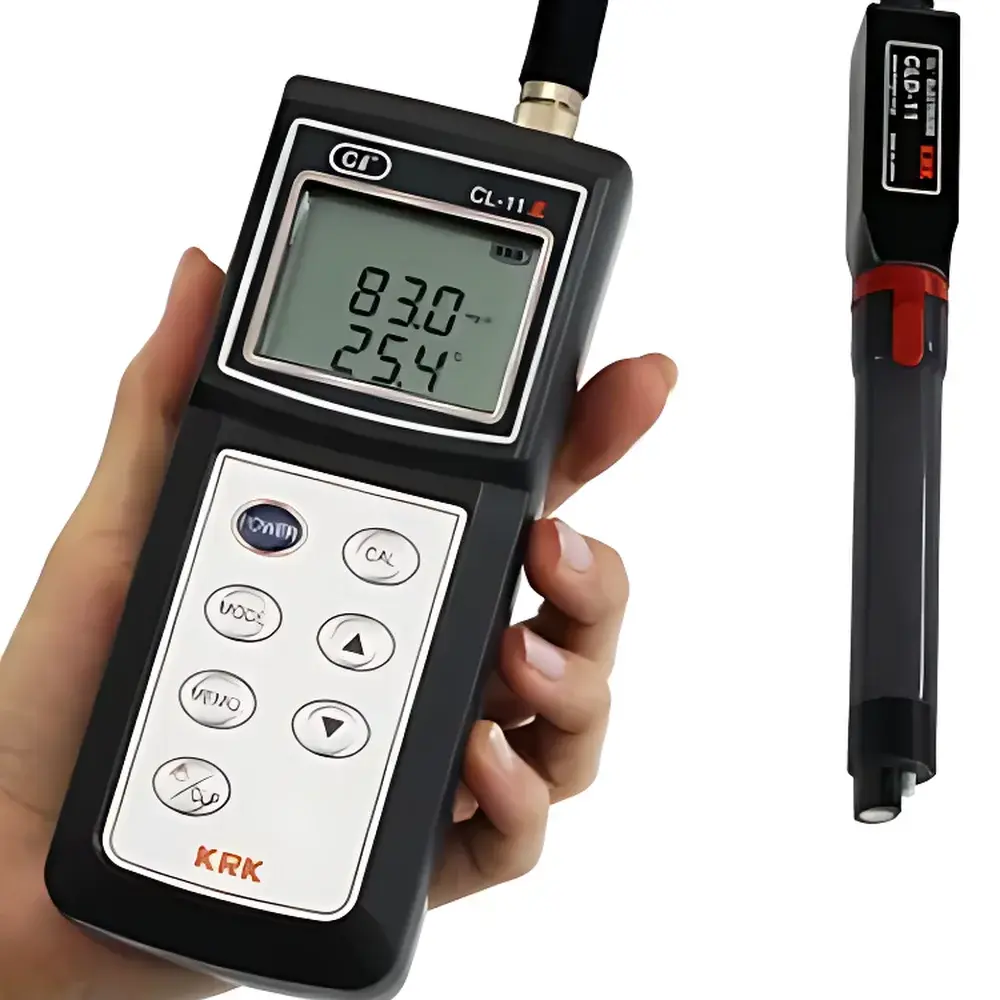
Rikorika CL-11Z Portable Chloride Ion Analyzer
| Brand | Rikorika |
|---|---|
| Origin | Japan |
| Model | CL-11Z |
| Instrument Type | Portable |
| Measurement Range | 0–2000 mg/L (ppm) Cl⁻ |
| Detection Limit | 0.1 mg/L |
| Response Time | 1 s |
| Accuracy | ±2% of reading |
| Temperature Compensation | Automatic (NTC thermistor) |
| Operating Temperature | 0–45 °C |
| IP Rating | IP67 |
| Display | 4-digit LCD with backlight |
| Resolution | 0.1 mg/L (0.1–99.9 mg/L), 1 mg/L (100–2000 mg/L) |
| Repeatability | ±2 mg/L (0.1–99.9 mg/L), ±5 mg/L (100–2000 mg/L) |
| Memory Capacity | 30 data points |
| Dimensions (main unit) | 70 × 40 × 173 mm (W × H × D) |
| Weight (main unit + electrode + 1 m cable) | ~430 g |
| Standard Accessories | CLD-11 chloride-selective electrode, CLSLN-10-50 & CLSLN-1000-50 standard solutions (50 mL each), CLDLQ-30 internal filling solution (30 mL), two syringes, ISAB solution (50 mL), user manual, warranty card, AA batteries |
Overview
The Rikorika CL-11Z is a field-deployable, potentiometric chloride ion analyzer engineered for rapid, on-site quantification of aqueous chloride concentration (Cl⁻) in environmental, industrial, and wastewater applications. It operates on the principle of ion-selective electrode (ISE) potentiometry: a chloride-selective membrane—typically based on silver sulfide (Ag₂S) or tungsten disulfide (WS₂)—generates a Nernstian potential shift proportional to the logarithm of chloride activity in solution. The integrated glass-body reference electrode (CLD-11) ensures stable junction potential and minimizes liquid junction drift. Built-in automatic temperature compensation (ATC) via an NTC thermistor corrects for thermal effects on electrode slope and sample activity, enabling reliable measurements across 0–45 °C without manual recalibration. Designed for regulatory-compliant field use, the CL-11Z delivers trace-level detection (0.1 mg/L LOD) with sub-second response kinetics and meets ISO 7888 and ASTM D4192 requirements for chloride determination in natural waters and treated effluents.
Key Features
- True portable architecture: compact main unit (70 × 40 × 173 mm) and lightweight design (~430 g with electrode and cable) for handheld operation in remote sampling locations.
- IP67-rated enclosure: fully dust-tight and protected against immersion up to 1 m for 30 minutes—suitable for humid, splash-prone, or outdoor deployment.
- Backlit 4-digit LCD display: high-contrast readout visible under low-light conditions; supports dual-mode output (Cl⁻ concentration in mg/L and raw mV potential).
- High-fidelity chloride ISE (CLD-11): solid-state, glass-bodied sensor with optimized membrane composition for selectivity over common interferents (e.g., Br⁻, I⁻, CN⁻) and minimal drift over extended field use.
- No ISAB addition required during calibration: pre-conditioned electrode design eliminates procedural variability associated with ionic strength adjustment buffer dosing.
- Two-point calibration protocol: uses certified Rikorika standard solutions (10 mg/L and 1000 mg/L Cl⁻) to establish linear response across full dynamic range (0–2000 mg/L).
- Onboard memory storage: retains up to 30 measurement records with timestamp and temperature metadata for audit-ready data logging.
Sample Compatibility & Compliance
The CL-11Z is validated for direct measurement of chloride in freshwater, surface water, groundwater, municipal wastewater, septic tank effluent, aquaculture systems, and saline process streams. It is not suitable for strongly oxidizing matrices (e.g., free chlorine >0.5 mg/L), highly turbid suspensions (>50 NTU), or samples containing >1000 mg/L suspended solids without filtration. Electrode performance conforms to ISO 9964-1 (ion-selective electrodes — terminology and general specifications) and supports GLP-aligned workflows through traceable calibration standards and documented measurement protocols. While not intrinsically compliant with FDA 21 CFR Part 11, its data export capability (via optional RS-232 interface) enables integration into validated LIMS environments where electronic record integrity is enforced.
Software & Data Management
The CL-11Z operates as a standalone instrument with no embedded firmware-based software stack. All calibration, measurement, and memory functions are implemented in hardware logic for deterministic response and immunity to OS-level vulnerabilities. Calibration coefficients and temperature compensation parameters are stored in non-volatile memory. Data retrieval requires manual transcription or optional serial connection to a PC running terminal emulation software (e.g., Tera Term). For regulated laboratories, Rikorika provides a complete validation package—including Certificate of Conformance, electrode certification reports, and standard solution traceability documentation—to support IQ/OQ/PQ execution per ISO/IEC 17025 requirements.
Applications
- Septic system monitoring: Quantifies chloride dilution ratios to assess hydraulic loading and treatment efficiency—critical for compliance with local discharge ordinances (e.g., JIS A 3302).
- Environmental baseline studies: Tracks chloride intrusion in coastal aquifers or road-salt contamination in snowmelt runoff.
- Aquaculture management: Maintains optimal salinity profiles by correlating Cl⁻ concentration with total dissolved solids (TDS) in recirculating systems.
- Industrial pretreatment verification: Confirms chloride removal efficacy in electrocoagulation or ion exchange units prior to discharge to municipal sewers.
- Educational field labs: Serves as a pedagogical tool for teaching potentiometric analysis, Nernst equation derivation, and water quality parameter interrelationships.
FAQ
Can the CL-11Z measure free chlorine or total residual chlorine?
No. The CL-11Z detects only chloride ion (Cl⁻), the reduced, non-oxidizing form of chlorine present in salts such as NaCl. Free chlorine (HOCl/OCl⁻) and combined chlorine (chloramines) require amperometric, DPD-colorimetric, or iodometric methods. This distinction is analytically fundamental—not a limitation of sensor design.
Why is chloride measurement critical in septic tank effluent assessment?
Chloride is a conservative tracer: it undergoes no biological degradation during anaerobic digestion. Its concentration in influent (e.g., ~5500 mg/L in human urine) remains stoichiometrically preserved, allowing precise calculation of dilution factors from measured effluent values—enabling quantitative evaluation of infiltration/inflow and system hydraulic retention time.
Does the CL-11Z require ionic strength adjustment (ISAB) during routine use?
No. The CLD-11 electrode is factory-optimized for direct measurement in low-to-moderate ionic strength matrices (0.001–0.1 M). ISAB addition is unnecessary for calibration or sample analysis unless measuring in ultra-low-conductivity waters (<50 µS/cm), where activity corrections may be warranted per ISO 9964-2.
What is the recommended calibration frequency for field deployments?
Calibrate before each sampling session using both 10 mg/L and 1000 mg/L standards. Verify electrode slope (−56 to −59 mV/decade at 25 °C) and zero potential (−10 to +10 mV in 10 mg/L standard) to ensure continued Nernstian behavior. Recalibrate immediately if readings deviate by >±5 mg/L from control check standards.
Is the CLD-11 electrode compatible with other meter platforms?
Yes. The CLD-11 features a standard BNC connector and outputs a stable mV signal compliant with ANSI/ASTM E2081. It can be used with any pH/mV meter supporting high-impedance input (>10¹² Ω) and manual slope/offset entry—though Rikorika-specific calibration algorithms and ATC integration are only available on the CL-11Z platform.







