
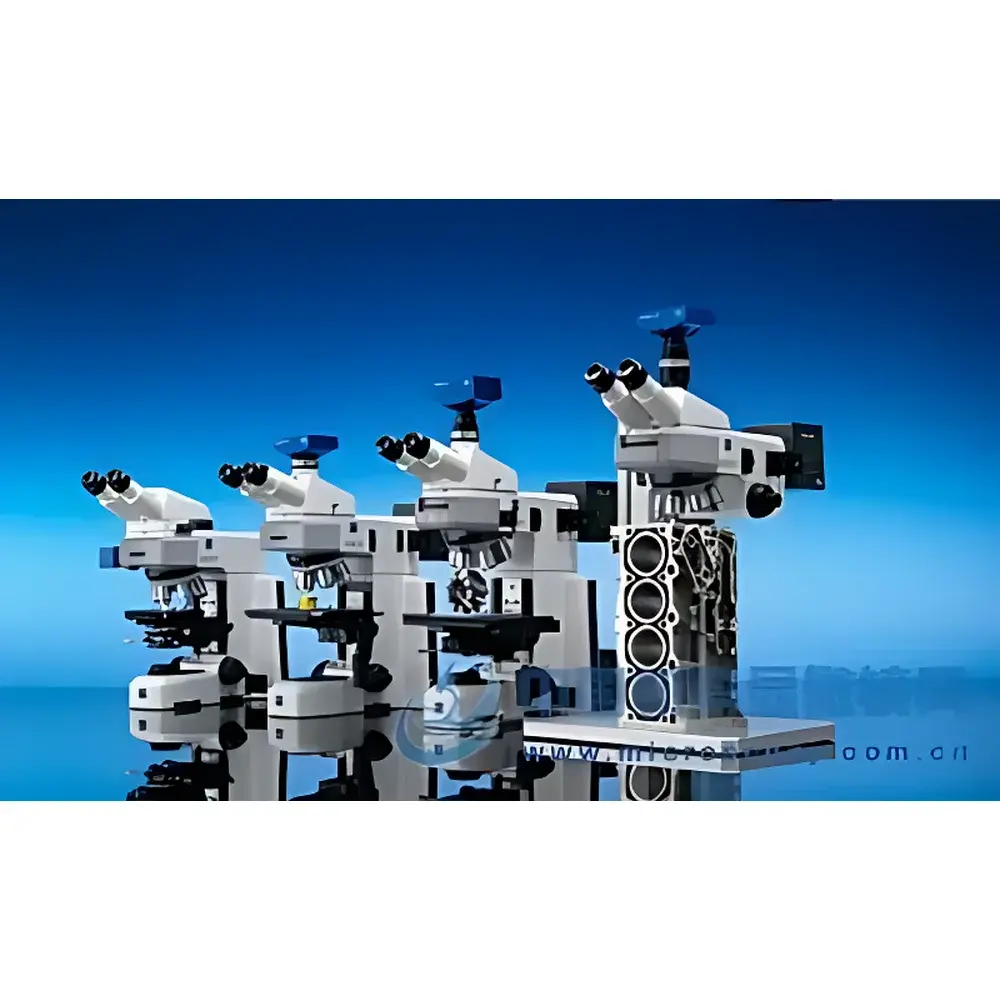
ZEISS Axio Scope A1 Upright Metallurgical Microscope
| Brand | ZEISS |
|---|---|
| Origin | Germany |
| Manufacturer | Carl Zeiss AG |
| Model | Axio Scope A1 |
| Configuration | Upright |
| Total Magnification Range | 50×–1000× |
| Eyepieces | 10×/23 mm field number |
| Objective Lenses | 5×, 10×, 20×, 50×, 100× (optional: 1.25×, 2.5×, 150×) |
| Optical System | Infinity-corrected ICCS (Improved Contrast and Color Corrected System) |
| Mechanical Design | FEM-optimized stand with ACR (Automatic Component Recognition) position encoding |
| Vertical Working Distance | Up to 380 mm |
| Imaging System | Integrated digital imaging workstation (includes high-resolution monochrome/color camera, analysis software, PC, and printer) |
| Upgrade Pathways | Automated motorized stage, particle analysis module, high-temperature metallurgical stage |
Overview
The ZEISS Axio Scope A1 is a research-grade upright metallurgical microscope engineered for precision microstructural analysis of opaque, reflective specimens—primarily metals, alloys, ceramics, and composites. It operates on reflected light (epi-illumination) principles, utilizing Köhler illumination and optimized beam path geometry to deliver high-contrast, aberration-corrected images across the full magnification range (50×–1000×). Designed in accordance with ISO 9001-certified manufacturing protocols at Carl Zeiss AG’s Oberkochen facility in Germany, the Axio Scope A1 integrates ZEISS’s proprietary ICCS (Improved Contrast and Color Corrected System) optics—an infinity-corrected platform that simultaneously corrects chromatic and spherical aberrations while enhancing edge definition and tonal fidelity. Its modular architecture supports rigorous metallurgical workflows including grain size assessment (ASTM E112), inclusion rating (ASTM E45), phase quantification, and defect characterization (e.g., porosity, cracking, segregation), all under standardized lighting conditions compliant with ISO 4096 and EN 13604.
Key Features
- ICCS optical system delivering diffraction-limited resolution and consistent color fidelity across all magnifications, validated per ISO 10934-1 for quantitative microscopy.
- FEM-optimized mechanical stand with 380 mm vertical clearance—enabling analysis of large-section metallographic mounts, heat-treated samples, or multi-layered cross-sections without stage interference.
- Modular configuration: Five interchangeable upper assemblies (including brightfield, darkfield, polarization, DIC, and fluorescence modules) and three lower assemblies (transmitted-light compatible variants available) allow adaptation to diverse specimen types and analytical requirements.
- ACR (Automatic Component Recognition) encoded turret and nosepiece—ensures software-synchronized objective identification, magnification calibration, and illumination parameter recall for GLP/GMP traceability.
- User-serviceable modularity: Lens changers, filter sliders, and illumination diaphragms are tool-free replaceable; no certified technician required for routine reconfiguration or field upgrades.
Sample Compatibility & Compliance
The Axio Scope A1 accommodates standard 30 mm–100 mm diameter metallographic mounts, as well as irregularly shaped castings, weld sections, and coated substrates up to 120 mm in height. Specimen preparation follows ASTM E3, E407, and ISO 14489 guidelines for grinding, polishing, and etching. The system complies with IEC 61000-6-3 (EMC emissions) and IEC 61000-6-2 (immunity), and meets CE marking requirements for laboratory instrumentation. Optional high-temperature stage integration supports in situ observation up to 1200 °C (per DIN 51005), enabling dynamic phase transformation studies under controlled atmospheres.
Software & Data Management
ZEISS ZEN Core software provides calibrated image acquisition, measurement annotation (line, area, angle, particle count), and automated reporting compliant with FDA 21 CFR Part 11 (audit trail, electronic signature, user access control). Raw TIFF/OME-TIFF export ensures compatibility with third-party platforms such as ImageJ/Fiji, MATLAB, and Thermo Scientific™ Avizo® for advanced segmentation and statistical analysis. All metadata—including objective ID, exposure time, illumination intensity, and stage coordinates—is embedded per MIAME/MINSEQ standards. Data integrity is preserved through hardware timestamping and SHA-256 hash logging for regulatory submissions.
Applications
- Quantitative metallography: Grain size distribution (ASTM E112), inclusion content (ISO 4967), and phase fraction analysis (e.g., ferrite/austenite ratio in duplex steels).
- Failure analysis: Fractography of fatigue cracks, intergranular corrosion, hydrogen embrittlement, and thermal fatigue in turbine blades or pressure vessels.
- Coating and surface engineering: Thickness measurement of PVD/CVD layers, adhesion interface characterization, and porosity mapping in thermal barrier coatings.
- Quality assurance: In-line verification of heat treatment homogeneity, casting integrity, and weld microstructure per ASME BPVC Section IX and EN 15614-1.
- Materials R&D: In situ high-temperature phase evolution, creep deformation tracking, and solidification behavior in additive manufacturing feedstocks.
FAQ
What illumination modes are supported by the Axio Scope A1?
Brightfield, darkfield, differential interference contrast (DIC), polarization, and optional fluorescence—each selectable via manual or motorized filter turrets calibrated to ZEISS optical path specifications.
Is the system compatible with automated stage scanning for large-area mosaic imaging?
Yes; the Axio Scope A1 supports ZEISS Motorized Stage M560 (with 100 × 100 mm travel) and ZEN Blue’s Tile Scan module for seamless, drift-compensated panoramic reconstruction.
Can the microscope be integrated into a networked QA/QC lab environment?
Fully supported via ZEN Connect: enables centralized instrument monitoring, remote diagnostics, secure data routing to LIMS, and synchronized firmware/software updates across multi-site deployments.
Does the ICCS optical system require specialized alignment tools or service intervals?
No; ICCS components are factory-aligned and sealed. Routine maintenance is limited to dust removal from external optics and annual verification using ZEISS-certified test slides (included with purchase).
What documentation is provided for regulatory compliance audits?
Each unit ships with Factory Calibration Certificate (traceable to PTB), IQ/OQ documentation templates, 21 CFR Part 11 validation package, and ISO/IEC 17025-compliant uncertainty budgets for measurement functions.




