
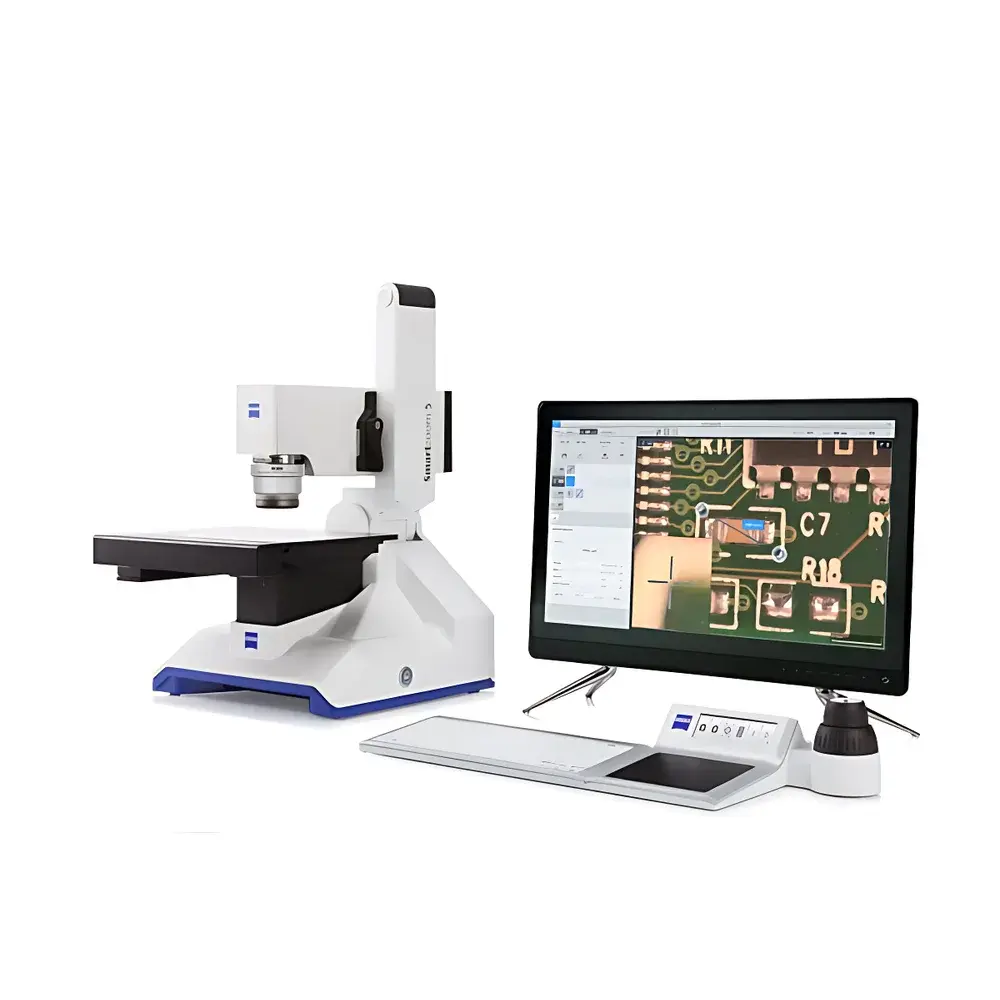
ZEISS Smartzoom 5 Intelligent Extended Depth-of-Field 3D Digital Microscope
| Brand | ZEISS |
|---|---|
| Origin | Germany |
| Model | Smartzoom 5 |
| Manufacturer | Carl Zeiss AG |
| Distribution Channel | Authorized Distributor (Imported) |
| Price | USD 102,000 (FOB Hamburg, ex. VAT & shipping) |
Overview
The ZEISS Smartzoom 5 is an advanced extended depth-of-field (EDOF) 3D digital microscope engineered for high-precision surface metrology and qualitative/quantitative microstructural analysis in industrial quality assurance and applied research laboratories. Unlike conventional optical microscopes relying solely on shallow depth of field or post-acquisition image stacking, the Smartzoom 5 integrates real-time focus variation optics with synchronized motorized zoom and autofocus algorithms to generate fully focused 3D topographic reconstructions—without mechanical scanning or z-stacking delays. Its optical architecture is based on a coaxial telecentric design combined with dynamic LED illumination management, enabling consistent magnification linearity, minimal parallax error, and sub-micron lateral resolution across the full zoom range (typically 12×–1380× equivalent, dependent on objective configuration). Designed and manufactured in Oberkochen, Germany, the system complies with ISO 9001-certified production protocols and meets CE, RoHS, and IEC 61000-4 electromagnetic compatibility standards.
Key Features
- Fully motorized operation: Precision stepper-driven zoom, focus, and XY stage control with programmable repeat accuracy ≤ ±0.5 µm
- Tilt-capable objective turret: Adjustable viewing angle up to ±60° for oblique surface inspection and shadow-free cavity imaging
- Integrated overview camera: 5 MP wide-field preview sensor for automated macro-to-micro navigation; touch-select any region of interest to auto-center and refocus
- Dual-LED illumination system: Coaxial high-intensity white LED (for reflective surfaces) and adjustable 8-segment ring LED (for directional contrast enhancement)
- Large-format mechanical stage: 130 mm × 100 mm travel range with load capacity up to 5 kg; compatible with custom fixtures and vacuum chucks
- Real-time EDOF rendering engine: Captures and fuses up to 60 depth-sliced frames per second at full HD resolution (1920 × 1080), enabling live 3D surface visualization
- Intelligent lens recognition: Auto-detection of mounted objectives (e.g., 0.7×–4.5× zoom body + optional 0.5×/1.0×/2.0× auxiliary lenses) to load calibrated magnification and working distance parameters
- Role-based user interface: Administrator mode (full system configuration, measurement calibration, report templates) and Operator mode (locked workflow execution with guided prompts and audit-trail logging)
Sample Compatibility & Compliance
The Smartzoom 5 accommodates diverse sample geometries—from flat wafers and PCBs to irregularly shaped machined parts, biological specimens, and fragile cultural heritage artifacts—without requiring conductive coating or vacuum environments. Its long working distance (>40 mm at lowest magnification) and non-contact measurement principle ensure safe inspection of soft polymers, hydrogels, and coated surfaces. The system supports GLP-compliant documentation workflows per ISO/IEC 17025 and FDA 21 CFR Part 11 requirements when paired with ZEISS ZEN core software: all measurements include timestamped operator ID, instrument configuration metadata, and raw depth map export (.zdf, .tif, .stl). Calibration is traceable to PTB (Physikalisch-Technische Bundesanstalt) reference standards.
Software & Data Management
ZEN Core software (v3.6+) provides integrated acquisition, measurement, annotation, and reporting modules. Key capabilities include: automatic roughness parameter calculation (Sa, Sq, Sz per ISO 25178), profile extraction along arbitrary lines or splines, volume estimation of pits or coatings, grain size analysis via threshold-based segmentation, and multi-layer comparative overlay. All reports are exportable as PDF/A-1b compliant documents with embedded digital signatures. Raw data—including full-focus stacks, depth maps, and color-coded height profiles—is stored in vendor-neutral formats compatible with third-party metrology platforms (e.g., MountainsMap®, Gwyddion). Audit trails record every user action, parameter change, and calibration event with immutable timestamps.
Applications
- Electronics: IC bond inspection, solder joint void analysis, PCB trace width/height verification, MEMS device actuation characterization
- Automotive & Aerospace: Surface defect mapping on turbine blades, wear scar quantification on bearing races, coating adhesion assessment on cast aluminum housings
- Materials Science: Fractography of ductile/brittle failure modes, corrosion pit depth profiling, thin-film thickness estimation via edge step-height analysis
- Medical Devices: Stent strut uniformity evaluation, catheter lumen integrity checks, suture thread morphology and fiber alignment analysis
- Battery R&D: Electrode particle distribution homogeneity, separator pore structure visualization, dendrite growth tracking on cycled anodes
- Cultural Heritage: Pigment layer stratigraphy in painted ceramics, corrosion product differentiation on archaeological metals, fiber-level textile weave reconstruction
- Life Sciences: Ex vivo tissue surface topography (e.g., corneal epithelium, insect cuticle), 3D morphometric analysis of plant trichomes or fungal hyphae
FAQ
What is the maximum achievable lateral resolution under standard illumination conditions?
Typical system resolution is ≤ 0.7 µm at 1380× effective magnification (using 2.0× auxiliary lens), verified per ISO 10110-7 using USAF 1951 target.
Does the Smartzoom 5 support automated measurement scripting?
Yes—ZEN scripting interface (Python-based) enables custom routines for batch measurement, pass/fail logic, and integration with factory MES systems via OPC UA.
Can third-party calibration standards be used for traceable verification?
Absolutely—NIST-traceable step-height standards (e.g., VLSI Standards S100 series) and roughness samples (e.g., NPL RM8000) are fully supported within ZEN’s calibration manager.
Is remote operation possible over corporate networks?
ZEN Connect enables secure remote access with TLS 1.3 encryption, role-limited UI sharing, and real-time collaborative annotation—fully auditable per ISO/IEC 27001 policies.
How does the Smartzoom 5 handle highly reflective or low-contrast samples?
Polarization filters, dynamic HDR exposure fusion, and multi-angle ring LED sequencing are available to suppress glare and enhance edge contrast without physical sample modification.




