
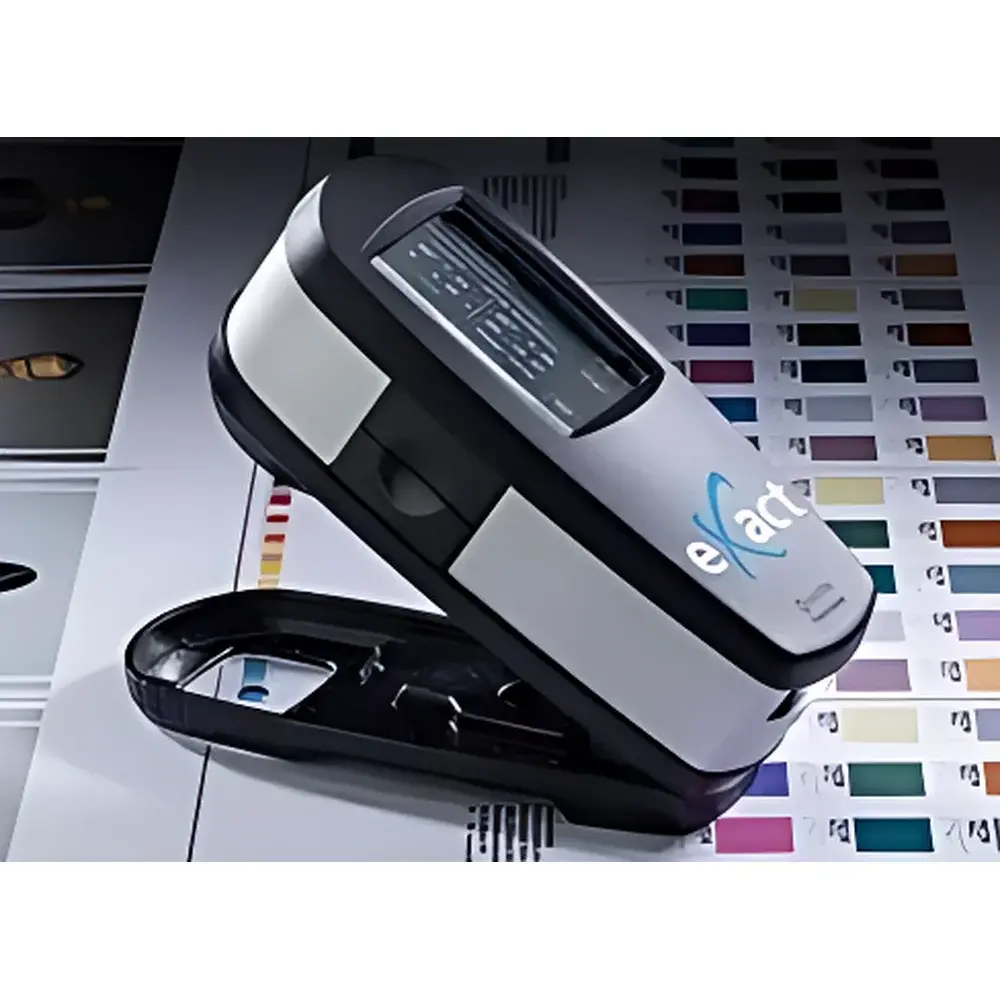
X-Rite eXact Advanced Spectrodensitometer
| Brand | X-Rite |
|---|---|
| Origin | USA |
| Model | eXact Advanced |
| Aperture Options | 1.5 mm, 2 mm, 4 mm, 6 mm |
| Compliance | ISO 5-4:2009, ISO 13655:2017 (M1/M2/M3), ASTM E308, DIN 5033, JIS Z 8722 |
| Software Integration | Color iQC Print, InkFormulation, PantoneLIVE™, NetProfiler 3 |
| Connectivity | Bluetooth 4.2, USB, Optional Scanning Mode |
| Calibration | Built-in ceramic calibration tile with NIST-traceable reference |
Overview
The X-Rite eXact Advanced is a high-precision, multi-aperture spectrodensitometer engineered for rigorous color and density measurement across industrial printing, packaging, and ink formulation environments. Operating on the principle of diffuse d/0° geometry with spectral data acquisition from 400–700 nm at 10 nm intervals, it delivers both spectrophotometric colorimetric values (CIE L*a*b*, ΔE00) and densitometric metrics (T, E, Status T/E/M, ISO TVI) in a single measurement cycle. Designed specifically for production-floor integration, the eXact Advanced supports real-time process control by enabling rapid verification of spot colors, process inks, and extended gamut formulations—regardless of substrate type (coated/uncoated paper, film, foil, or corrugated board). Its optical architecture complies with ISO 13655:2017 for spectral measurement conditions (M1/M2/M3) and meets ISO 5-4:2009 requirements for densitometer accuracy, ensuring metrological consistency across global supply chains.
Key Features
- Four user-selectable apertures (1.5 mm, 2 mm, 4 mm, 6 mm) optimized for fine-screen halftones, solid patches, wide-area packaging substrates, and flexographic anilox roll validation.
- Integrated NIST-traceable ceramic calibration tile with automated self-check routine—performed before each measurement session or on schedule per GLP-compliant workflows.
- One-touch “Best Match” function that compares live measurements against target ink formulations and recommends incremental ink key adjustments to maintain density and chromaticity within ±0.05 ΔE00 tolerance bands.
- Customizable GUI layout with role-based interface profiles: preconfigured dashboards for press operators (density + TVI + ink key guidance), QC technicians (full spectral report + pass/fail thresholds), and lab managers (batch trending + SPC charts).
- Bluetooth 4.2 and USB 2.0 connectivity supporting wireless synchronization with Color iQC Print for inline reporting and secure cloud backup via X-Rite’s hosted ColorCert Server infrastructure.
Sample Compatibility & Compliance
The eXact Advanced accommodates heterogeneous sample geometries—including glossy, matte, textured, and transparent films—through its dual-mode illumination (pulsed xenon + LED white light source) and polarization filtering to suppress specular reflectance artifacts. It conforms to ISO/IEC 17025:2017 calibration traceability requirements when used with X-Rite-certified calibration services. All firmware and measurement algorithms are validated against ASTM E308-22 (standard practice for computing CIE colors) and DIN 5033-7 (colorimetric tolerancing for graphic arts). For regulated industries, the device supports audit-ready data logging with time-stamped metadata, user authentication, and electronic signatures compatible with FDA 21 CFR Part 11 and EU Annex 11 compliance frameworks when deployed with Color iQC Enterprise Edition.
Software & Data Management
Data generated by the eXact Advanced feeds directly into X-Rite’s modular software ecosystem. Color iQC Print enables real-time pass/fail evaluation against customer-defined tolerances (e.g., G7 Gray Balance, GRACoL Coated v2, SWOP Coated), with automatic PDF reports containing spectral curves, density deltas, and TVI compensation tables. InkFormulation leverages measured ΔE and density data to compute optimal pigment additions for rework batches—reducing ink waste by up to 22% in comparative studies. PantoneLIVE™ integration ensures consistent interpretation of PMS references across digital proofing, prepress, and press-side validation. NetProfiler 3 extends this capability enterprise-wide: centralized spectral database management, inter-device correlation analysis, and cross-site color deviation heatmaps—enabling root-cause identification in multi-plant production networks.
Applications
- Press-side color verification during makeready and run-length monitoring for offset, gravure, flexo, and digital inkjet presses.
- Lab-to-press correlation validation between ink formulation labs and production facilities using standardized M1 illumination and substrate-specific spectral correction.
- Packaging quality assurance for brand-critical assets—including metallic inks, pearlescent effects, and UV-curable coatings—via spectral reflectance curve analysis and metamerism index calculation.
- Supplier qualification and incoming material inspection per ISO 12647-2:2013 (offset) and ISO 12647-6:2012 (flexo) standards.
- G7 certification support through automated gray balance measurement and neutral print density profiling.
FAQ
Does the eXact Advanced support M1/M2/M3 measurement modes?
Yes—it automatically detects and applies the appropriate illumination condition (D50 for M1, D65 filtered for M2, polarized for M3) based on embedded spectral characterization and user-selected standard.
Can measurement data be exported to ERP or MES systems?
Yes—CSV, XML, and JSON exports are supported; API integration with SAP QM, Oracle Quality, and Rockwell FactoryTalk is available via X-Rite’s ColorCert Connect module.
Is firmware update performed locally or over-the-air?
Firmware updates are delivered via X-Rite’s Secure Update Portal and require manual initiation with SHA-256 checksum verification to ensure integrity and regulatory compliance.
How often must the instrument be recalibrated?
Daily verification using the built-in ceramic tile is required; full recalibration by an X-Rite-certified service center is recommended every 12 months or after 10,000 measurements, whichever occurs first.
What security protocols govern Bluetooth data transmission?
All Bluetooth sessions use AES-128 encryption with device-pairing authentication and session timeout after 90 seconds of inactivity—meeting ISO/IEC 27001:2022 requirements for portable instrumentation.





