
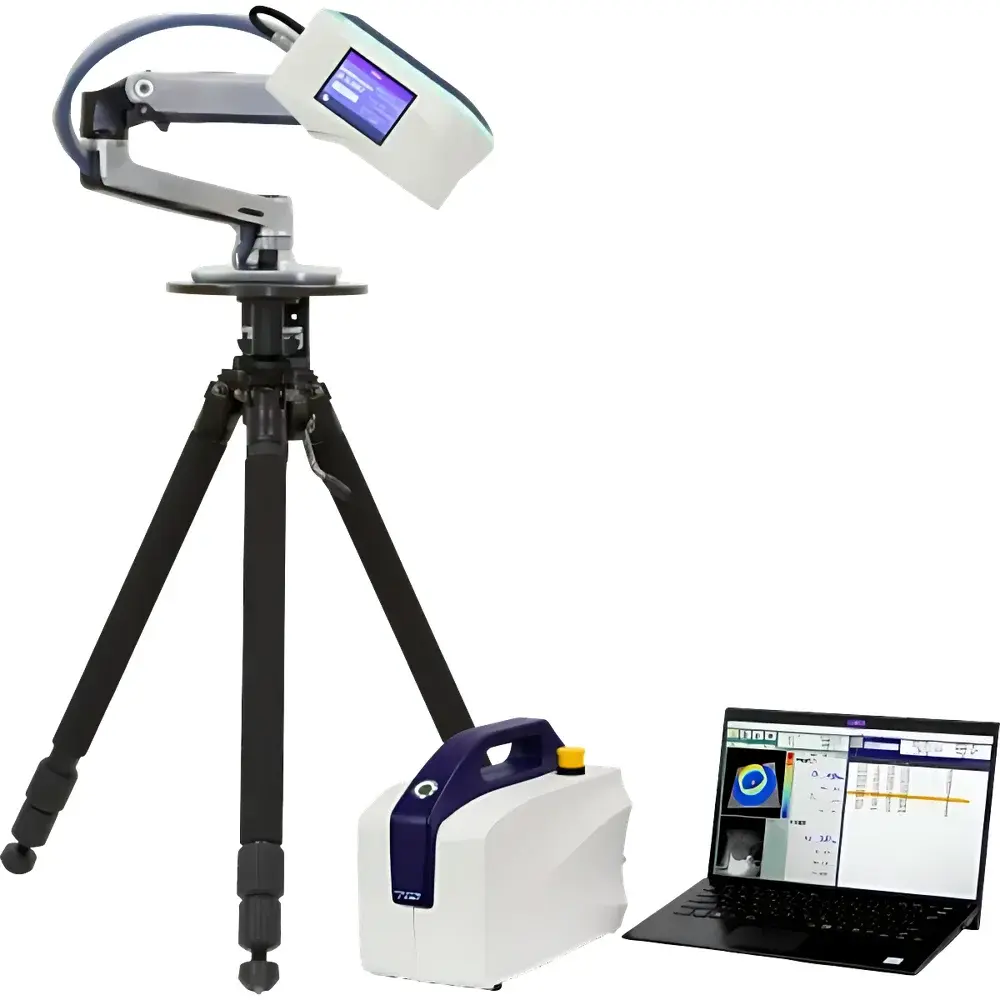
Pulstec μ-X360J Portable X-ray Residual Stress Analyzer
| Brand | Pulstec |
|---|---|
| Origin | Japan |
| Model | μ-X360J |
| X-ray Tube | 30 kV, 1.6 mA |
| Target Material | Standard Cr (optional V, Cu, Co, Mn) |
| Collimator | Ø1 mm (custom sizes available) |
| Detector | Full 2D area detector |
| Measurement Time | ~60 s per point |
| Power Supply | 130 W, 110–240 V, 50–60 Hz |
| Cooling | Air-cooled, no water chiller required |
| Portability | Battery-operated, weight ≈ 8.1 kg |
| Compliance | JSMS-SD-14-20 (Japan) |
Overview
The Pulstec μ-X360J is a field-deployable, high-precision X-ray residual stress analyzer engineered for non-destructive, in-situ measurement of lattice strain-induced residual stresses in polycrystalline metallic materials. It operates on the sin²ψ method—leveraging Bragg’s law and elastic diffraction theory—where residual stress is derived from angular shifts in the Debye–Scherrer ring caused by interplanar spacing (d-spacing) changes under stress. Unlike conventional θ–2θ goniometer-based systems, the μ-X360J employs a full 2D area detector to capture the entire diffraction ring in a single exposure at a fixed incident angle. This eliminates mechanical scanning, removes dependence on precision goniometry, and enables robust measurements on irregular geometries, confined spaces, and large-scale infrastructure—without sample removal or surface preparation beyond standard metallographic finishing.
Key Features
- Single-angle, single-shot acquisition: Full Debye ring captured in one exposure; no motorized goniometer or multi-angle repositioning required.
- High statistical fidelity: Simultaneous fitting of up to 500 diffraction peaks per measurement improves stress calculation reproducibility and reduces uncertainty in heterogeneous microstructures.
- True portability: Compact form factor (≈8.1 kg), integrated battery support, and air-cooled X-ray tube enable operation in laboratories, production floors, shipyards, bridges, pipelines, and nuclear containment zones.
- Modular target system: Interchangeable anode targets (Cr standard; optional V, Cu, Co, Mn) allow optimization of Kα wavelength for diverse alloy systems—including Ti-6Al-4V (TC4), stainless steels, Ni-superalloys, and Al alloys—ensuring optimal diffraction intensity and peak separation.
- No external cooling infrastructure: Eliminates dependency on recirculating chillers or tap water, reducing setup complexity and operational footprint.
- Integrated optical alignment: Built-in CCD camera with crosshair overlay and real-time sample preview ensures precise positioning—even on curved or recessed surfaces—without reliance on external fixtures.
Sample Compatibility & Compliance
The μ-X360J is validated for use on ferrous and non-ferrous engineering metals—including carbon steels, austenitic and martensitic stainless steels, aluminum alloys, titanium alloys (e.g., TC4), nickel-based superalloys, and cast irons. Its measurement protocol conforms to the Japanese Society for Materials Science (JSMS) standard JSMS-SD-14-20, which defines calibration procedures, d₀ reference determination, ψ-angle selection, and uncertainty estimation for X-ray diffraction-based residual stress analysis. While not certified to ISO 21943 or ASTM E915 directly, its methodology aligns with the physical principles underpinning those standards. Data traceability supports GLP-compliant reporting when paired with audit-trail-enabled software configurations. The instrument does not require vacuum or inert gas environments, making it suitable for ambient-air measurements on machined, welded, shot-peened, or thermally treated surfaces.
Software & Data Management
The proprietary μ-X360J software suite provides fully automated stress calculation, peak fitting, and visualization. Key capabilities include: automatic d-spacing refinement using internal standard powders or stress-free reference samples; semi-quantitative evaluation of crystallite size and microstrain via full-width-at-half-maximum (FWHM) analysis; one-click execution of preconfigured material templates (e.g., “AISI 4140 – Cr Kα”); and region-of-interest (ROI) mapping when coupled with the optional XY scanning stage. Raw 2D detector images are stored in TIFF format with embedded metadata (voltage, current, exposure time, collimator ID, target type). Export options include CSV (stress tensor components σ₁₁, σ₂₂, τ₁₂), PDF reports with annotated diffraction patterns, and XML files compatible with third-party finite element post-processing tools. Software versioning and user access controls meet baseline requirements for FDA 21 CFR Part 11 compliance when deployed in regulated manufacturing environments.
Applications
- Weld integrity assessment: Quantification of heat-affected zone (HAZ) stresses in pipeline girth welds, pressure vessel seams, and rail joint welds—both pre- and post-stress relief.
- Surface treatment validation: Verification of compressive stress profiles induced by shot peening, laser shock peening, roller burnishing, and nitriding—critical for fatigue life extension in aerospace turbine blades and automotive crankshafts.
- Manufacturing process monitoring: In-line stress mapping of machined features (e.g., milled slots, turned grooves), forged dies, and additive-manufactured (AM) lattice structures to correlate thermal history with distortion risk.
- Infrastructure health monitoring: Field measurement on bridge orthotropic decks, offshore platform nodes, nuclear reactor coolant piping, and wind turbine tower flanges—without disassembly or scaffolding.
- Advanced metallurgical characterization: Combined residual stress + retained austenite quantification (via optional module), texture analysis (pole figure reconstruction), and grain orientation spread (GOS) mapping for deformation mechanism studies.
FAQ
Does the μ-X360J require a vacuum chamber or helium purge?
No. It operates reliably in ambient air for most metallic samples. Helium purging is optional for low-energy targets (e.g., V Kα) on light-element matrices but not necessary for Cr Kα on steel or Ti alloys.
Can it measure through coatings or paint layers?
Only if the coating is thin (<10 µm) and X-ray transparent (e.g., phosphate conversion coatings). Thick paints, thermal barrier coatings, or oxide scales attenuate the diffracted signal and must be mechanically removed prior to measurement.
What is the minimum measurable stress resolution?
Typical repeatability is ±15 MPa for steel under controlled lab conditions. Field performance depends on surface finish, grain size, and signal-to-noise ratio—verified per JSMS-SD-14-20 Annex B.
Is operator certification required?
While no formal licensing is mandated, users should possess foundational knowledge in X-ray diffraction physics, crystallography, and mechanical metallurgy. Pulstec offers application training aligned with JSMS guidelines.
How is calibration maintained across field deployments?
The system uses internal geometric calibration routines executed before each session. Certified reference samples (e.g., stress-free Fe powder) are recommended for d₀ verification at least weekly in high-accuracy applications.




