
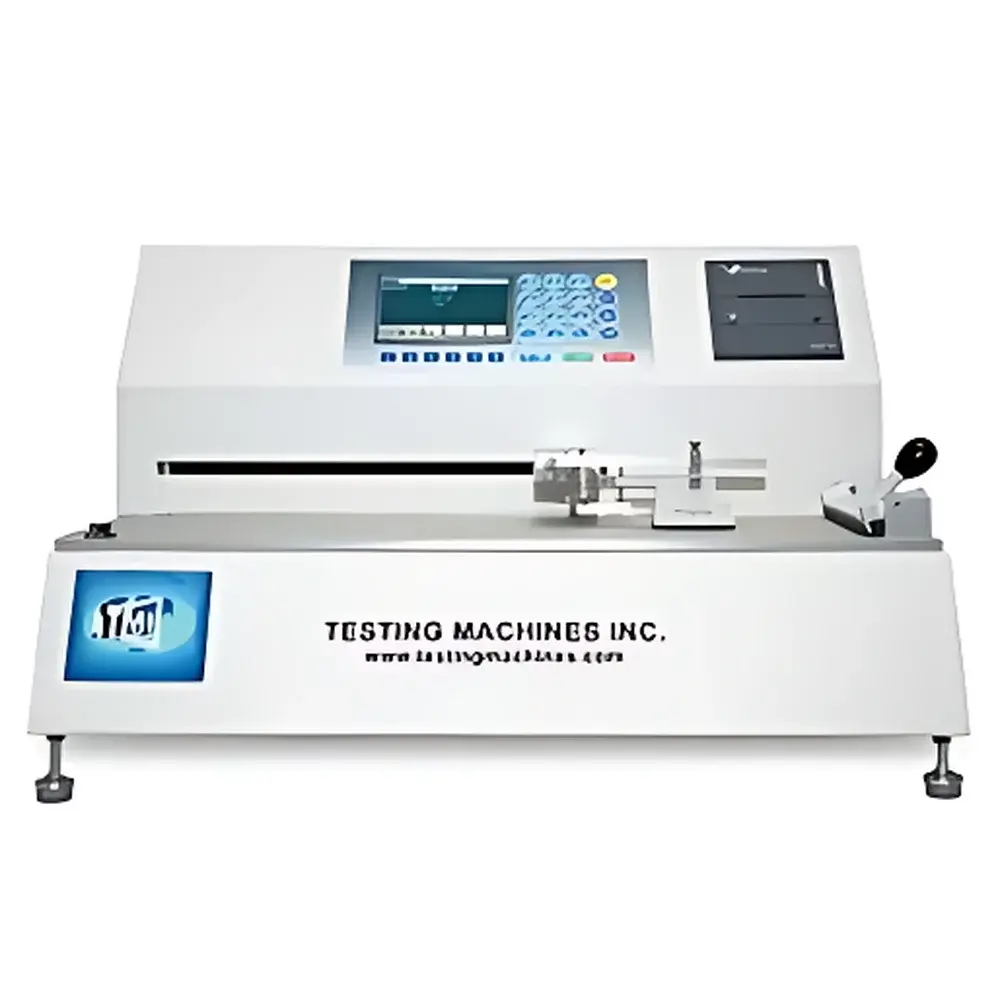
TMI 32-07 Coefficient of Friction Tester
| Brand | TMI |
|---|---|
| Origin | USA |
| Model | 32-07 |
| Adjustable Speed Range | 5–43 cm/min |
| Adjustable Travel Distance | 2.5–30.5 cm |
| Weight | 25 kg |
| Dimensions | 515 × 495 × 508 mm |
| Compliance | ASTM D1894, TAPPI T816 & T549 |
| Display | 5.7-inch color LCD |
| Data Storage | 100 readings with statistical analysis (mean, SD, min/max) |
| Interface | RS232 |
| Optional Heating Chamber | Ambient to 177 °C |
Overview
The TMI 32-07 Coefficient of Friction Tester is a precision-engineered instrument designed for the quantitative measurement of static and kinetic coefficients of friction (COF) between two planar material surfaces under controlled mechanical conditions. Based on the fundamental principle of horizontal pull testing—where a standardized sled is drawn across a stationary test specimen at a defined speed and normal load—the system delivers repeatable, traceable COF values in accordance with internationally recognized standards including ASTM D1894, TAPPI T816, and TAPPI T549. Developed by Testing Machines Inc. (TMI), a U.S.-based manufacturer with over three decades of specialization in materials surface interaction instrumentation, the 32-07 integrates robust mechanical architecture with intuitive digital control to support quality assurance, R&D validation, and process optimization in packaging, paper, film, and composite manufacturing environments.
Key Features
- Simultaneous real-time acquisition and display of both static (μs) and kinetic (μk) coefficients of friction within a single test cycle
- Programmable test speed range from 5 to 43 cm/min (2–17 in/min), adjustable in 0.1 cm/min increments for precise velocity control
- Configurable travel distance from 2.5 to 30.5 cm (1–12 in), enabling flexibility across sample geometries and industry-specific test protocols
- 5.7-inch full-color LCD touchscreen interface supporting bilingual menu navigation (English default), real-time graphical trace visualization, and on-screen parameter configuration
- Dedicated sled guidance mechanism ensuring unidirectional linear motion without lateral deviation or rotational torque—critical for minimizing measurement uncertainty
- Horizontally aligned sled coupling system that maintains consistent normal force application and eliminates parasitic bending moments during traction
- Integrated thermal chamber option (ambient to 177 °C) for evaluating temperature-dependent COF behavior—ideal for heat-seal integrity assessment and high-temperature packaging validation
- Onboard data management: stores up to 100 test records with automatic calculation of mean, standard deviation, minimum, and maximum COF values per batch
- RS232 serial interface compliant with standard laboratory data acquisition systems; supports direct export to LIMS or Excel-compatible CSV files
- Built-in thermal printer for immediate hardcopy reporting with date/time stamp, operator ID, and configurable header fields
Sample Compatibility & Compliance
The TMI 32-07 accommodates a broad spectrum of planar, flexible, and semi-rigid substrates used across regulated and industrial sectors. Validated applications include polyolefin films (LDPE, PP), metallized PET, laminated pouches, coated papers, corrugated board liners, rubber sheets, PVC flooring, printed labels, and multi-layer composites. All test configurations adhere strictly to ASTM D1894 (Standard Test Method for Coefficient of Friction of Plastic Film and Sheeting) and TAPPI T816 (Friction of Paper and Paperboard), ensuring methodological consistency for internal QC, supplier qualification, and regulatory submissions. The instrument’s mechanical repeatability and calibration traceability align with ISO/IEC 17025 requirements for accredited testing laboratories. Optional heating functionality enables compliance with modified test conditions specified in ASTM F88 (Seal Strength of Flexible Barrier Materials) when evaluating hot-slip performance.
Software & Data Management
No proprietary software installation is required—the 32-07 operates autonomously via its embedded firmware platform. All test parameters, results, and statistical summaries are stored in non-volatile memory and accessible through the front-panel interface. For integration into enterprise-level quality systems, the RS232 port supports ASCII-based command-response communication compatible with LabVIEW, Python-based automation scripts, or custom MES interfaces. Audit trails—including operator ID, timestamp, calibration status, and parameter modification history—are retained locally and can be exported upon request. While the base unit does not include 21 CFR Part 11-compliant electronic signature or role-based access control, it serves as a validated endpoint in GMP/GLP workflows when paired with validated third-party data capture solutions meeting FDA and EU Annex 11 requirements.
Applications
- Quantifying slip resistance of food packaging films to prevent jamming in high-speed filling lines
- Evaluating anti-block additive efficacy in extruded polyethylene films
- Validating coefficient consistency across roll-to-roll production batches for pharmaceutical blister lidding
- Assessing print surface tack and ink adhesion stability on coated cartons
- Characterizing frictional behavior of release liners used in adhesive tape manufacturing
- Supporting root cause analysis of web handling issues—including telescoping, wrinkling, and misregistration—in converting operations
- Generating comparative COF datasets for raw material qualification against supplier specifications
FAQ
What standards does the TMI 32-07 comply with?
The instrument is fully compliant with ASTM D1894, TAPPI T816, and TAPPI T549. Optional configurations may support supplementary methods such as ISO 8295 and DIN 53375 upon user-defined setup validation.
Is calibration traceable to NIST or other national metrology institutes?
Yes—the included calibration kit contains certified reference masses and sled weights with NIST-traceable certificates of calibration. Users are advised to perform annual verification using this kit or an accredited external service provider.
Can the 32-07 measure friction at elevated temperatures?
An optional heated test chamber (model suffix -HT) is available, providing precise temperature control from ambient to 177 °C with ±1 °C accuracy over the operating range.
Does the instrument support GLP/GMP documentation requirements?
While the standalone unit lacks built-in electronic signatures or audit trail encryption, its deterministic output, calibrated hardware, and exportable data formats enable full integration into validated quality management systems when deployed with appropriate procedural controls.
How is sled alignment verified prior to testing?
The sled mounting system incorporates a self-centering dovetail guide and horizontal tension sensor feedback loop to ensure zero angular deviation during pull initiation—verified during factory acceptance testing and confirmed annually via mechanical inspection checklist.
Related Products





