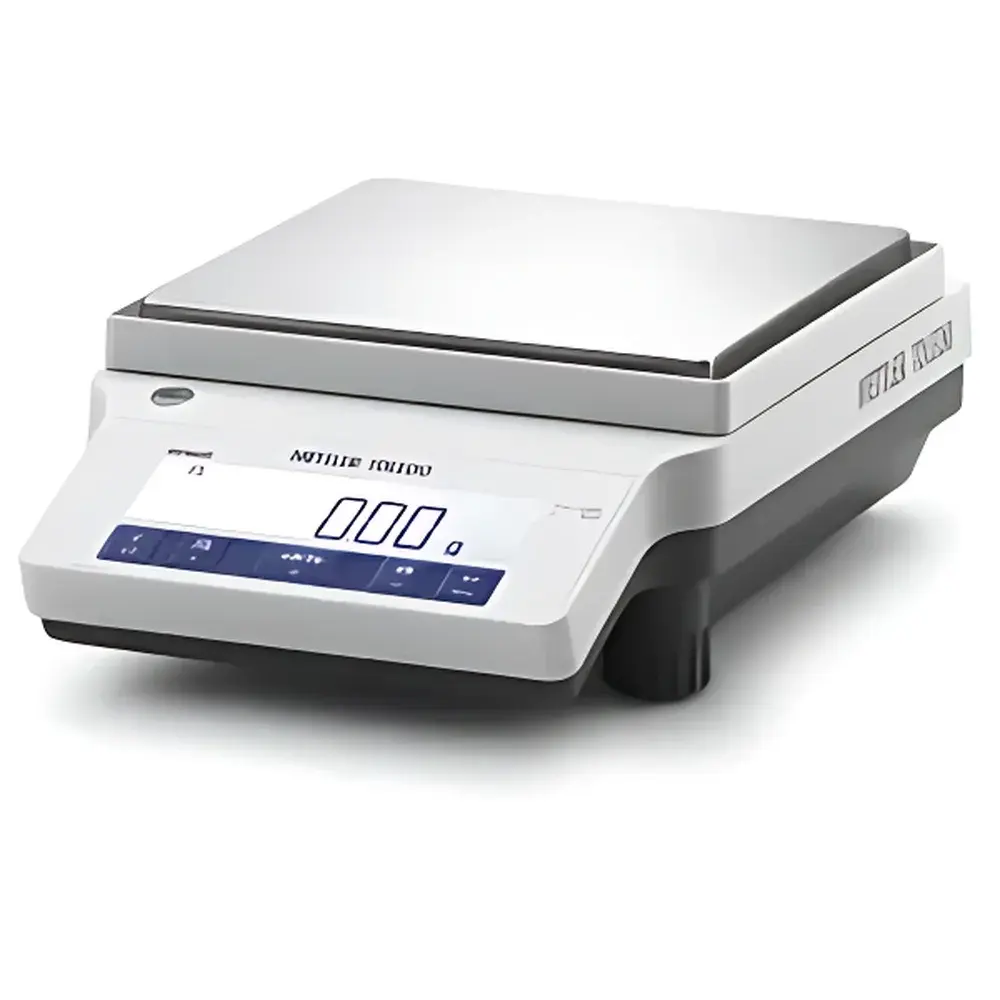
METTLER TOLEDO ME4002 Precision Balance with Internal Calibration and 0.01 g Readability
| Brand | METTLER TOLEDO |
|---|---|
| Origin | Shanghai, China |
| Model | ME4002 /02 |
| Instrument Type | Precision Balance |
| Maximum Capacity | 4200 g |
| Readability | 0.01 g |
| Repeatability (typ.) | 0.007 g |
| Minimum Weight (U=1%, k=2, typ.) | 1.4 g |
| Minimum Weight (USP <0.1% RSD, typ.) | 14 g |
| Stabilization Time | 1.5 s |
| Calibration | Internal |
| Interface | RS232 (integrated), Bluetooth (optional) |
| Display | Backlit LCD |
| Pan Dimensions (W×D) | 180 mm × 180 mm |
| Overall Dimensions (H×W×D) | 100 mm × 200 mm × 319 mm |
| Housing | Die-cast aluminum base with ABS top cover |
| 秤盘 Material | Stainless steel |
| Overload Protection | Yes |
| Legal-for-Trade Certification | Not applicable (non-regulatory use) |
Overview
The METTLER TOLEDO ME4002 is a high-reliability precision balance engineered for routine laboratory and industrial weighing tasks requiring consistent 0.01 g readability and robust operational integrity. Based on METTLER TOLEDO’s proven electromagnetic force compensation (EMFC) transduction principle, the ME4002 delivers stable, drift-resistant measurements across its full 4200 g capacity range. Unlike strain-gauge-based platforms, EMFC technology ensures linear response, temperature-invariant performance, and long-term calibration stability—critical attributes for quality control labs, educational institutions, and production environments where traceable, repeatable mass determination is foundational to process consistency. The balance operates without external weights during routine calibration, relying instead on an integrated motorized internal calibration mass that engages automatically or on demand via single-button activation. This design eliminates manual handling errors, reduces operator dependency, and supports adherence to internal SOPs aligned with GLP and ISO/IEC 17025 documentation requirements.
Key Features
- Internal calibration system with motor-driven reference mass—activated by one-touch operation for rapid verification and adjustment
- Dual-material construction: die-cast aluminum base for mechanical damping and thermal mass stability, combined with an impact-resistant ABS housing for durability in shared lab environments
- Stainless steel weighing pan (180 mm × 180 mm) with integrated overload protection to withstand accidental overloading up to 150% of maximum capacity
- Backlit LCD display with high-contrast characters and adjustable brightness—optimized for visibility under varied ambient lighting conditions
- Fast stabilization time of 1.5 seconds (typical), enabling high-throughput workflows without compromising measurement fidelity
- RS232 interface as standard; Bluetooth connectivity available as optional module for wireless data transfer to PCs, LIMS, or ERP systems
- LevelControl™ integrated leveling assistance—visual indicator guides users to optimal horizontal alignment without requiring external tools
Sample Compatibility & Compliance
The ME4002 accommodates a broad range of sample types—including powders, granules, liquids in containers, and solid components—within its 180 mm × 180 mm stainless steel pan. Its minimum weight performance (1.4 g at U = 1%, k = 2; 14 g per USP <0.1% RSD criteria) ensures reliable quantification for applications such as formulation checks, raw material receipt inspection, and batch record documentation. While not certified for legal-for-trade use (e.g., NTEP, OIML R76, or EC Class II), the ME4002 meets functional accuracy expectations for non-regulated weighing tasks. Its design supports audit readiness through consistent repeatability (≤0.007 g typical), documented stabilization behavior, and compatibility with electronic signature-capable software platforms compliant with FDA 21 CFR Part 11 when used in conjunction with METTLER TOLEDO LabX or third-party validated data capture solutions.
Software & Data Management
Data output follows ASCII protocol via RS232, enabling seamless integration with spreadsheet applications, custom databases, or laboratory information management systems (LIMS). Optional Bluetooth functionality permits secure, cable-free transmission to Windows or macOS workstations running METTLER TOLEDO’s free MT-SICS software or industry-standard serial terminal emulators. All transmitted records include timestamp, net weight, tare value, unit identifier, and status flags (e.g., “stable”, “overload”, “calibration due”). When paired with LabX, the ME4002 supports user access control, electronic audit trails, automatic report generation, and configurable PDF export—fulfilling ALCOA+ data integrity principles (Attributable, Legible, Contemporaneous, Original, Accurate, Complete, Consistent, Enduring, Available).
Applications
- Quality assurance laboratories performing incoming inspection of bulk chemicals, excipients, or packaging materials
- Educational settings conducting stoichiometric experiments, solution preparation, and physical property determinations
- Manufacturing floor stations verifying component counts, filling weights, or assembly subunit masses
- Environmental testing labs preparing reagent standards and calibrating volumetric glassware
- R&D departments executing preliminary formulation trials where moderate precision suffices prior to analytical-grade validation
FAQ
Is the ME4002 suitable for GMP-regulated environments?
It can be deployed in GMP contexts for non-critical weighing tasks (e.g., gross ingredient dispensing), provided it is included in the site’s equipment qualification protocol (IQ/OQ/PQ) and calibrated per defined intervals using traceable standards.
What is the difference between repeatability and readability on this balance?
Readability (0.01 g) defines the smallest displayed increment; repeatability (≤0.007 g typical) reflects the instrument’s ability to return identical results under identical conditions—both are essential for assessing measurement uncertainty.
Can the ME4002 be connected to a networked LIMS?
Yes—via RS232-to-Ethernet converters or Bluetooth-to-PC gateways, enabling automated data capture without manual transcription.
Does internal calibration satisfy ISO/IEC 17025 requirements?
Internal calibration alone does not replace periodic external verification with accredited reference masses; however, it serves as an effective intermediate check between formal calibrations.
How often should the ME4002 be recalibrated?
Frequency depends on usage intensity, environmental fluctuations, and risk assessment; daily internal calibration is recommended for critical processes, supplemented by external verification at least weekly or per organizational SOP.