
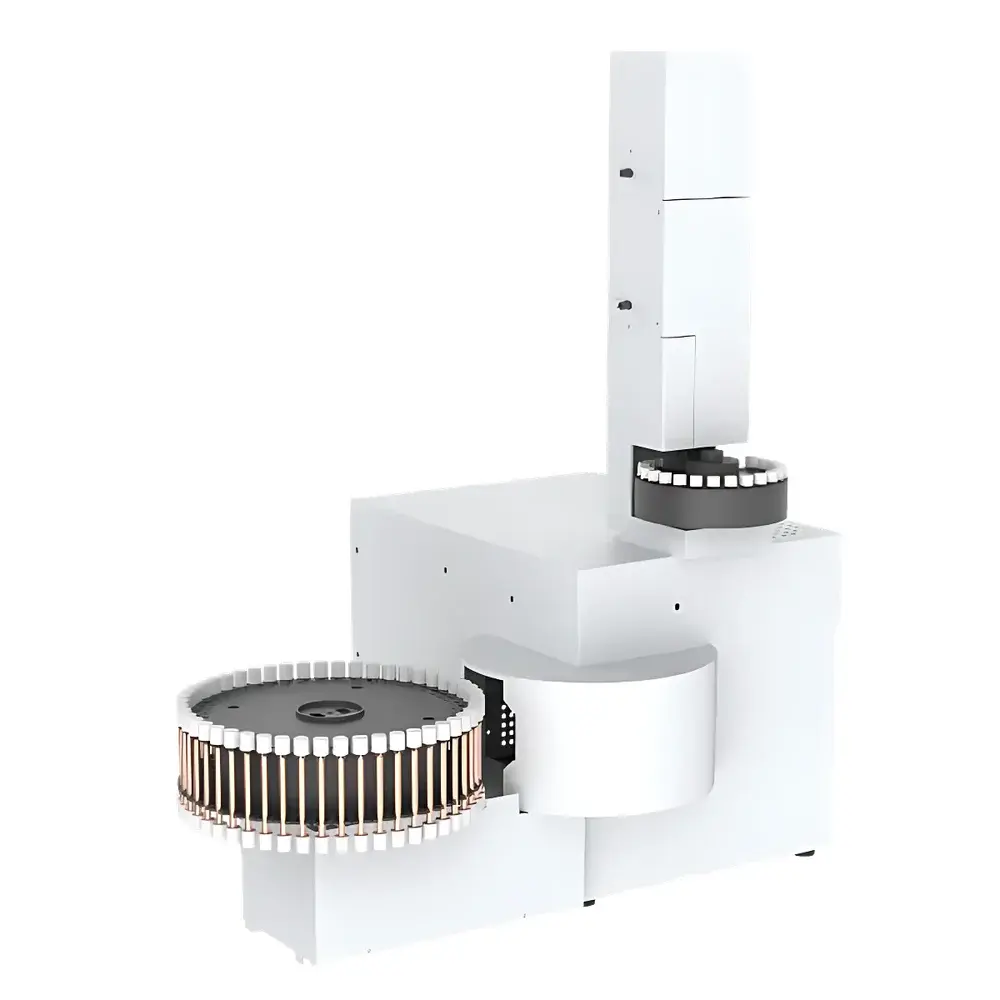
AutoS 50 Standalone Spiking Instrument by Colintech
| Brand | Colintech |
|---|---|
| Origin | Sichuan, China |
| Manufacturer Type | Original Equipment Manufacturer (OEM) |
| Product Origin | Domestic (China) |
| Model | AutoS 50 |
| Pricing | Upon Request |
Overview
The AutoS 50 Standalone Spiking Instrument is a precision-engineered laboratory automation system designed exclusively for the preparation of calibrated thermal desorption (TD) sampling tubes. It enables reproducible, traceable spiking of volatile organic compounds (VOCs) onto sorbent-packed tubes—critical for generating multi-point or single-point calibration standards used in environmental air, industrial stack gas, and indoor air quality analysis. The instrument operates on two complementary spiking modalities: liquid-phase standard addition via programmable syringe-based delivery, and gas-phase standard introduction using mass flow-controlled dynamic dilution. Its architecture adheres to fundamental principles of quantitative analytical chemistry—namely, gravimetric and volumetric spiking traceability, temperature-stabilized vaporization kinetics, and time-synchronized purge dynamics—to ensure metrological integrity across concentration ranges from parts-per-trillion (ppt) to parts-per-million (ppm).
Key Features
- Automated dual-mode spiking: supports both liquid standard solutions (via heated syringe module) and certified gas standards (via thermal mass flow controllers)
- Integrated needle wash, bubble purge, aspiration, injection, and post-injection purge sequence for liquid handling—eliminating carryover and ensuring inter-run reproducibility
- Heated valving and vaporization chamber (ambient to 300 °C, ±1.0 °C stability) for controlled volatilization of low-volatility analytes and solvent-free transfer
- Mass flow control accuracy ≤0.1 mL/min across the full operational range, enabling precise gas-phase dilution and volume-based spiking
- Simultaneous internal standard addition capability for both liquid and gaseous spiking streams—ensuring co-spiking with target analytes into the same tube batch
- 16-position liquid standard carousel with individual vial identification support for method-driven sequential or randomized spiking protocols
- Independent spiking workflow execution—no dependency on TD autosamplers or GC systems—enabling dedicated, offline calibration tube preparation
Sample Compatibility & Compliance
The AutoS 50 accommodates industry-standard 6 mm OD × 89 mm thermal desorption tubes (e.g., Tenax TA, Carbopack B/C, graphitized carbon black composites) and supports both single-bed and multi-bed configurations. It complies with methodological requirements defined in major regulatory frameworks including HJ 644–2013 (Determination of VOCs in Ambient Air by Thermal Desorption–Gas Chromatography–Mass Spectrometry), HJ 734–2014 (Determination of VOCs in Exhaust Gas by TD–GC–MS), HJ 583–2010 (Determination of Benzene Series in Ambient Air by TD–GC), GB 50325–2020 (Control Standard for Indoor Environmental Pollution in Civil Building Engineering), and GB/T 18883–2022 (Indoor Air Quality Standard). All spiking operations are logged with timestamped metadata—including spiking volume/mass, temperature setpoints, purge duration, and internal standard identity—supporting GLP/GMP-aligned audit trails.
Software & Data Management
The instrument is operated via a Windows-based control interface with role-based user authentication, method library management, and electronic signature support compliant with FDA 21 CFR Part 11 requirements. Each spiking run generates an immutable .csv log file containing all critical parameters and sensor readings (e.g., actual vaporization temperature, measured mass flow rate, syringe position feedback). Method templates can be exported/imported for cross-laboratory harmonization, and audit logs retain operator ID, date/time stamps, and modification history for full data lineage tracking. No cloud connectivity or remote access is enabled by default—data residency remains fully on-premise unless explicitly configured per institutional IT policy.
Applications
- Preparation of certified reference material (CRM)-traceable TD calibration curves for EPA TO-17, ISO 16017-1, and EN 14662 compliant analyses
- Multi-level calibration series generation for benzene, toluene, ethylbenzene, xylenes (BTEX), C2–C12 aliphatics, chlorinated solvents, and oxygenated VOCs
- Method validation studies requiring spike recovery assessment across matrix-matched sorbent tubes
- Development and verification of internal standard correction strategies for quantitative TD–GC–MS workflows
- High-throughput lab-scale production of QC check standards and continuing calibration verification (CCV) tubes
FAQ
Does the AutoS 50 require integration with a specific thermal desorption unit?
No—it operates as a standalone spiking platform and does not require hardware or software interfacing with any TD autosampler or GC system.
Can the instrument handle viscous or high-boiling-point standard solutions?
Yes—the heated syringe path, valve manifold, and vaporization chamber (up to 300 °C) enable reliable handling of solvents such as methanol, acetone, CS₂, and low-volatility surrogates like d8-naphthalene or d12-biphenyl.
Is audit trail functionality available for regulatory submissions?
Yes—electronic records include operator ID, method version, parameter settings, real-time sensor values, and digital signatures, meeting minimum ALCOA+ (Attributable, Legible, Contemporaneous, Original, Accurate) criteria for regulated laboratories.
What maintenance intervals are recommended for the liquid handling module?
Syringe cleaning and seal inspection are advised every 200 spiking cycles; mass flow controller calibration verification is recommended annually or after 500 gas spiking events.
Does the system support custom spiking sequences beyond linear calibration curves?
Yes—users may define non-linear, bracketed, or randomized spiking patterns via the method editor, including conditional logic for internal standard inclusion per tube.



