
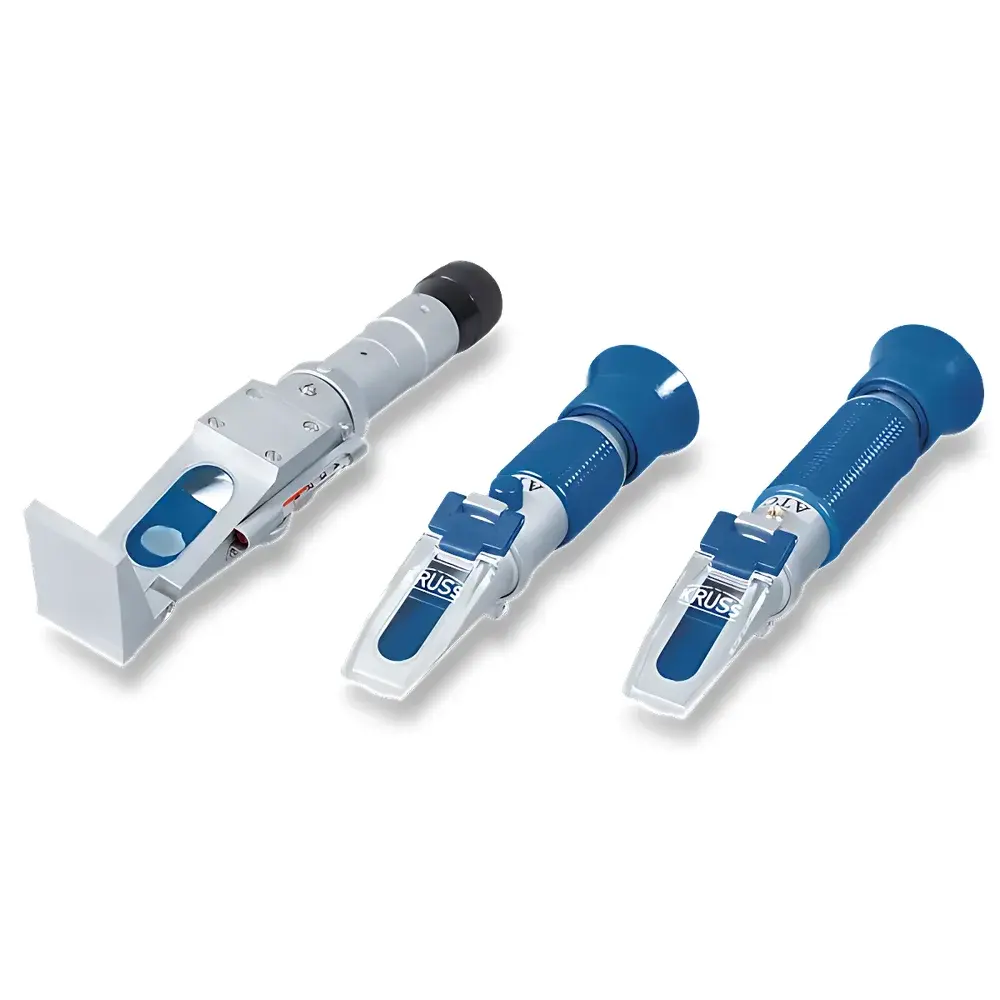
KRUESS HR-Series Manual Portable Refractometer
| Brand | KRUESS |
|---|---|
| Origin | Germany |
| Product Type | Handheld Refractometer |
| Display | Digital |
| Temperature Compensation | Not Available (except HRT, HROT, HRMT18, HRKFZ1 models) |
| Measurement Range | 0–10 %Brix (HR10, HR18-01) |
| Density d | 1.000–1.070 (HR27-100) |
| Salinity | 0–160 ‰ (HRS16) |
| Protein | 0–12 g/dL & Urine Specific Gravity: 1.000–1.050 (HRM18, HRMT18) |
| Oechsle | 30–130 °Oe & Alcohol: 4.4–19 % (HRO32, HROT32) |
| Antifreeze | 50–0 °C frost protection & Battery acid density: 1.10–1.30 g/cm³ (HRKFZ1) |
| Accuracy | 0.1 %Brix (HR10, HR18-01, HRH30) |
Overview
The KRUESS HR-Series Manual Portable Refractometer is an optical precision instrument engineered for rapid, field-deployable determination of refractive index and derived concentration parameters—including Brix, Oechsle, alcohol content, salinity, urine specific gravity, protein concentration, battery electrolyte density, and antifreeze freeze-point—based on Snell’s Law of refraction. Each unit employs a high-stability Abbe-type prism assembly with hardened optical glass (BK7 or SF2 depending on model), calibrated against NIST-traceable standards. The measurement principle relies on the critical angle shift at the prism-sample interface, converted into a digital readout via integrated photodiode array and linear CCD sensor. Designed for ambient temperature operation (typically 10–30 °C unless otherwise specified), the HR-Series complies with ISO 21745:2020 (Refractometry — General principles and practice) and supports routine verification using distilled water (nD = 1.3330 at 20 °C) or certified calibration plates. No external power supply is required beyond standard AAA batteries; operational lifetime exceeds 10,000 measurements per set.
Key Features
- German-manufactured optical train with temperature-stabilized prism housing and anti-reflective coated optics for consistent signal fidelity across repeated use cycles
- Digital LCD display with backlight illumination (model-dependent), enabling legible readings in low-light industrial environments including production floors and outdoor field sites
- Manual focus adjustment and interchangeable scale modules (via mechanical dial or prism rotation) to support multi-parameter analysis without recalibration
- Rugged anodized aluminum chassis rated IP54 for dust and splash resistance—suitable for continuous use in food processing lines, chemical plants, and wastewater treatment facilities
- Select models (HRT32, HRT62, HRMT18, HROT32, HRKFZ1) integrate Automatic Temperature Compensation (ATC) based on thermistor-coupled prism thermal monitoring, conforming to ASTM D115–22 Annex A1 for temperature correction algorithms
- Calibration traceability documented per ISO/IEC 17025:2017 requirements; factory calibration certificates available upon request with uncertainty budgets
Sample Compatibility & Compliance
The HR-Series accommodates aqueous solutions, syrups, oils, coolants, glycol-based antifreezes, battery electrolytes, urine, plasma, and opaque suspensions—provided samples are free of particulate contamination that may scatter incident light. Direct measurement requires ≥0.5 mL sample volume applied evenly across the prism surface; indirect illumination mode (HR900, HR901, HR25-800) permits analysis of turbid or highly viscous media by fiber-optic coupling. All instruments meet CE marking directives (2014/30/EU EMC & 2014/35/EU LVD) and RoHS 2011/65/EU material restrictions. For regulated environments, models with ATC and audit-trail-capable firmware (e.g., HRMT18) support GLP/GMP workflows under FDA 21 CFR Part 11 when paired with KRUESS-certified data logging software.
Software & Data Management
While the core HR-Series operates as a standalone instrument, optional USB-C or Bluetooth 5.0 interfaces (available on HR900 and HR901 variants) enable direct data export to KRUESS RefraLink™ PC software. This platform provides automated report generation compliant with ISO 17025 documentation templates, statistical process control (SPC) charting, user-access-level management, and electronic signature capability aligned with ALCOA+ data integrity principles. Raw refractive index values are stored with timestamp, operator ID, ambient temperature, and calibration status metadata—facilitating full traceability during internal audits or regulatory inspections.
Applications
- Food & Beverage: Real-time Brix monitoring in juice extraction, soft drink formulation, jam production, honey quality grading (water content via HRH30), and wine must analysis (Oechsle/alcohol via HRO32)
- Pharmaceuticals: Urine specific gravity screening (HRM18), plasma protein quantification (HRMT18), and excipient concentration verification
- Chemical & Petrochemical: Coolant glycol concentration (HRN62/HRT62), lubricant water contamination (HR92), and sulfuric acid density in lead-acid batteries (HRKFZ1)
- Environmental: Salinity profiling in estuarine waters (HRS16, HR146, HR27-100) and wastewater effluent characterization
- Textiles & Paper: Sizing agent concentration control and caustic soda bath strength verification
- Metalworking: Emulsion coolant concentration tracking to maintain optimal machining performance and corrosion inhibition
FAQ
What calibration standards are recommended for daily verification?
Distilled water (nD = 1.3330 at 20 °C) is the primary reference for Brix and refractive index scales. For specialized applications, KRUESS offers certified calibration fluids traceable to BAM (Federal Institute for Materials Research and Testing) with stated uncertainties ≤±0.0002 nD.
Can the HR-Series measure opaque or colored samples?
Yes—models HR900, HR901, and HR25-800 support indirect illumination using external LED or fiber-optic light sources, enabling reliable readings from dark syrups, vegetable purees, or dyed industrial fluids without sample dilution.
Is temperature compensation mandatory for accurate results?
Not mandatory—but strongly advised for measurements outside 20 ±2 °C. Non-ATC models require manual correction using published temperature coefficient tables (e.g., −0.00045/°C for sucrose solutions), whereas ATC-equipped units apply real-time polynomial compensation per ISO 21745 Annex B.
How often should factory recalibration be performed?
Annual recalibration is recommended for instruments used in QA/QC labs; biannual verification suffices for routine field use. KRUESS service centers provide ISO/IEC 17025-accredited recalibration with post-calibration verification reports.
Are replacement prisms and scale inserts available for multi-range adaptation?
Yes—KRUESS supplies OEM-matched prism assemblies, scale dials, and calibration plates under part numbers HR-PRISM-KIT, HR-SCALE-ASSY, and HR-CAL-PLATE-SET, ensuring metrological continuity across instrument lifecycles.




