
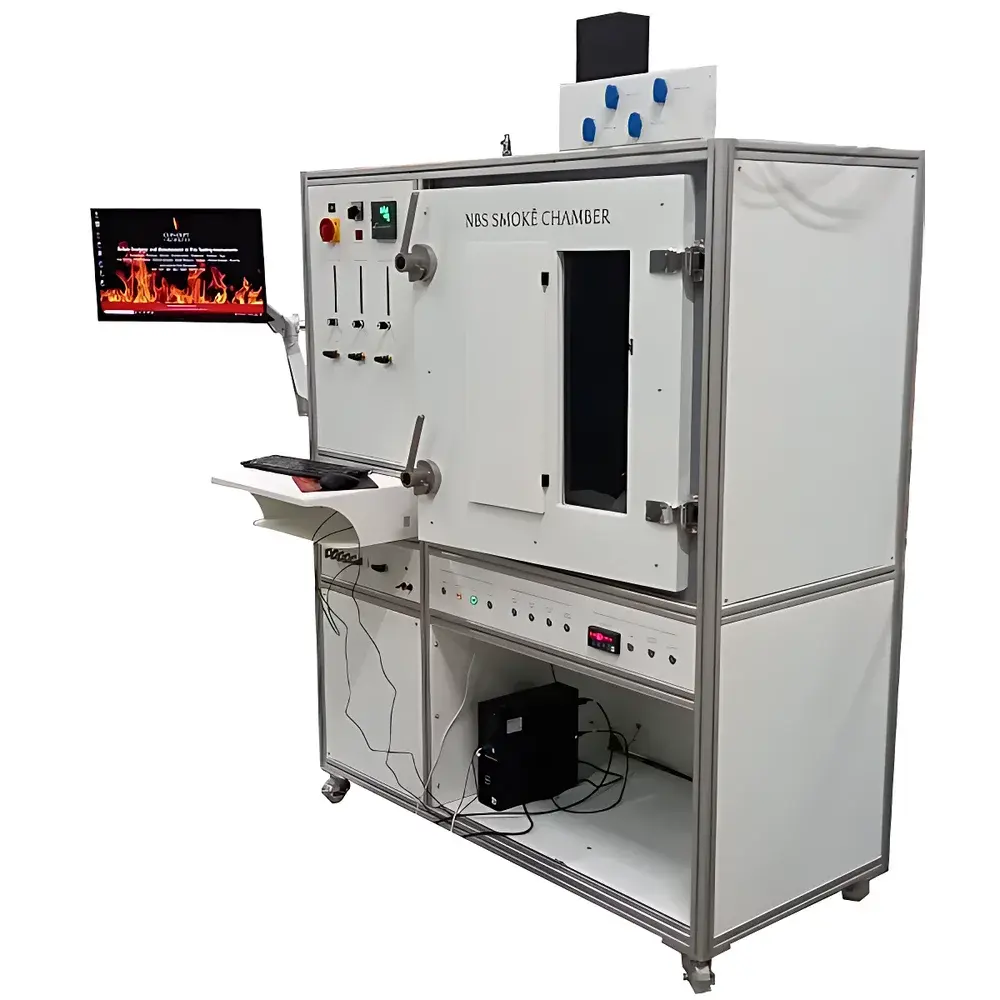
Concept NBS Smoke Density Chamber
| Brand | Concept |
|---|---|
| Origin | United Kingdom |
| Manufacturer Type | Authorized Distributor |
| Origin Category | Imported |
| Model | NBS SMOKE CHAMBER |
| Pricing | Upon Request |
Overview
The Concept NBS Smoke Density Chamber is a rigorously engineered, dual-configuration fire testing instrument designed to quantify smoke obscuration from solid materials under controlled radiant or flame exposure. Based on the foundational NBS (National Bureau of Standards, now NIST) methodology, it implements standardized optical attenuation measurement via a collimated light beam traversing a defined 900 mm path length through the smoke-laden test chamber. The system operates according to the fundamental principle of specific optical density (Ds), calculated in real time from transmitted light intensity using the Beer–Lambert law. It supports both vertical orientation (per ASTM E662 and BS 6401) and horizontal orientation (per ISO 5659-2), enabling compliance with a broad spectrum of international fire safety regulations governing aerospace, rail, marine, and building product certification.
Key Features
- Dual-orientation capability: Interchangeable vertical and horizontal test configurations — vertical setup conforms to ASTM E662 and BS 6401; horizontal setup complies with ISO 5659-2, EN 45545-2, NES 711, AITM 2.0007/2.0008/3.0005, BSS 7239, and ABD0031.
- High-fidelity optical system: Vertical configuration employs a precision photomultiplier tube (PMT) detector with digital signal processing, ensuring high sensitivity and repeatability in Ds measurement across the full dynamic range (0–1000 Ds units).
- Thermally stable stainless-steel test chamber: Full-size hinged door with integrated quartz observation window; corrosion-resistant heated chamber walls maintain uniform thermal boundary conditions during extended tests.
- Programmable radiant heat source: 25 kW/m² vertical cone heater (ASTM/BS mode) or calibrated horizontal radiant panel (ISO 5659-2 mode), both traceable to NPL or NIST standards.
- Automated mechanical subsystems: Software-controlled pneumatic lower exhaust damper, upper ventilation flap, and motorized sample positioning stage — all synchronized with data acquisition for precise temporal alignment.
- Integrated combustion system: Multi-port stainless-steel pilot burner with adjustable propane flow and air-assisted ignition; includes dedicated compressed air supply manifold for burner operation, radiation sensor calibration, and actuator control.
- Modular toxicity interface: Optional toxic gas sampling port compatible with BSS 7239 and AITM 3.0005 protocols; supports direct coupling to FTIR or GC-MS analyzers for CO, HCN, HCl, HF, SO₂, and other combustion byproducts.
Sample Compatibility & Compliance
The chamber accommodates flat, rigid specimens up to 100 mm × 100 mm × 25 mm (vertical) or 150 mm × 150 mm × 25 mm (horizontal), including polymers, composites, foams, coated textiles, and laminates. All hardware and software configurations are validated against the metrological requirements of ISO/IEC 17025-accredited laboratories. Test reports generated meet evidentiary criteria for regulatory submissions under FAA AC 20-135, EASA CS-25 Appendix F, IMO FTP Code Part 2, and EU CPR Annex I. Calibration procedures follow ASTM E1529 Annex A1 and ISO 5659-2 Clause 8, with optional third-party verification available per UKAS or DAkkS scope.
Software & Data Management
The embedded control and acquisition platform runs on a real-time Windows OS with dedicated DAQ hardware (24-bit resolution, 1 kHz sampling). The software provides full audit trail functionality compliant with FDA 21 CFR Part 11 (electronic signatures, user access levels, change history), supports GLP/GMP-aligned report generation (PDF + CSV export), and includes automated Ds(t) curve fitting, peak smoke density (Ds,max), smoke production rate (SPR), and time-to-Ds=50/100/200 calculations. Raw optical voltage, thermocouple readings, gas flow rates, and actuator status are timestamped and archived with metadata tagging for traceability.
Applications
This instrument serves as a primary screening tool for material developers and certification bodies evaluating smoke hazard in transportation interiors (aircraft cabin panels, train flooring, ship bulkheads), construction products (fire-stopping systems, insulation boards), and electrical enclosures. Its dual-mode flexibility enables comparative assessment of material behavior under flaming vs. non-flaming pyrolysis conditions — critical for hazard modeling in CFD-based fire simulations (e.g., FDS, PyroSim). Regulatory end users include notified bodies (e.g., UL, BRE, TÜV SÜD), aerospace OEMs (Airbus, Boeing, Bombardier), and rail system integrators validating against EN 45545-2 HL2/HL3 requirements.
FAQ
What standards does the Concept NBS Smoke Density Chamber support?
ASTM E662, ISO 5659-2, BS 6401, IMO FTP Code Part 2, NES 711, BSS 7239, AITM 2.0007/2.0008/3.0005, ABD0031, and EN 45545-2.
Can the same chamber be used for both vertical and horizontal testing?
Yes — the stainless-steel chamber is mechanically and software-configurable for either orientation; switching requires only repositioning of the heater assembly and recalibration per standard procedure.
Is toxicity measurement integrated or optional?
Toxicity sampling is an optional module; it adds a calibrated gas extraction port, temperature-controlled transfer line, and interface logic compatible with FTIR, GC-MS, or electrochemical sensor arrays.
What electrical and utility requirements must be met for installation?
110 V AC / 25 A / 60 Hz or 230 V AC / 16 A / 50 Hz single-phase supply; ambient operating temperature 10–35 °C; dedicated propane and compressed air (≥7 bar) lines with filtration and pressure regulation.
Does the system support remote monitoring or networked data export?
Yes — the DAQ system includes Ethernet connectivity, OPC UA server integration, and configurable REST API endpoints for enterprise LIMS or MES synchronization.



