
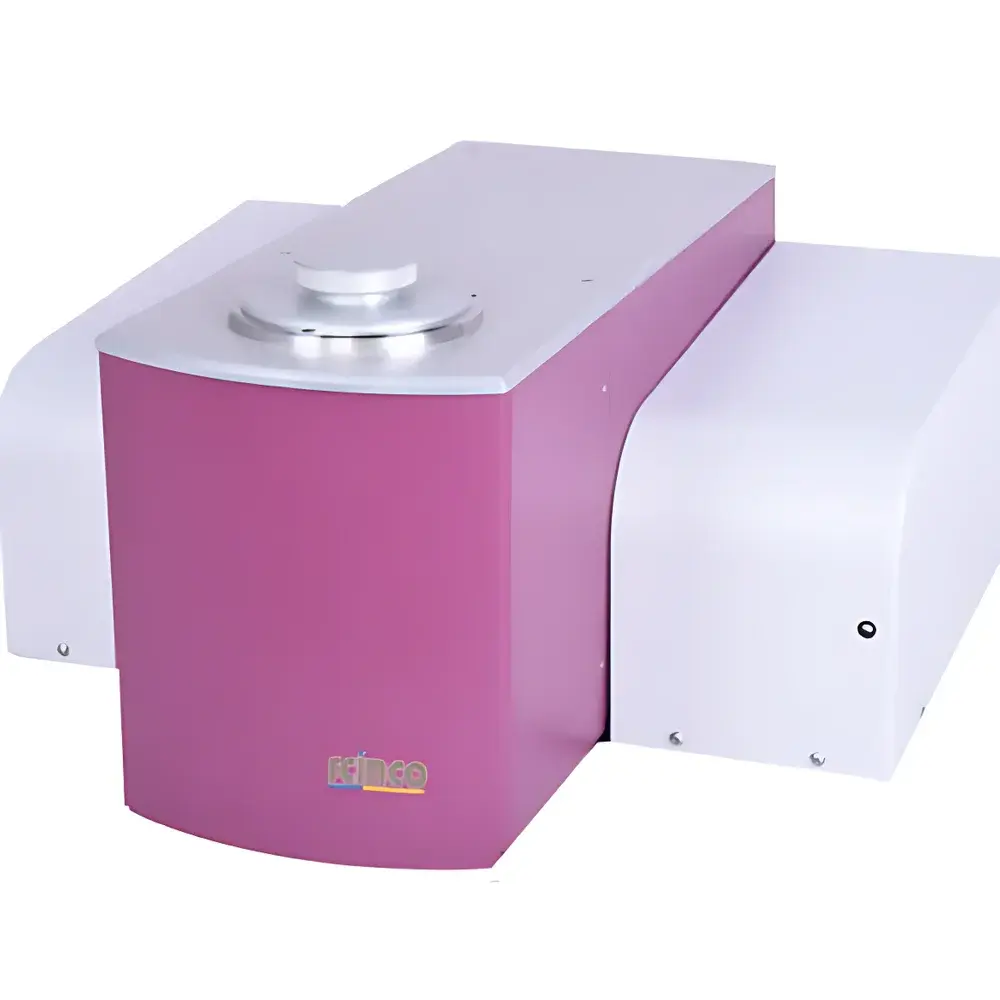
SCINCO DSC N-650 Differential Scanning Calorimeter
| Brand | SCINCO |
|---|---|
| Origin | USA |
| Model | DSC N-650 |
| Sample Capacity | Single |
| Instrument Type | Differential Scanning Calorimeter (DSC) |
| Temperature Range | −150 °C to 725 °C |
| Temperature Accuracy | ±0.1 °C |
| Temperature Precision | ±0.1 °C |
| Thermocouple Type | Type K |
| Heating/Cooling Rate | 0.1–200 °C/min |
| Baseline Stability | High |
| Heat Flow Sensor Noise Level | Low |
| Cooling Method | Optional Water Cooling |
| Sample Pan Enclosure | Sealed |
| Temperature Control | Dual-PID |
Overview
The SCINCO DSC N-650 Differential Scanning Calorimeter is a high-performance thermal analysis instrument engineered for precise quantification of heat flow differences between a sample and an inert reference as a function of temperature or time under controlled atmospheric conditions. Operating on the principle of heat-flux DSC, the system employs dual thermopile-based sensors integrated into a symmetric, low-thermal-mass furnace architecture to detect minute enthalpic changes—such as glass transitions (Tg), melting (Tm), crystallization (Tc), solid-solid transitions, oxidative induction time (OIT), and reaction enthalpies—with exceptional sensitivity and reproducibility. Its extended operational range—from cryogenic −150 °C to high-temperature 725 °C—enables characterization across polymer processing, pharmaceutical stability testing, metallurgical phase mapping, and battery material decomposition studies. The instrument’s thermal design minimizes parasitic heat transfer between sample and reference positions, resulting in a baseline stability superior to conventional single-sensor DSC platforms and a signal-to-noise ratio optimized for low-mass or low-enthalpy samples.
Key Features
- Extended temperature capability: −150 °C to 725 °C, supported by liquid nitrogen cooling and high-temperature furnace options
- Dual-PID temperature control algorithm ensuring rapid stabilization and minimal overshoot during dynamic heating/cooling ramps
- Sealed, hermetic sample chamber compatible with inert (N2, Ar), oxidative (air, O2), or vacuum environments per ASTM E1269 and ISO 11357 standards
- Low-noise heat-flow sensor assembly with optimized thermal symmetry, delivering up to 2× higher sensitivity than standard commercial DSC systems
- Programmable heating and cooling rates from 0.1 to 200 °C/min, enabling both high-resolution transition analysis and accelerated stability screening
- Optional water-cooling interface for enhanced thermal management during extended high-rate experiments
- User-selectable heat-flux plate materials (e.g., alumina, sapphire) to match specific thermal conductivity and chemical resistance requirements
- Automated purge gas flow control with mass flow meter integration for repeatable atmosphere conditioning
Sample Compatibility & Compliance
The DSC N-650 accommodates standard crucibles (aluminum, gold-plated aluminum, stainless steel, ceramic) with capacities ranging from 0.5 mg to 50 mg, supporting solids, powders, thin films, gels, and small-volume liquids. Its sealed cell design prevents cross-contamination and enables quantitative analysis of volatile or moisture-sensitive compounds—including APIs, excipients, lithium-ion cathode materials, and reactive organometallics. The system complies with key regulatory and quality frameworks: data acquisition and reporting meet FDA 21 CFR Part 11 requirements for electronic records and signatures when paired with validated software; thermal calibration traceability follows NIST-traceable indium, zinc, and tin standards per ASTM E967 and E968; and hardware architecture supports GLP/GMP laboratory audit readiness through full event logging and user-access controls.
Software & Data Management
Controlled via SCINCO’s TA-Suite v5.x analytical software, the DSC N-650 provides real-time visualization, multi-step method programming, and automated peak integration with baseline correction algorithms (tangent, step, or polynomial). Raw data are stored in vendor-neutral ASCII format with embedded metadata (operator ID, timestamp, instrument serial number, calibration history). Advanced modules include: Cp calculation using sapphire standard method (ASTM E1269); purity determination via van’t Hoff analysis; kinetic modeling (Friedman, Ozawa-Flynn-Wall); and isoconversional analysis for decomposition onset prediction. All software functions support audit trail generation, electronic signature workflows, and export to LIMS-compatible formats (CSV, XML, PDF/A-2u).
Applications
- Pharmaceutical: Quantifying polymorphic transitions, amorphous content, hydrate/dehydrate behavior, and excipient compatibility per ICH Q5E guidelines
- Polymers: Measuring Tg, degree of crystallinity, cold crystallization kinetics, and thermal degradation onset in thermoplastics, elastomers, and composites
- Electrochemical Materials: Evaluating SEI formation enthalpy, cathode structural instability, and electrolyte thermal runaway thresholds in Li-ion battery R&D
- Metals & Alloys: Characterizing solidus/liquidus temperatures, precipitation reactions, and phase transformation hysteresis in aluminum, titanium, and nickel-based superalloys
- Food Science: Assessing starch gelatinization, fat polymorphism, and protein denaturation profiles under controlled humidity conditions
FAQ
What calibration standards are recommended for routine DSC N-650 verification?
Indium (Tm = 156.6 °C, ΔHfus = 28.45 J/g) and zinc (Tm = 419.5 °C) are primary standards for temperature and enthalpy calibration per ASTM E968.
Is the DSC N-650 compatible with modulated DSC (MDSC®) techniques?
No—the DSC N-650 implements conventional heat-flux DSC only; it does not support sinusoidal temperature modulation or reversing/non-reversing heat flow separation.
Can the instrument operate under vacuum without external pumping accessories?
Yes—the sealed chamber supports static vacuum operation down to 10−2 mbar using the built-in vacuum valve; active high-vacuum pumping requires optional external turbomolecular pump integration.
Does the software support automated batch processing of multiple DSC runs?
Yes—TA-Suite includes scriptable batch analysis mode with customizable report templates and pass/fail criteria for QA/QC release testing.
What maintenance intervals are recommended for optimal thermal performance?
Furnace alignment and sensor zero-point verification every 6 months; thermocouple and purge line inspection quarterly; full system calibration annually or after major component replacement.



