
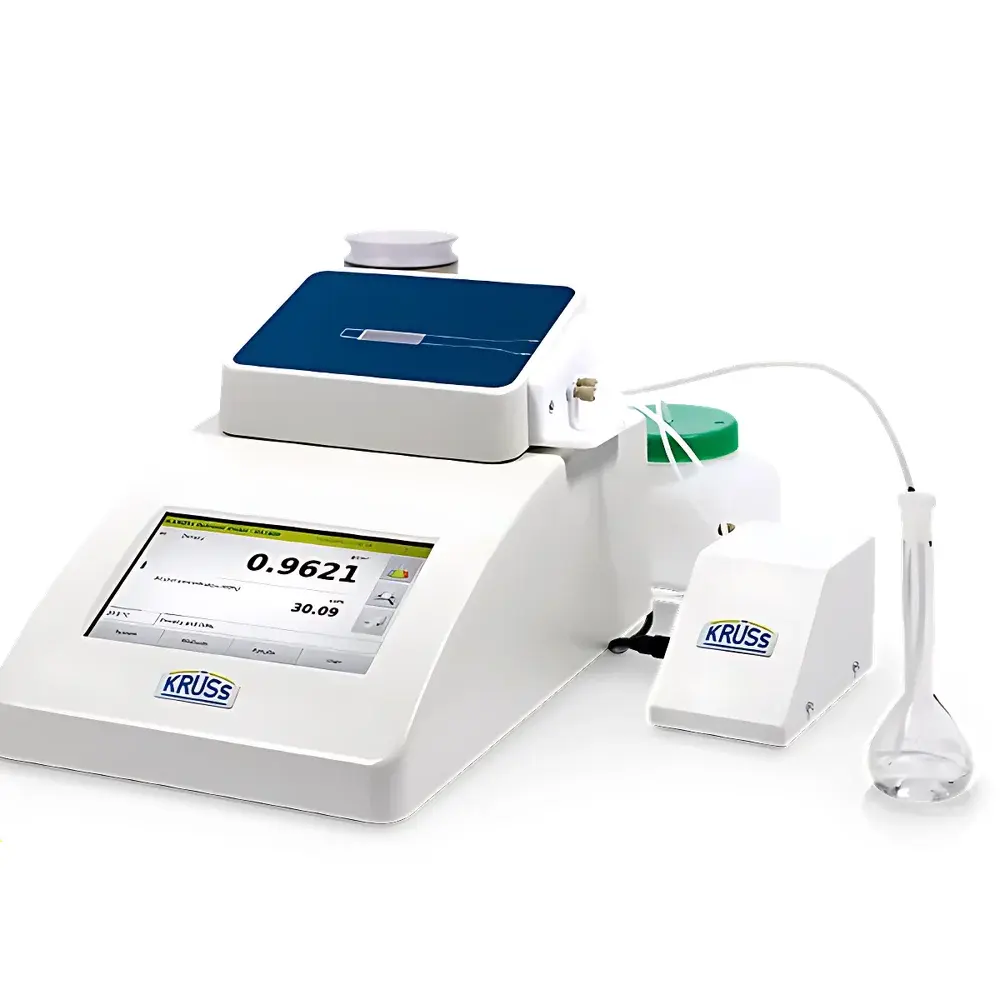
KRUESS DS7800 Digital Oscillating U-Tube Densimeter
| Brand | KRUESS |
|---|---|
| Origin | Germany |
| Model | DS7800 |
| Instrument Type | Laboratory Benchtop Oscillating U-Tube Densimeter |
| Sample Type | Liquid |
| Density Range | 0.0000–1.9999 g/cm³ |
| Density Accuracy | ±0.0001 g/cm³ |
| Density Resolution | 0.0001 g/cm³ |
| Repeatability | ±0.0001 g/cm³ |
| Temperature Control Range | 10–40 °C |
| Temperature Stability | ±0.02 °C |
| Minimum Sample Volume | 0.9 mL |
| Measurement Time | ~5 min |
| Calibration Standards | Dry air and distilled water |
| Compliance | ASTM D4052, ASTM D5002, NIST-traceable, GLP/GMP-ready |
| Data Storage | SQL database (999 results) |
| Interface Options | Ethernet, USB 2.0, RS-232 |
| Display | 5.7″ TFT color LCD (640×480 VGA) |
| Power Supply | 90–264 V AC, 50/60 Hz |
| User Management | Three-level password protection |
| Language Support | 6 languages |
| LIMS Compatibility | Yes |
Overview
The KRUESS DS7800 is a high-precision laboratory benchtop densimeter engineered for traceable, repeatable density determination of liquid samples using the oscillating U-tube principle. Based on the fundamental relationship between the resonant frequency of a filled U-shaped glass tube and the density of the sample, the DS7800 delivers metrologically sound measurements compliant with internationally recognized standards including ASTM D4052 (Standard Test Method for Density, Relative Density, and API Gravity of Crude Petroleum and Liquid Petroleum Products by Digital Density Meter) and ASTM D5002 (Standard Test Method for Density of Biodiesel and Biodiesel Blends by Digital Density Analyzer). Its core measurement cell—fabricated from borosilicate glass and precisely temperature-controlled via integrated Peltier elements—ensures minimal thermal drift and high mechanical stability. The instrument operates across a broad density range (0.0000–1.9999 g/cm³) with resolution and repeatability both at 0.0001 g/cm³, enabling quantitative analysis in applications where small compositional changes significantly impact physical behavior—such as concentration monitoring in pharmaceutical formulations or alcohol content verification in spirits.
Key Features
- U-tube oscillation sensor with optical window monitoring to eliminate bubble interference and ensure robust signal acquisition
- Integrated semiconductor-based temperature control system (±0.02 °C stability) spanning 10–40 °C, eliminating need for external thermostats
- Dedicated dry-air purge unit and peristaltic pump for automated sample handling, rinsing, and drying cycles
- 5.7″ VGA TFT color touchscreen interface with intuitive menu navigation and real-time display of all critical parameters (density, temperature, frequency, status)
- Onboard SQL database supporting storage of up to 999 measurement records with timestamp, operator ID, method name, and calibration history
- Multi-interface connectivity: Ethernet (for networked lab integration), USB 2.0 (data export and firmware updates), and RS-232 (legacy printer support)
- Three-tier user access management with configurable password protection (administrator, supervisor, operator) aligned with GLP/GMP audit requirements
- Support for 99 user-defined measurement methods, each configurable for units (g/cm³, kg/m³, °API, % w/w, etc.), temperature correction models, and auto-validation rules
Sample Compatibility & Compliance
The DS7800 is validated for use with low-to-medium viscosity liquids—including aqueous solutions, organic solvents, hydrocarbons, glycols, alcohols, acids, bases, and emulsions—provided they are non-corrosive to borosilicate glass and do not polymerize or crystallize within the U-tube during measurement. Its 0.9 mL minimum sample volume reduces reagent consumption and supports analysis of precious or hazardous materials. The instrument meets ISO/IEC 17025 documentation requirements for accredited testing laboratories and incorporates full electronic audit trail functionality (e.g., operator logins, method modifications, calibration events) satisfying FDA 21 CFR Part 11 expectations for electronic records and signatures when configured with enabled user authentication and secure data export protocols. All factory calibrations are traceable to NIST-certified reference standards.
Software & Data Management
Embedded firmware provides menu-driven calibration routines using dry air and double-distilled water, supporting 4–10 user-selectable calibration points for multi-point validation. Raw oscillation frequency data, temperature readings, and calculated density values are stored with metadata (date/time, method ID, operator code, environmental conditions). Export options include CSV via USB, direct Ethernet transfer to LIMS or ELN platforms, and serial printing. The SQL database structure enables structured querying—e.g., filtering by date range, operator, or method—and facilitates periodic backup and regulatory review. Optional software modules extend functionality to include statistical process control (SPC) charting, trend analysis over time, and automated report generation compliant with internal QA templates.
Applications
- Pharmaceutical QC: Active pharmaceutical ingredient (API) concentration verification, excipient density screening, solvent purity assessment
- Fine chemical synthesis: Reaction progress monitoring via density shift, batch-to-batch consistency evaluation
- Food & beverage: Alcohol content (ethanol/water mixtures), sugar concentration (Brix), dairy product standardization
- Petroleum & biofuels: API gravity, biodiesel blend ratio (B0–B100), crude oil classification
- Electrolyte formulation: Battery-grade lithium salt solutions, conductivity–density correlation studies
- Environmental labs: Density profiling of wastewater streams, leachate characterization, slurry solids content estimation
FAQ
What standards does the DS7800 comply with?
ASTM D4052, ASTM D5002, ISO 12185, and NIST-traceable calibration protocols.
Can the DS7800 be integrated into a LIMS environment?
Yes—via Ethernet or USB, with structured data export (CSV/SQL) and optional middleware for HL7 or ASTM E1384 mapping.
Is temperature control fully automatic?
Yes—the Peltier-based system maintains setpoint stability within ±0.02 °C without external chillers or baths.
How is bubble interference mitigated during measurement?
Optical detection through a dedicated quartz window monitors U-tube fill level and triggers automatic rejection of incomplete or bubbled fills.
Does the instrument support multi-language operation?
Yes—six pre-installed languages: English, German, French, Spanish, Italian, and Chinese (simplified).
What is the expected maintenance interval for the U-tube sensor?
Under normal use with proper cleaning protocols, the glass U-tube requires no scheduled replacement; lifetime exceeds 10 years with routine inspection.



