
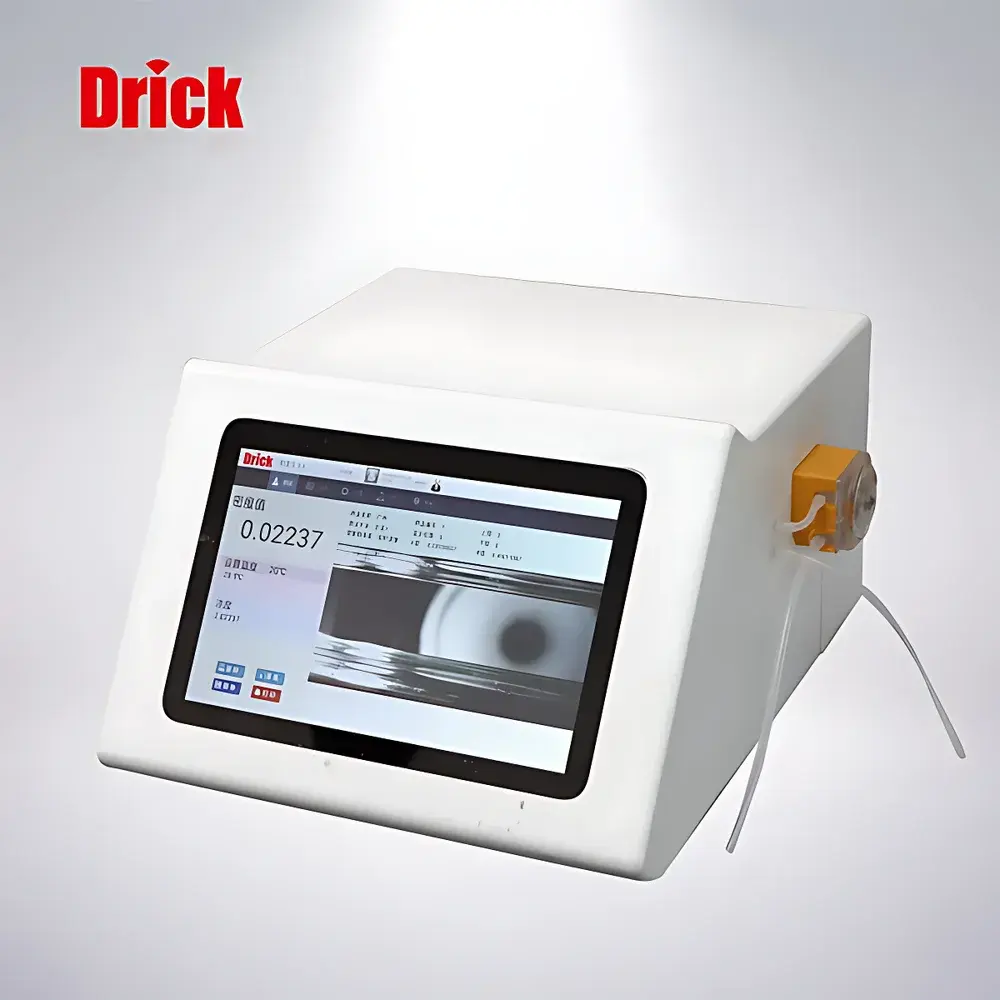
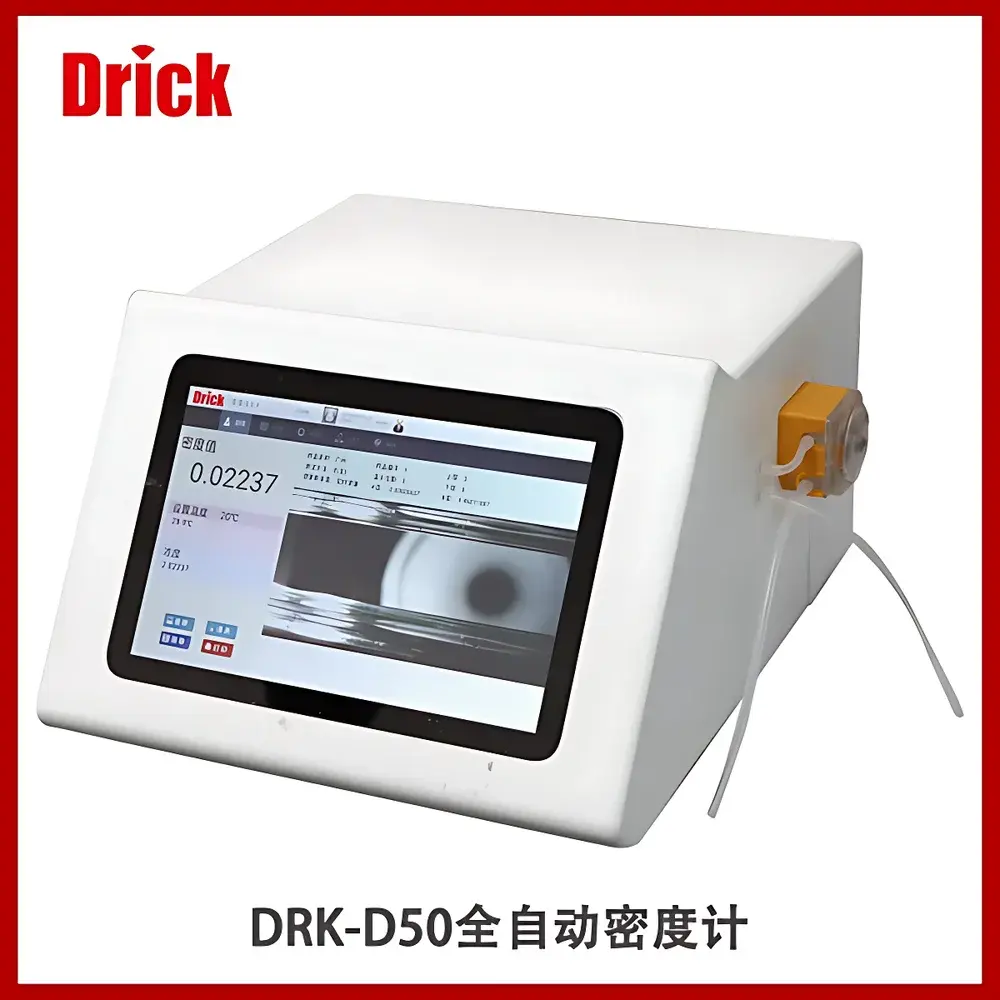
Drick DRK-D50 U-Tube Oscillating Density Meter
| Brand | Drick |
|---|---|
| Origin | Shandong, China |
| Manufacturer Type | OEM Manufacturer |
| Regional Classification | Domestic (China) |
| Model | DRK-D50 |
| Instrument Type | Oscillating U-Tube Densimeter |
| Form Factor | Benchtop Laboratory Instrument |
| Sample Type | Liquids Only |
| Density Range | 0 to 3 g/cm³ |
| Temperature Control Range | 5 °C to 45 °C |
| Repeatability | ±0.0002 g/cm³ |
| Resolution | ±0.0001 g/cm³ |
| Display | Digital LCD |
| Primary Application | Determination of density and derived physical parameters (e.g., specific gravity, API gravity, alcohol content, concentration) in liquid samples |
Overview
The Drick DRK-D50 U-Tube Oscillating Density Meter is a precision benchtop instrument engineered for high-accuracy, rapid, and operator-independent density measurement of homogeneous liquid samples. It operates on the fundamental principle of oscillating U-tube densimetry: a precisely machined borosilicate glass U-tube is filled with sample and electromagnetically excited into resonant oscillation; the natural frequency of oscillation is inversely proportional to the square root of the sample’s mass, enabling direct calculation of density via calibrated frequency–density correlation. This method—standardized in ISO 12058, ASTM D4052, and DIN 51757—delivers traceable, SI-traceable results without reliance on buoyancy or hydrostatic pressure, ensuring robust performance across diverse chemical matrices including aqueous solutions, organic solvents, viscous oils, and aggressive reagents common in pharmaceutical, petrochemical, food, and fine chemical manufacturing.
Key Features
- High-stability temperature-controlled Peltier system maintaining ±0.02 °C uniformity across the oscillation cell, critical for compliance with ISO 5725 reproducibility requirements.
- Automated air- and solvent-compatible filling protocol with integrated purge cycle, minimizing carryover and cross-contamination between sequential measurements.
- Digital LCD interface with intuitive menu navigation and real-time display of density (g/cm³), temperature (°C), and oscillation frequency (Hz).
- Robust mechanical architecture featuring vibration-damped base and rigid aluminum housing, suitable for shared laboratory environments with variable ambient conditions.
- Calibration traceability supported by certified reference materials (e.g., water, air, and standard density fluids traceable to NIST SRMs) and dual-point calibration routine compliant with GLP documentation standards.
Sample Compatibility & Compliance
The DRK-D50 is validated for use with transparent, low-to-moderate viscosity liquids (up to ~500 mPa·s) that do not precipitate or polymerize within the U-tube during analysis. It meets essential regulatory expectations for routine QC/QA workflows: its measurement uncertainty profile supports alignment with USP , EP 2.2.5, and ICH Q5C stability-indicating protocols. While not inherently 21 CFR Part 11–compliant out-of-the-box, the instrument’s deterministic output and audit-ready calibration logs enable integration into validated systems when paired with appropriate LIMS or ELN platforms. All wetted parts are chemically resistant borosilicate glass and PTFE-sealed stainless steel—compatible with ethanol, acetone, methanol, mineral oil, sucrose solutions, and buffered saline formulations.
Software & Data Management
The DRK-D50 operates as a standalone instrument with embedded firmware supporting manual data logging via USB export (CSV format). Optional PC-based software (DRK-DensitySuite v3.x) provides extended functionality: automated report generation (PDF/Excel), statistical trend analysis (X-bar & R charts), multi-sample batch processing, and user-access-level management (administrator/operator modes). Raw oscillation frequency data, timestamped measurement records, and calibration history are stored locally with time/date stamping—enabling retrospective review consistent with ALCOA+ data integrity principles. Exported files include metadata fields required for FDA audit readiness: operator ID, instrument serial number, calibration certificate ID, and environmental temperature at time of measurement.
Applications
- Pharmaceuticals: Density verification of active pharmaceutical ingredient (API) solutions, excipient slurries, and final dosage form syrups per USP monographs; concentration monitoring in buffer preparation and cleaning validation studies.
- Petrochemicals: API gravity determination of crude fractions and refined fuels (gasoline, diesel, jet fuel); ethanol-blend verification in biofuels per ASTM D5006.
- Food & Beverage: Brix estimation in fruit juices and soft drinks; alcohol content quantification in wines and spirits (via density–alcohol correlation tables); quality control of dairy cream and plant-based milk alternatives.
- Chemical Manufacturing: In-process density monitoring for reaction endpoint detection in esterification, polymerization, and neutralization processes; raw material identity verification against specification sheets.
- Academic & Regulatory Labs: Teaching tool for physical chemistry labs demonstrating fundamental fluid property relationships; reference instrument for inter-laboratory comparison studies under ISO/IEC 17043 proficiency testing schemes.
FAQ
What is the minimum sample volume required for analysis?
Typical fill volume is 1.5–2.0 mL; the U-tube geometry ensures full immersion of the oscillation node while minimizing waste—critical for high-value or hazardous samples.
Can the DRK-D50 measure density of suspensions or emulsions?
No. The instrument requires optically clear, homogeneous, non-settling liquids; particulates or phase separation will disrupt oscillation stability and invalidate results.
Is temperature calibration performed automatically during each measurement?
Yes. An integrated Pt100 sensor continuously monitors cell temperature; all density values are corrected to the user-specified reference temperature (e.g., 20 °C or 25 °C) using the instrument’s built-in temperature compensation algorithm.
How often must the U-tube be recalibrated?
Initial two-point calibration (air + water or certified standard) is required after installation, following maintenance, or if ambient lab temperature shifts >5 °C; routine daily verification with a single standard is recommended for GLP-compliant environments.
Does the instrument support external data acquisition via RS-232 or Ethernet?
Standard configuration includes USB 2.0 host port only; optional RS-232 module (DRK-RS232-KIT) enables integration with SCADA or MES systems for Industry 4.0 process monitoring deployments.



