
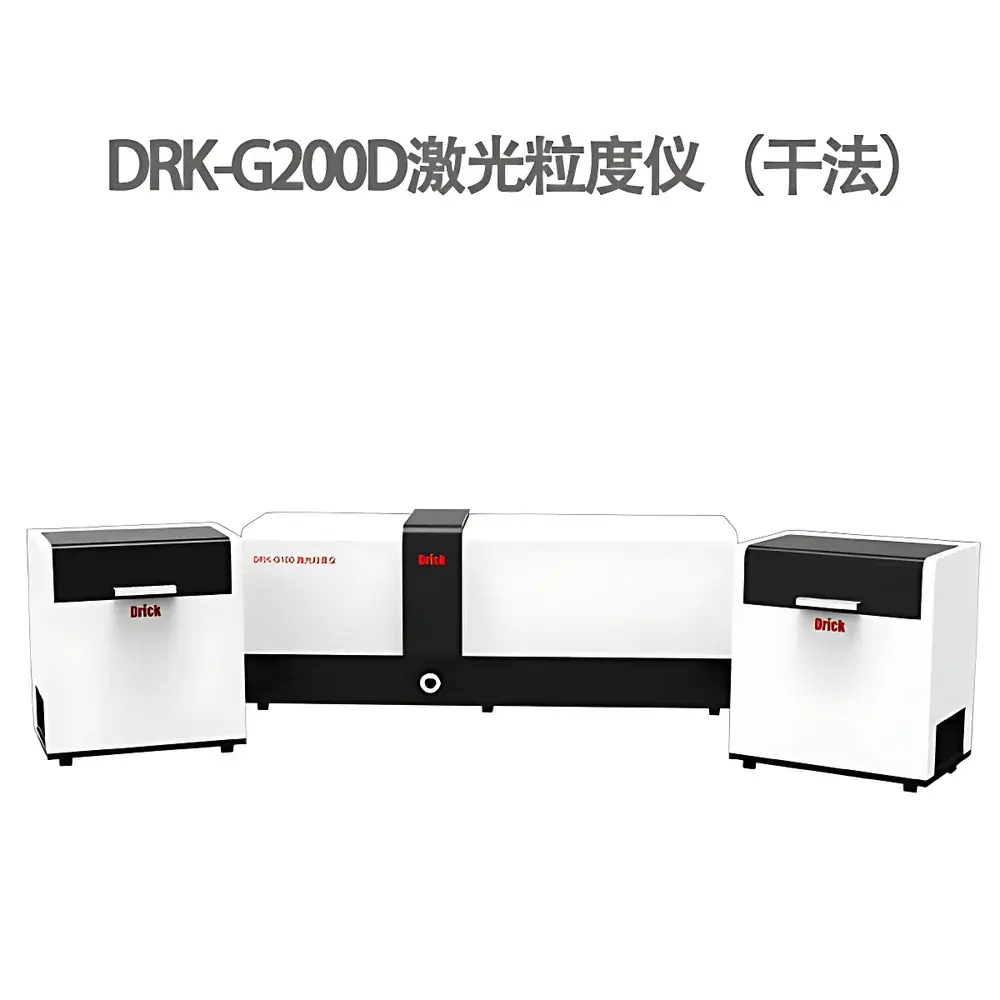
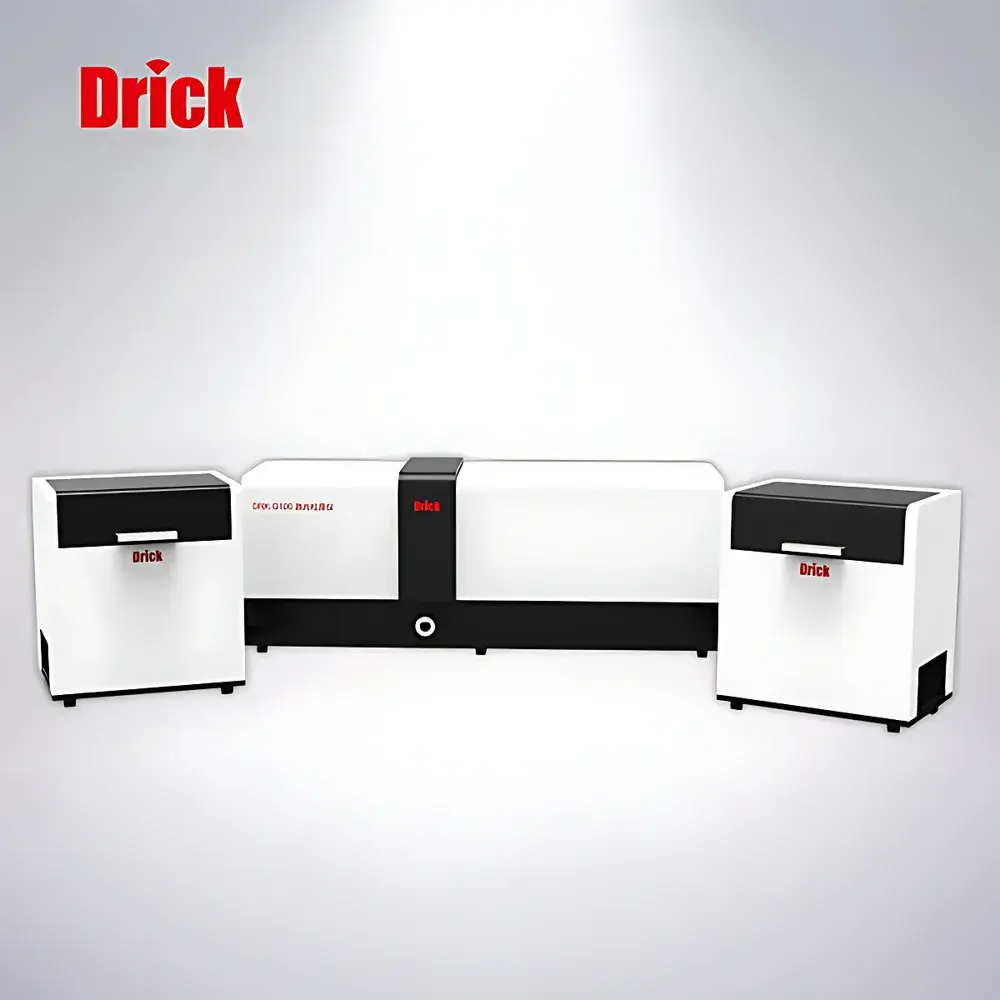
Drick DRK-G200D Dry-Dispersion Laser Particle Size Analyzer
| Brand | Drick |
|---|---|
| Origin | Shandong, China |
| Manufacturer Type | Direct Manufacturer |
| Product Category | Domestic Laboratory Instrument |
| Model | DRK-G200D |
| Dispersion Method | Dry Dispersion |
| Instrument Type | Benchtop Laser Particle Size Analyzer |
| Measurement Range (Dry Mode) | 0.1–2000 µm |
| Repeatability | <1% RSD (verified with NIST-traceable standard reference material, D50) |
Overview
The Drick DRK-G200D is a benchtop dry-dispersion laser particle size analyzer engineered for high-reproducibility granulometric characterization of free-flowing powders and dry particulates. It operates on the principle of Fraunhofer diffraction and Mie scattering theory, with an optimized optical path design that ensures robust signal capture across the full 0.1–2000 µm dynamic range. Unlike wet-dispersion systems requiring solvents or surfactants, the DRK-G200D employs a high-efficiency turbulent air jet dispersion unit to de-agglomerate particles in situ—minimizing moisture-induced artifacts and eliminating sample preparation delays associated with liquid media. Its modular optical bench integrates a 635 nm diode laser source, dual-angle detection array (forward-scatter up to 15° and back-scatter up to 165°), and real-time data acquisition at 10 kHz sampling rate. The system is calibrated using certified NIST-traceable silica and polystyrene latex standards, supporting traceable compliance with ISO 13320:2020 (Particle size analysis — Laser diffraction methods) and ASTM E2987–22 (Standard Practice for Determining Particle Size Distribution of Powders Using Laser Diffraction).
Key Features
- Dry dispersion module with adjustable airflow (0.5–4.0 bar) and programmable feed rate control for consistent de-agglomeration without mechanical grinding or shear degradation
- Integrated vacuum-assisted sample recovery system minimizing cross-contamination between runs
- Optimized lens configuration enabling simultaneous measurement of sub-micron fines (1000 µm) within a single scan
- Real-time monitoring of dispersion efficiency via integrated aerosol concentration sensor and scattered light intensity feedback loop
- Robust industrial-grade chassis with electromagnetic shielding and temperature-stabilized optical housing (±0.5°C stability over 8 h)
- Compliance-ready firmware architecture supporting audit trails, user access levels, and electronic signature protocols aligned with FDA 21 CFR Part 11 requirements
Sample Compatibility & Compliance
The DRK-G200D is validated for use with non-cohesive, low-moisture powders including food-grade starches, dairy powders (e.g., whey, casein), flour blends, sugar crystals, cocoa powder, and functional food additives. It accommodates samples with bulk densities ranging from 0.2 to 2.5 g/cm³ and flowability indices (Hausner ratio) ≤1.4. The instrument meets ISO/IEC 17025:2017 general requirements for competence of testing and calibration laboratories when operated under documented SOPs. Measurement reports include full metadata (laser power, detector gain, background subtraction parameters, and dispersion pressure), satisfying GLP and GMP documentation needs for QC release testing in food manufacturing facilities.
Software & Data Management
The proprietary Drick Particle Analysis Suite (v4.2) provides ISO-compliant data processing using both Fraunhofer approximation (for particles >50 µm) and Mie theory (for full-range analysis with user-defined refractive index input). Software features include batch report generation (PDF/CSV/XLSX), statistical comparison of multiple distributions (t-test, ANOVA), outlier detection via interquartile range filtering, and customizable pass/fail criteria per USP , ISO 8503-2, or internal specifications. All raw scatter patterns and processed results are stored with immutable timestamps and operator IDs. Data export supports LIMS integration via ODBC and HL7-compatible structured output.
Applications
- Quality control of spray-dried milk powder for D50 consistency and tail-end coarse fraction quantification
- Monitoring milling endpoint in cereal flour production to ensure compliance with AACC Method 22-01
- Characterization of functional ingredient agglomeration (e.g., lecithin-coated vitamin C) during dry blending
- Verification of particle size distribution in infant formula powders per Codex Alimentarius STAN 72-1981 Annex II
- R&D screening of novel encapsulation matrices (e.g., maltodextrin vs. gum arabic carriers) for controlled-release food applications
- Batch-to-batch comparability assessment in spice grinding operations where over-milling causes volatile loss
FAQ
What refractive index values should be used for common food powders?
Typical defaults: skim milk powder (1.52 + 0.001i), wheat flour (1.54 + 0.005i), sucrose (1.56 + 0.000i). Users may input experimentally determined values for improved accuracy.
Can the DRK-G200D measure hygroscopic or electrostatic-prone materials?
Yes—with optional anti-static ionizer module (accessory DRK-AS1) and nitrogen purge interface to suppress moisture adsorption and charge buildup during dispersion.
Is method transfer possible from wet-dispersion instruments?
Method equivalence studies per ISO 13320 Annex B are supported; dry-mode results typically show 2–5% lower Dv50 versus wet mode due to absence of surface tension effects—validation templates are included in software.
How often does the optical alignment require verification?
Factory alignment is stable for ≥12 months under normal lab conditions; quarterly verification using built-in He–Ne alignment check routine is recommended.
Does the system support 21 CFR Part 11 compliance out-of-the-box?
Yes—audit trail logging, role-based access control (admin/operator/analyst), and electronic signature workflows are enabled by default and configurable via system administrator mode.



