
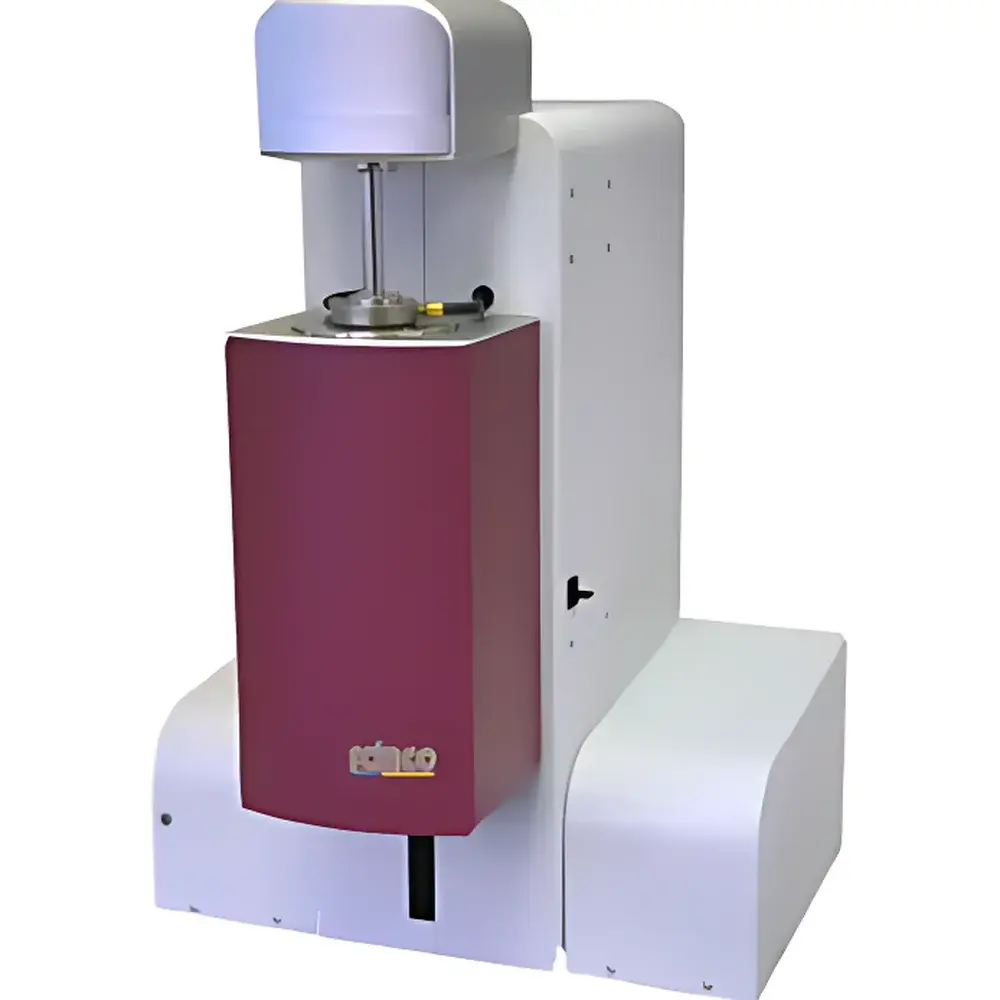
Scinco STA N-650/1000/1200/1500 Simultaneous Thermal Analyzer
| Brand | Scinco |
|---|---|
| Origin | USA |
| Model | STA N-650/1000/1200/1500 |
| Temperature Range | –125 to 650 °C, RT to 1000/1200/1500 °C |
| Heating/Cooling Rate | 0.1–100 °C/min (N-650), 0.1–40 °C/min (N-1000/N-1200/N-1500) |
| Maximum Sample Mass | 400 mg |
| Temperature Accuracy | ±0.1 °C |
| Mass Accuracy | ±0.1 µg |
| Gas Purge | Integrated automatic gas switching (optional) |
| Furnace Design | Vertical micro-balance architecture with water-cooled furnace |
| Compatibility | FT-IR, Q-MS, and other evolved gas analysis (EGA) systems |
Overview
The Scinco STA N-650/1000/1200/1500 is a high-performance simultaneous thermal analyzer engineered for precise, real-time coupling of differential scanning calorimetry (DSC) and thermogravimetric analysis (TGA) within a single instrument platform. It operates on the principle of concurrent measurement: while the ultra-sensitive microbalance continuously records mass change under controlled temperature programming (TGA), the high-resolution heat-flux sensor simultaneously detects enthalpic events—including phase transitions, decomposition, oxidation, and crystallization—via differential thermal response between sample and reference (DSC). This dual-signal acquisition eliminates temporal misalignment inherent in sequential measurements, ensuring strict correlation between mass loss steps and corresponding thermal events. The system employs a vertically oriented, low-inertia furnace design with integrated water cooling, enabling rapid thermal response (<1 s thermal lag), stable baseline performance, and reproducible cooling rates down to ambient or sub-ambient conditions (–125 °C optional with cryo-accessory). All models are factory-calibrated using certified reference materials traceable to NIST standards, supporting quantitative interpretation of onset temperatures, peak resolution, and enthalpy values per ASTM E794, ISO 11357, and USP <1163> guidelines.
Key Features
- True simultaneous DSC-TGA operation with synchronized data acquisition at up to 50 Hz sampling rate
- High-stability vertical microbalance with ±0.1 µg mass resolution and active drift compensation
- Modular furnace architecture: N-650 supports –125 to 650 °C (cryo-compatible); N-1000/N-1200/N-1500 extend to 1000 °C, 1200 °C, and 1500 °C respectively, all with programmable heating/cooling rates from 0.1 to 40 °C/min (N-650: up to 100 °C/min)
- Integrated gas handling system with automated multi-gas switching (N2, Ar, O2, synthetic air), mass flow control, and purge gas synchronization with temperature ramp initiation
- Optimized evolved gas analysis (EGA) interface compatible with FT-IR, quadrupole mass spectrometry (Q-MS), and GC-MS systems via heated transfer line (150–300 °C)
- Compact, low-thermal-mass furnace core with independent atmosphere isolation—ensuring minimal cross-contamination between sample chamber and heating elements
- Automatic calibration routines for temperature (In, Zn, Sn, Bi, Al) and enthalpy (KCl, benzoic acid) per ISO 11357-1 and ASTM E967
Sample Compatibility & Compliance
The Scinco STA accommodates solid, powder, fiber, thin-film, and small-volume liquid samples (≤400 mg max loading) in standard alumina, platinum, or gold crucibles. Its vertical balance geometry minimizes buoyancy effects and ensures high signal-to-noise ratio across wide dynamic ranges—from nanogram-scale polymer additives to milligram-level pharmaceutical excipients. The system meets critical regulatory requirements for GxP environments: full audit trail capability, electronic signature support, and 21 CFR Part 11-compliant software modules (available as optional upgrade). Data integrity complies with ALCOA+ principles (Attributable, Legible, Contemporaneous, Original, Accurate, Complete, Consistent, Enduring, Available), and thermal calibration protocols align with ISO/IEC 17025 accreditation criteria for testing laboratories.
Software & Data Management
ThermalPro™ v5.x analytical suite provides intuitive method development, real-time visualization of dual-channel signals (mass % vs. temp/time and dH/dt vs. temp/time), and advanced deconvolution tools including derivative thermogravimetry (DTG), peak fitting (Gaussian/Lorentzian), and kinetic modeling (Friedman, Ozawa-Flynn-Wall). Raw data export supports ASCII, CSV, and universal .itx formats for third-party integration (e.g., MATLAB, OriginLab, Thermo-Calc). Automated report generation includes customizable templates compliant with internal SOPs and external submission standards (e.g., ICH Q5C, FDA IND/NDA filings). All instrument logs—including gas flow logs, temperature setpoint history, and balance diagnostics—are timestamped and encrypted for long-term archival.
Applications
- Polymers: Quantification of filler content, degradation kinetics, glass transition (Tg), and oxidative induction time (OIT)
- Pharmaceuticals: Hydrate/solvate stability assessment, polymorph screening, excipient compatibility, and residual solvent quantification
- Ceramics & composites: Sintering behavior, binder burnout profiles, and thermal expansion coefficient derivation
- Batteries: Cathode/anode thermal runaway onset, SEI layer formation enthalpy, and electrolyte decomposition pathways
- Geological & metallurgical samples: Mineral dehydration, carbonate decomposition, and phase transformation mapping under controlled atmospheres
FAQ
Can the STA N-1500 operate under reducing atmospheres such as H₂ or forming gas?
Yes—the furnace and gas delivery system are rated for inert, oxidizing, and mildly reducing atmospheres; H₂ use requires optional quartz liner and dedicated leak-tested gas manifold.
Is baseline correction automated during multi-step temperature programs?
Yes—ThermalPro™ applies dynamic baseline subtraction using pre- and post-event isothermal segments, with manual override capability for complex overlapping transitions.
What is the minimum detectable mass change for kinetic studies?
Under optimized conditions (low noise mode, 10 mg sample, 10 °C/min ramp), the system resolves mass changes ≥0.02% with RSD < 0.5% across replicate runs.
Does the system support modulated temperature TGA (MTGA)?
No—MTGA is not implemented; however, the high-speed data acquisition (50 Hz) enables post-acquisition numerical modulation for pseudo-modulated analysis when combined with custom scripting modules.
Are calibration certificates provided with each instrument shipment?
Yes—each unit ships with a full metrological certificate documenting as-delivered performance against NIST-traceable standards for temperature, mass, and heat flow, valid for 12 months from commissioning.



