
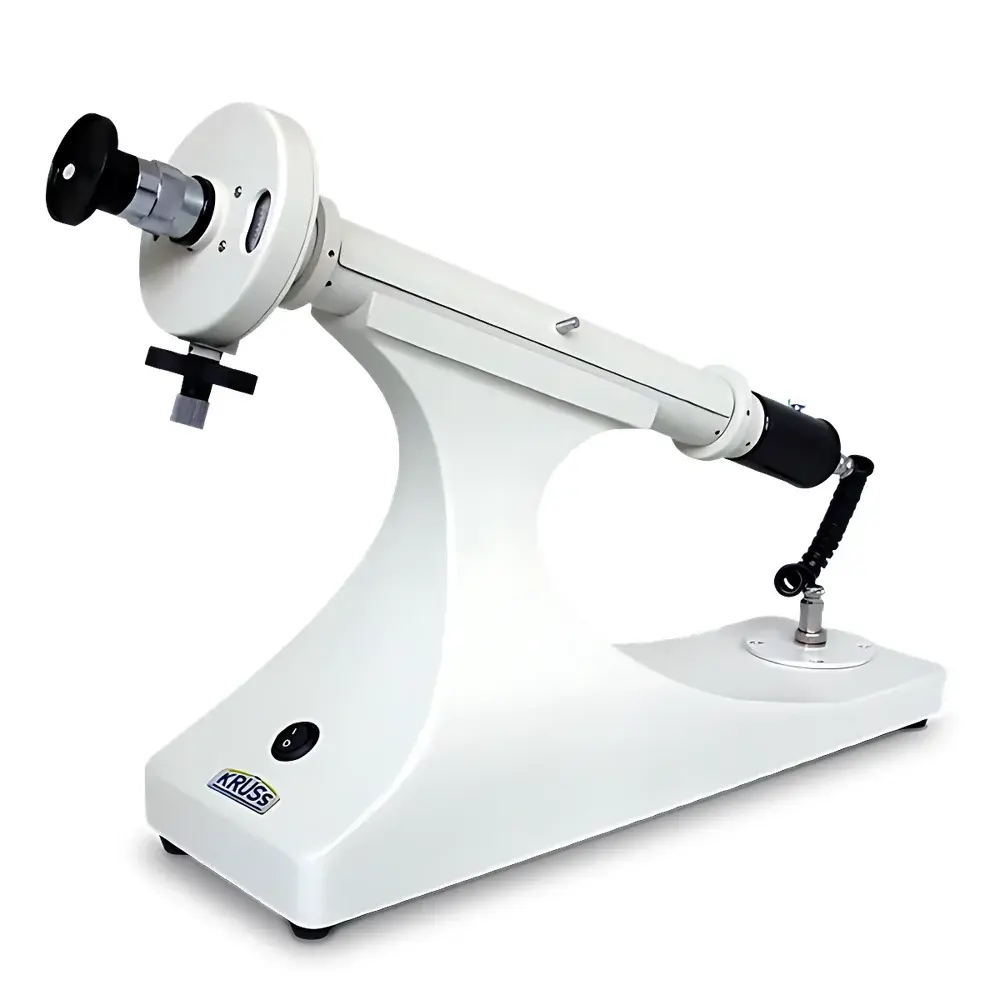
KRUESS P1000-LED Manual Polarimeter
| Brand | KRUESS |
|---|---|
| Origin | Germany |
| Model | P1000-LED |
| Instrument Type | Circular Disc Polarimeter |
| Temperature Control | None |
| Digital Display | None |
| Light Source | High-Stability LED |
| Measurement Range | 0–180° (two half-circles) |
| Angular Accuracy | ±0.01 °Z |
| Angular Precision | ±0.01 °Z |
| Scale Division | 1° |
| Vernier Reading Resolution | 0.05° |
| Sample Cell Length Compatibility | 100–200 mm |
| Dimensions (W × D × H) | 14.0 × 33.0 × 50.0 cm |
| Weight | 4.3 kg |
| LED Lifetime | >50,000 hours (≈500× longer than Na lamp) |
Overview
The KRUESS P1000-LED Manual Polarimeter is a precision optical instrument engineered for fundamental polarimetric analysis in academic laboratories, quality control environments, and industrial training settings. It operates on the classical half-shade field principle—a well-established optical method rooted in the differential extinction of polarized light passing through optically active substances. When plane-polarized light traverses a chiral sample (e.g., sucrose solutions, pharmaceutical intermediates, or essential oils), its plane of polarization rotates proportionally to concentration, path length, and specific rotation ([α]). The P1000-LED enables direct visual null-point determination using a calibrated rotating analyzer and dual-field half-shade viewing system, delivering traceable angular measurements without electronic interpolation or algorithmic correction. Its mechanical architecture—featuring a rigid metal base, precision-ground optical mounts, and a manually adjustable analyzer drum—ensures long-term stability and minimal drift under routine benchtop conditions.
Key Features
- High-stability monochromatic LED light source (589 nm equivalent), eliminating warm-up time, spectral drift, and mercury/sodium vapor hazards associated with traditional lamps
- Robust mechanical design with all-metal housing and vibration-damped base, optimized for consistent alignment over extended service life
- Manual half-shade field adjustment via precision-machined analyzer drum, enabling intuitive visual null detection with vernier-assisted readout
- Wide sample cell compatibility: accommodates standard glass tubes from 100 mm to 200 mm in length (including 220 mm maximum chamber depth)
- Vernier scale with 1° main divisions and 0.05° interpolation capability—supporting manual resolution sufficient for USP , EP 2.2.7, and ISO 5725-2 compliance verification
- No embedded electronics or firmware: inherently immune to software obsolescence, cybersecurity vulnerabilities, or calibration certificate invalidation due to firmware updates
Sample Compatibility & Compliance
The P1000-LED accepts standard cylindrical glass sample cells sealed with ground-glass or PTFE stoppers, compatible with aqueous, alcoholic, and low-viscosity organic solutions. Its open optical path supports rapid cell exchange and cleaning—critical for teaching labs handling multiple student samples per session. While lacking active temperature regulation, the instrument’s thermal mass and ambient-stable LED source minimize short-term thermal influence on readings when operated within ISO 29551 Class II laboratory conditions (20–25 °C, ±2 °C/h). The device meets foundational requirements for pharmacopoeial methods including United States Pharmacopeia “Optical Rotation”, European Pharmacopoeia 2.2.7, and Japanese Pharmacopoeia 6.03, where manual polarimeters remain accepted for compendial assays requiring operator verification of endpoint clarity. As a Class I optical measuring instrument per IEC 61000-4-2, it requires no electrical safety certification beyond standard lab grounding.
Software & Data Management
The P1000-LED is a fully analog, non-digitizing instrument: all measurements are recorded manually by the operator into laboratory notebooks or LIMS-compatible spreadsheets. This design aligns with GLP and GMP Annex 11 principles for instruments where human observation constitutes the primary measurement act—eliminating validation burdens associated with data acquisition software, audit trails, or electronic signature modules. No drivers, firmware, or proprietary software are required; thus, no version control, patch management, or cybersecurity assessment is necessary. For regulated environments, users may implement standardized SOPs for reading documentation (e.g., dual-operator verification, pre- and post-calibration checks using quartz control plates), ensuring full traceability per FDA 21 CFR Part 11 “electronic records” exemptions for paper-based manual systems.
Applications
- Educational demonstration of optical activity, chirality, and Fresnel’s theory of rotary polarization
- Concentration determination of sucrose in food and beverage QC (Brix correlation via known [α]ₛᵤcᵣₒₛₑ = +66.4° at 20 °C, D-line)
- Identity testing and purity assessment of enantiomerically enriched APIs (e.g., L-DOPA, ibuprofen, menthol)
- Raw material verification in fine chemical manufacturing per ASTM E1252-98 (Standard Practice for General Techniques for Isolating Optical Rotatory Dispersion)
- Calibration reference for automated polarimeters using NIST-traceable quartz rotatory standards
FAQ
Does the P1000-LED comply with pharmacopoeial standards for official assays?
Yes—it satisfies the physical configuration and performance criteria outlined in USP , Ph. Eur. 2.2.7, and JP 6.03 for manual polarimetry, provided operators follow validated SOPs and use certified reference materials.
Can it be used for temperature-dependent measurements?
No—this model lacks integrated temperature control or monitoring. For temperature-sensitive studies (e.g., [α] vs. T curves), external thermostatted cell holders or alternative instruments with Peltier stages are required.
What is the expected lifetime of the LED source?
Rated for >50,000 hours of continuous operation—approximately 500× longer than conventional sodium-vapor lamps—with negligible spectral shift or intensity decay over time.
Is calibration traceable to national standards?
Yes—KRUESS provides optional NIST-traceable quartz control plates (e.g., +34.0°, +85.0° at 20 °C) with individual calibration certificates issued by DAkkS-accredited laboratories.
How is measurement uncertainty determined for manual reading?
Combined uncertainty derives from vernier resolution (±0.05°), operator repeatability (typically ±0.02° under controlled lighting), and reference standard uncertainty (±0.005° for DAkkS-certified quartz)—yielding an expanded uncertainty (k=2) of ≤±0.01°Z for trained users.





