
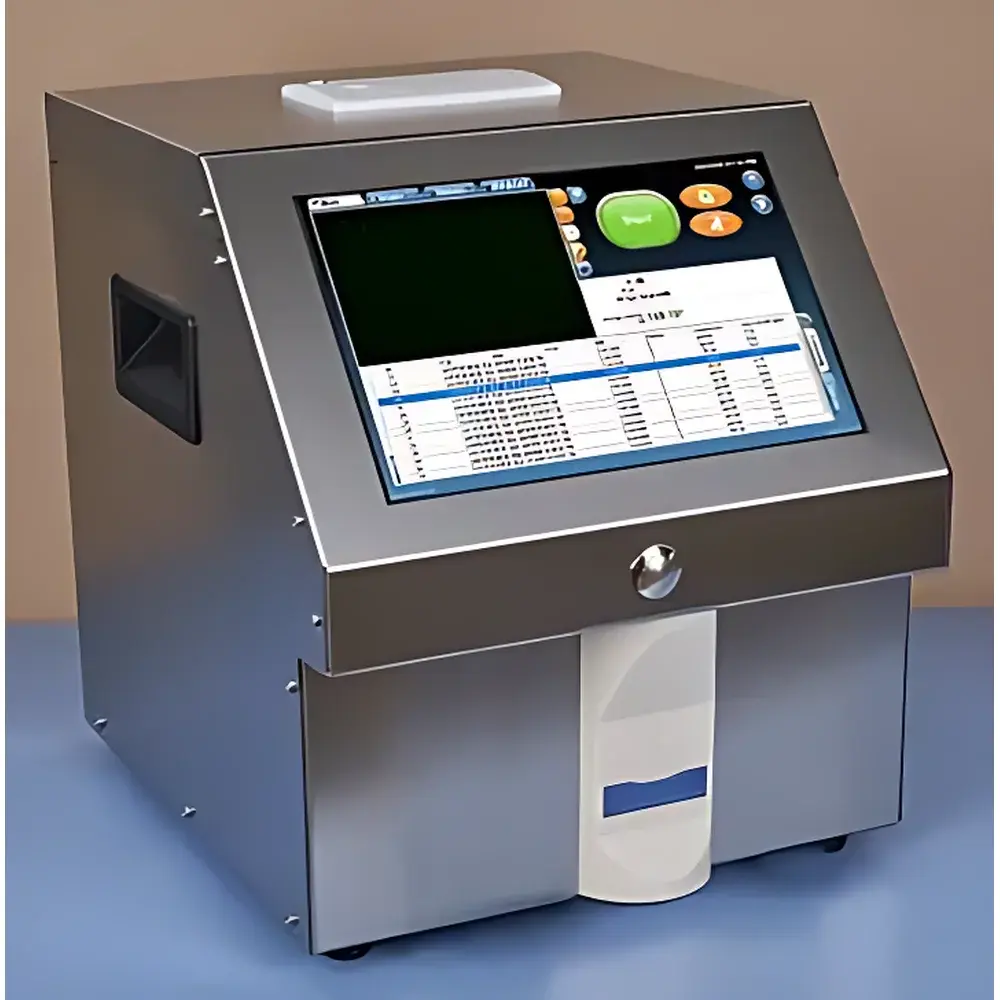
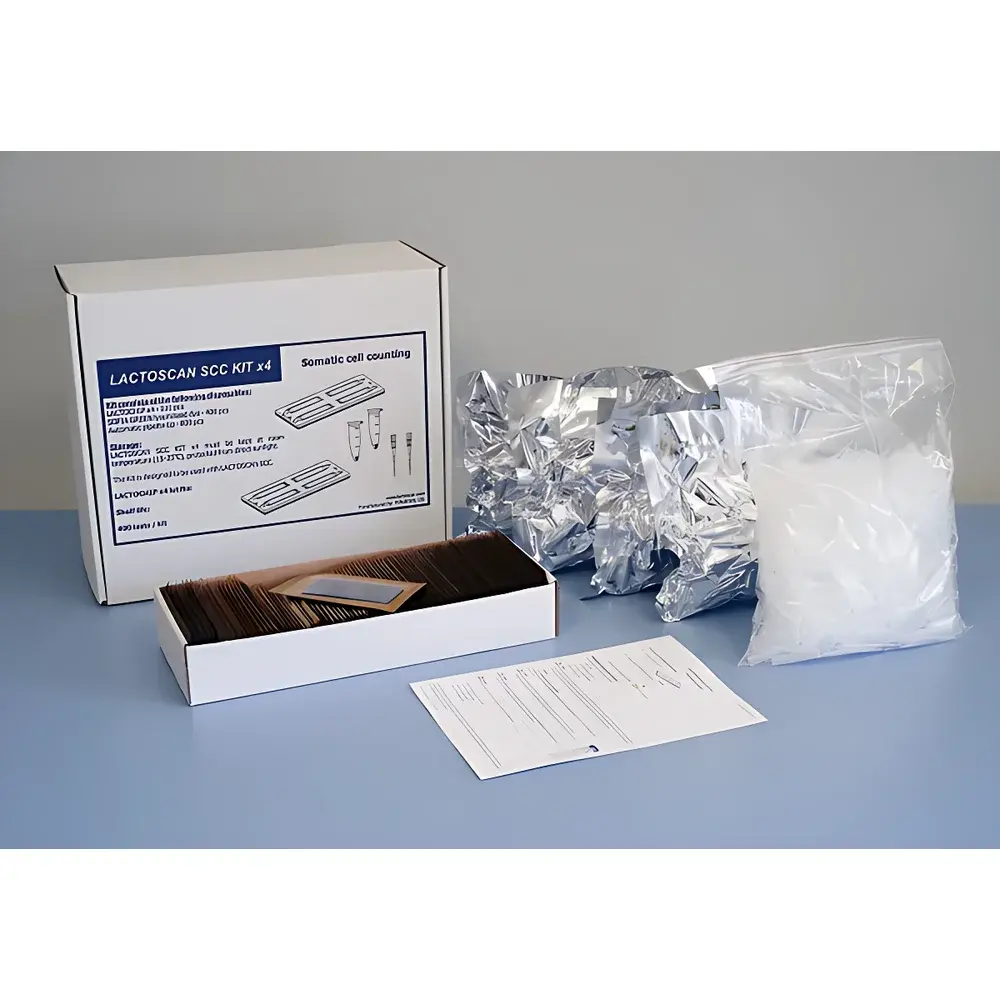
Lactoscan LACTOSCAN SCC Somatic Cell Counter
| Brand | Lactoscan |
|---|---|
| Country of Origin | Bulgaria |
| Manufacturer Type | Authorized Distributor |
| Origin Category | Imported |
| Model | LACTOSCAN SCC |
| Detection Target | Somatic Cells in Raw Milk |
| Automation Level | Fully Automatic |
| Analysis Time | 20–60 seconds per sample |
| Detection Range | 0–1×10⁷ cells/mL |
| Repeatability | ≤5% CV at 100,000 cells/mL |
| Precision | ±5% at 1×10⁵ cells/mL, ±3% at 4×10⁵ cells/mL, ±2% at 6×10⁵ cells/mL |
| Sample Volume | 12–20 µL (dependent on LACTO chip type) |
| Dimensions | 39 × 30 × 26.5 cm |
| Weight | 7.3 kg |
| Power Supply | 100–240 VAC, 1.6 A, 50/60 Hz |
| Operating Temperature | 15–35 °C |
| Relative Humidity | 0–95% non-condensing |
| Optical System | Four 5 W blue LEDs (475 nm), dual-band excitation/emission filters, high-sensitivity CCD camera |
| USB Ports | 4 |
| Consumables | LACTOSCAN SCC Kit (includes 100 × 4-well chips = 400 tests |
Overview
The Lactoscan LACTOSCAN SCC Somatic Cell Counter is a CE-marked, fully automated fluorescence-based analyzer engineered for rapid, standardized enumeration of somatic cells in raw bovine milk. It operates on the principle of fluorescent staining and digital image cytometry: milk samples are mixed with a proprietary DNA-binding fluorophore, loaded onto a disposable 4-well LACTO chip, and imaged under controlled blue-light excitation (475 nm). A high-resolution CCD camera captures 16 sequential micrographs per well, enabling robust cell segmentation and counting via embedded image-processing algorithms. Designed to meet the analytical rigor required by dairy quality assurance laboratories, regulatory bodies, and farm-level milk collection centers, the instrument delivers ISO 13366-1:2006–compliant results without manual dilution, centrifugation, or post-analysis cleaning—significantly reducing operator dependency and cross-contamination risk.
Key Features
- Fully automated workflow: From sample loading to report generation in ≤60 seconds, including on-board fluorescence staining, imaging, and quantitative analysis.
- No post-run cleaning: Single-use LACTO chips eliminate carryover and eliminate routine maintenance associated with flow-cell or capillary-based systems.
- High-throughput chip design: Each 4-well chip supports parallel analysis of four independent samples; 100 chips per kit enable up to 400 determinations.
- Optimized optical architecture: Four precisely aligned 5 W blue LEDs (475 nm) ensure uniform illumination; paired excitation/emission filters maximize signal-to-noise ratio for low-abundance cell detection.
- Robust environmental tolerance: Certified operation across 15–35 °C ambient temperature and 0–95% non-condensing humidity—suitable for mobile labs, chilling rooms, and rural collection points.
- Traceable calibration: Factory-calibrated against NIST-traceable reference suspensions; optional periodic verification using certified control materials (not requiring full recalibration).
Sample Compatibility & Compliance
The LACTOSCAN SCC is validated for use with chilled, preservative-free raw cow’s milk (including samples containing natural inhibitors such as lactoferrin or lysozyme). It is not intended for pasteurized, homogenized, or ultrafiltered milk matrices without prior method validation. The system conforms to ISO 13366-1:2006 (Milk — Determination of somatic cell count — Fluorometric method) and supports compliance with EU Regulation (EC) No 853/2004 and national milk quality standards (e.g., US Grade A, Canadian DFO specifications). All measurement data—including timestamps, chip lot numbers, operator ID, and raw image thumbnails—are stored locally with audit-trail capability, facilitating GLP-aligned record retention and internal QA review.
Software & Data Management
The embedded firmware (v3.2+) provides intuitive touchscreen navigation and real-time result visualization. Data export is supported via USB 2.0 (four ports) in CSV and PDF formats, compatible with LIMS integration through configurable field mapping. The software maintains full traceability: each test log records chip serial number, reagent batch ID, ambient sensor readings (temperature/humidity), and full image metadata. Optional PC-based LactoView Suite enables advanced trend analysis, multi-instrument fleet monitoring, and automated report generation compliant with FDA 21 CFR Part 11 requirements (electronic signatures, audit trail, role-based access control).
Applications
- On-farm mastitis screening: Early detection of subclinical infection via elevated SCC (>200,000 cells/mL) without laboratory delay.
- Dairy plant intake testing: High-volume, shift-based verification of supplier milk quality prior to processing.
- Research in udder health: Longitudinal SCC profiling across lactation cycles, breed comparisons, or therapeutic intervention studies.
- Regulatory compliance monitoring: Routine verification against national SCC thresholds (e.g., EU limit: 400,000 cells/mL; US limit: 750,000 cells/mL).
- Contractual quality arbitration: Objective, instrument-based SCC reporting for milk pricing and penalty clauses.
FAQ
Does the LACTOSCAN SCC require daily calibration?
No. The system is factory calibrated and maintains stability over extended periods. Verification using certified control materials is recommended every 30 days or after 100 tests—full recalibration is not required unless hardware service is performed.
Can the instrument analyze goat or sheep milk?
Method validation for non-bovine species is not included in the standard CE declaration. Users must perform matrix-specific validation per ISO/IEC 17025 guidelines before deploying for alternative ruminant milks.
What happens if a chip is misloaded or air bubbles appear?
The firmware includes real-time image quality assessment. If insufficient cell contrast or bubble interference is detected in ≥2 of 16 frames per well, the system flags the result as “INDETERMINATE” and prompts retesting.
Is remote software update supported?
Yes—firmware updates are delivered via encrypted USB stick with version-signed checksums. Over-the-air (OTA) updates are not implemented to preserve network isolation in regulated environments.
How is data integrity ensured during power interruption?
The device features non-volatile flash memory with atomic write operations. Any test in progress at power loss resumes from the last stable checkpoint upon restart, with no data corruption or partial-result exposure.





