
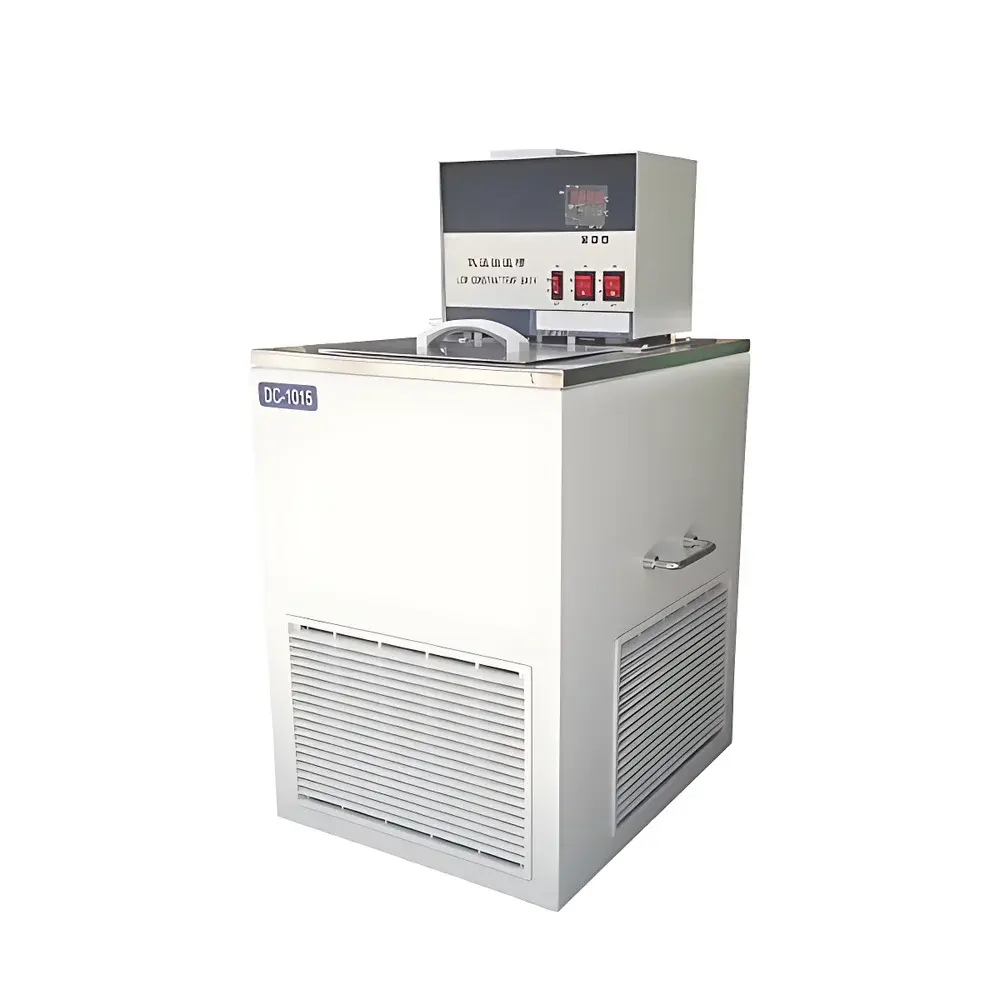
Tianfeng TF-DC Series High-Precision Low-Temperature Circulating Bath
| Brand | Tianfeng |
|---|---|
| Model | TF-DC Series |
| Type | Circulating Bath |
| Capacity | 6 L |
| Temperature Range | −5 °C to 100 °C |
| Temperature Stability | ±0.05 °C (at 25 °C, water or ethanol) |
| Control Method | Microprocessor-based PID with Self-Tuning |
| Sensor | Pt100 Platinum Resistance Thermometer |
| Circulation | Internal & External (Optional) |
| Pump Flow Rate | 8 L/min (6–10 L models), 10–12 L/min (15–30 L models) |
| Refrigeration | Hermetically Sealed Compressor (Dual-Stage Cascade for ≤−40 °C models) |
| Display Resolution | 0.1 °C (0.01 °C optional for high-stability variants) |
| Construction | 304 Stainless Steel Interior & Deck |
| Power Supply | 220 VAC ±10%, 50 Hz |
Overview
The Tianfeng TF-DC Series High-Precision Low-Temperature Circulating Bath is a laboratory-grade temperature control system engineered for thermal stability, repeatability, and operational flexibility in demanding scientific and industrial applications. Utilizing a closed-loop refrigeration architecture with hermetically sealed compressors and optimized heat exchange design, the bath maintains precise temperature setpoints across a broad operational range—from −5 °C to 100 °C—while delivering consistent thermal uniformity within the working chamber. Its core operating principle relies on active liquid circulation combined with microprocessor-controlled PID regulation and real-time feedback from calibrated Pt100 platinum resistance sensors. This architecture ensures rapid thermal response, minimal overshoot, and long-term drift-free performance—critical for applications requiring traceable, GLP-compliant temperature conditioning. The unit supports both internal immersion use (e.g., sample beakers, viscometers, refractometers) and external temperature field establishment via recirculating fluid loops, enabling integration with reactors, spectrometers, and other externally mounted instrumentation.
Key Features
- Microprocessor-based temperature controller with self-tuning PID algorithm for adaptive thermal regulation and optimal disturbance rejection.
- Pt100 platinum resistance sensor (IEC 60751 Class A) with ±0.1 °C accuracy over full range, independently calibrated and traceable to NIST standards.
- Stainless steel 304 tank interior and deck—corrosion-resistant, non-reactive, and compliant with ISO 15190:2020 requirements for laboratory equipment materials.
- High-efficiency circulation pump with flow rates of 8 L/min (6–10 L models), 10 L/min (15 L), and 12 L/min (20–30 L), supporting both internal homogenization and external loop delivery.
- Dual-stage cascade refrigeration system (standard on models rated ≤−40 °C) for stable sub-zero operation without cryogenic fluids or consumables.
- Integrated safety protocols including over-temperature alarm, dry-run protection, low-level fluid detection, and sensor failure diagnostics with visual alert display.
- Ergonomic design with foldable side handles; heavy-duty locking casters (standard on ≥20 L and ultra-low-temperature models) for safe relocation.
- High-density polyurethane foam insulation (≥50 mm wall thickness) minimizing thermal leakage and improving energy efficiency per ISO 17025 Annex A.3 guidelines.
Sample Compatibility & Compliance
The TF-DC series accommodates a wide range of sample formats—including glassware (beakers, flasks, cuvettes), analytical probes (viscometers, refractometers, polarimeters), and process interfaces (jacketed reactors, condensers, CCD coolers). Its open-bath geometry and standardized mounting dimensions allow seamless integration with third-party instruments such as rotary evaporators (IKA RV 10, Buchi R-300), atomic absorption spectrometers (PerkinElmer AAnalyst), and rheometers (Anton Paar MCR series). All units comply with IEC 61010-1:2010 for electrical safety in laboratory environments and meet EMC requirements per EN 61326-1:2013. Optional RS232/RS485 Modbus RTU interface enables audit-trail-capable data logging aligned with FDA 21 CFR Part 11 and EU Annex 11 expectations for regulated laboratories.
Software & Data Management
While the base model operates via front-panel digital interface, optional communication modules support bidirectional integration with LabVIEW, MATLAB, or LIMS platforms. The RS485 interface (Modbus RTU) permits remote setpoint adjustment, real-time temperature telemetry, and event-triggered logging—including alarm timestamps, power cycle history, and thermal deviation alerts. An optional 1–30 segment programmable temperature profile function allows automated ramp-hold-cool sequences, essential for accelerated aging tests (ASTM D3045), viscosity-temperature profiling (ASTM D445), or enzyme activity assays (USP ). All logged data are time-stamped and exportable in CSV format for post-processing and regulatory submission.
Applications
The TF-DC series serves as a primary thermal environment source across multiple disciplines:
In biotechnology—maintaining constant temperature for cell culture incubation validation, PCR instrument calibration, and calorimetric assay standardization.
In analytical chemistry—stabilizing detectors in HPLC, GC, and ICP-MS systems; controlling bath temperature for Karl Fischer titrators and density meters.
In materials science—conditioning samples during XRD alignment, TEM grid preparation, and thin-film deposition processes requiring thermal soak stability.
In pharmaceutical QA/QC—supporting dissolution testing (USP ), tablet coating uniformity studies, and stability chamber qualification per ICH Q1A(R2).
In physics and engineering—serving as cold/hot source for laser cavity cooling, superconducting magnet quench testing, and thermal expansion coefficient measurement (ASTM E228).
FAQ
What is the difference between internal and external temperature control modes?
Internal mode regulates the bath’s working fluid temperature directly. External mode uses an optional extended Pt100 probe to monitor and control temperature at a remote point (e.g., reactor jacket inlet), with the bath dynamically adjusting output to maintain setpoint at that location.
Can this bath be used with organic solvents like ethanol or acetone?
Yes—provided compatibility is verified with the pump seals and tank gasket materials (standard EPDM/NBR); for aggressive solvents (e.g., chloroform, THF), optional fluorocarbon-seal kits are available.
Is the temperature stability specification valid across the entire range?
The ±0.05 °C stability is validated at 25 °C using water or ethanol. At extremes (e.g., −40 °C or 100 °C), stability may degrade slightly (±0.1 °C typical); high-stability variants (±0.03 °C) are offered for critical metrology applications.
Does the unit support GMP/GLP documentation requirements?
With optional communication module and validated software, it supports electronic records, user access control, and audit trail generation compliant with 21 CFR Part 11 and EU GMP Annex 11.
What maintenance is required to sustain long-term accuracy?
Biannual cleaning of condenser coils and compressor air intakes is recommended. Calibration verification using a traceable reference thermometer (e.g., Fluke 1523) should be performed annually or per internal SOP.



